As businesses become increasingly digital, cybersecurity has become one of the most important priorities for organizations worldwide. Every day, companies process vast amounts of sensitive information, including customer records, financial transactions, employee data, and confidential business documents. This growing reliance on technology has also increased exposure to cyber threats, making cybersecurity an essential part of modern business strategy.
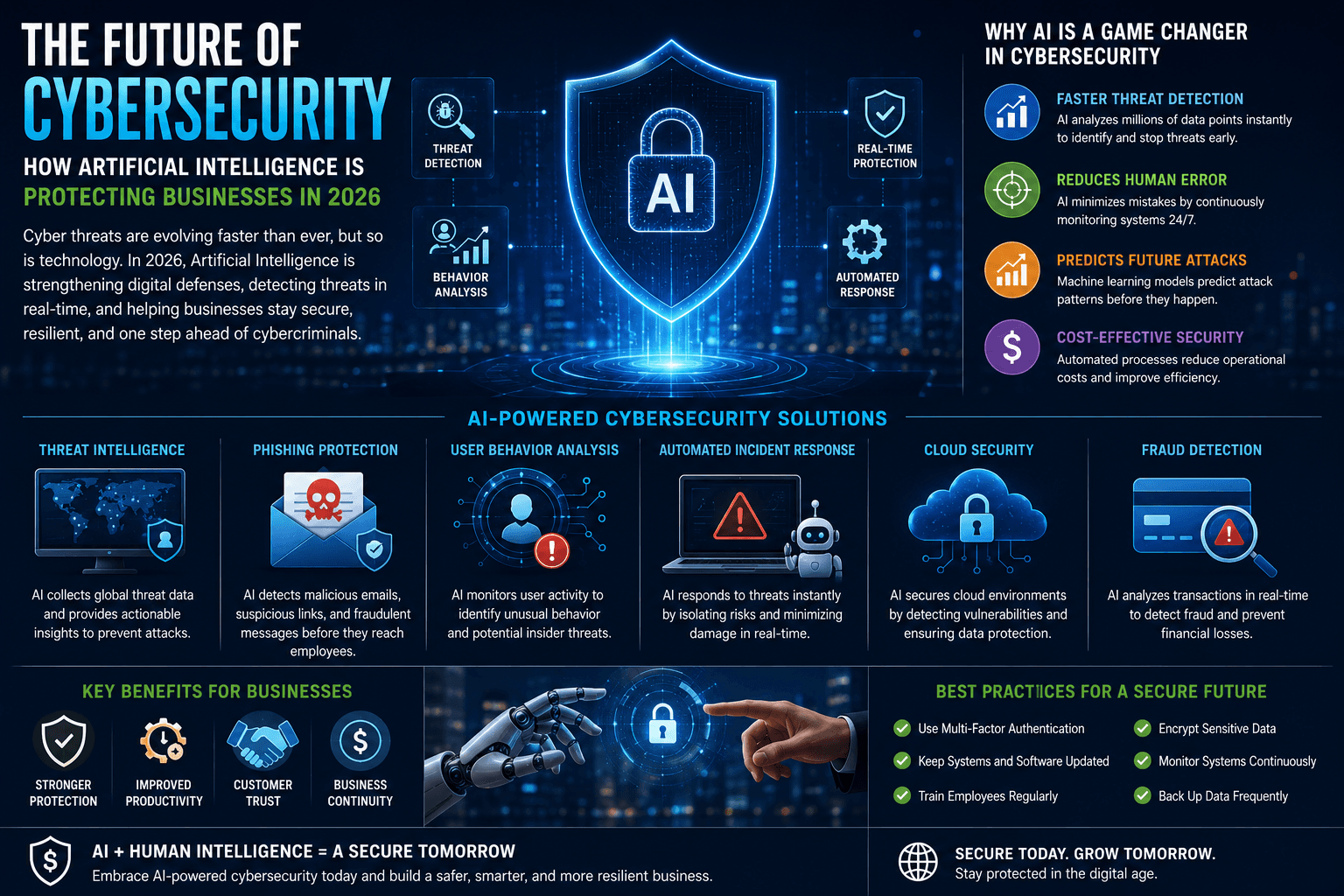
In 2026, artificial intelligence (AI) is playing a transformative role in protecting businesses from cyberattacks. AI-powered security systems can analyze millions of events in real time, identify suspicious behavior, and respond to threats much faster than traditional security methods. From preventing ransomware attacks to detecting fraud, AI is helping organizations strengthen their digital defenses while improving operational efficiency.
This article explores how AI is reshaping cybersecurity and why businesses of every size should invest in modern security solutions.
The Growing Cybersecurity Challenge
Cybercrime continues to evolve as attackers use increasingly sophisticated methods to target businesses. Common threats include:
Phishing emails
Ransomware attacks
Data breaches
Identity theft
Malware
Insider threats
Cloud security vulnerabilities
Even small businesses are becoming attractive targets because many lack advanced security systems. As a result, organizations must adopt proactive security strategies instead of reacting only after an attack occurs.
Artificial Intelligence Is Changing Cybersecurity
Traditional cybersecurity tools rely heavily on predefined rules and known attack signatures. While these systems remain useful, they often struggle to detect new and evolving threats.
Artificial intelligence improves cybersecurity by continuously learning from large volumes of security data. AI can identify unusual activity, detect hidden attack patterns, and respond automatically before significant damage occurs.
Instead of replacing cybersecurity professionals, AI works alongside them to improve detection speed and decision-making.
Real-Time Threat Detection
One of AI's greatest strengths is its ability to analyze data in real time.
Modern AI security platforms continuously monitor:
Network traffic
User activity
Login attempts
Cloud applications
Connected devices
Financial transactions
When suspicious behavior is detected, the system can immediately alert security teams or automatically isolate affected systems.
This rapid response helps reduce the impact of cyberattacks.
Fighting Phishing and Email Fraud
Phishing remains one of the most common methods used by cybercriminals.
AI-powered email security systems analyze:
Sender reputation
Writing patterns
Suspicious links
Attachment behavior
Domain authenticity
By identifying unusual characteristics, AI can block malicious emails before they reach employees.
This significantly reduces the likelihood of successful phishing attacks.
AI Enhances Fraud Prevention
Banks, e-commerce companies, and financial institutions increasingly rely on AI to detect fraudulent activity.
Machine learning algorithms analyze customer behavior and transaction history to identify unusual spending patterns.
If suspicious activity occurs, businesses can request additional verification or temporarily block transactions until they are confirmed.
This helps protect both businesses and customers from financial losses.
Securing Cloud Computing
Cloud services have become essential for modern organizations.
However, cloud environments also introduce new security challenges.
AI improves cloud security by:
Monitoring user access
Detecting unauthorized logins
Identifying configuration errors
Protecting sensitive information
Preventing data leakage
As more organizations migrate to cloud platforms, intelligent cloud security will continue growing in importance.
Supporting Security Teams
Cybersecurity professionals receive thousands of security alerts every day.
Artificial intelligence helps prioritize these alerts by identifying which incidents require immediate attention.
This reduces alert fatigue and allows security teams to focus on the most critical threats.
AI also assists with incident investigation by organizing evidence and suggesting possible responses.
Protecting Customer Trust
Customers expect businesses to safeguard their personal information.
A single data breach can damage a company's reputation and reduce customer confidence.
Strong cybersecurity demonstrates that an organization values privacy, security, and responsible business practices.
Businesses that invest in security often strengthen long-term customer relationships.
Challenges of AI in Cybersecurity
Although AI offers significant advantages, it also presents challenges.
Organizations should consider:
Data privacy
AI bias
System transparency
Regulatory compliance
Human oversight
Continuous training
Cybersecurity strategies should combine intelligent technology with experienced professionals to achieve the best results.
Best Practices for Businesses
Organizations can strengthen cybersecurity by following several important practices:
Enable multi-factor authentication.
Keep software updated.
Train employees to recognize phishing attacks.
Back up important business data.
Monitor networks continuously.
Encrypt sensitive information.
Develop an incident response plan.
Combining these practices with AI-powered security creates stronger protection against evolving cyber threats.
The Future of AI and Cybersecurity
Artificial intelligence will continue becoming more advanced over the coming years.
Future developments may include:
Predictive threat intelligence
Autonomous security systems
AI-powered identity verification
Smarter fraud prevention
Enhanced cloud protection
Automated incident response
Businesses that invest in modern cybersecurity today will be better prepared for tomorrow's digital challenges.
Conclusion
Cybersecurity has become a business necessity rather than simply an IT responsibility. As cyber threats continue evolving, artificial intelligence is helping organizations detect attacks faster, improve operational efficiency, and protect valuable information.
Companies that combine AI-powered security with employee awareness, responsible data management, and strong security policies will be better positioned to safeguard customer trust and support long-term business success.
In 2026, cybersecurity is no longer just about defending against attacks—it is about enabling businesses to grow confidently in an increasingly digital world.