
TCThe Cost of Cross-Border Trade: Navigating Supply Chain Disruptions in Regional Tech Sectors
Artificial intelligence is no longer just a futuristic technology. In 2026, AI is becoming a core part of how businesses operate, make decisions, serve customers, and manage employees. From AI agents and automation to intelligent cybersecurity and predictive analytics, new technologies are changing the modern workplace at an incredible pace.
For businesses, understanding these trends is becoming essential. Companies that adopt the right AI tools can improve productivity, reduce costs, and create better customer experiences. At the same time, employees are learning new ways to work alongside intelligent systems rather than simply competing with them.
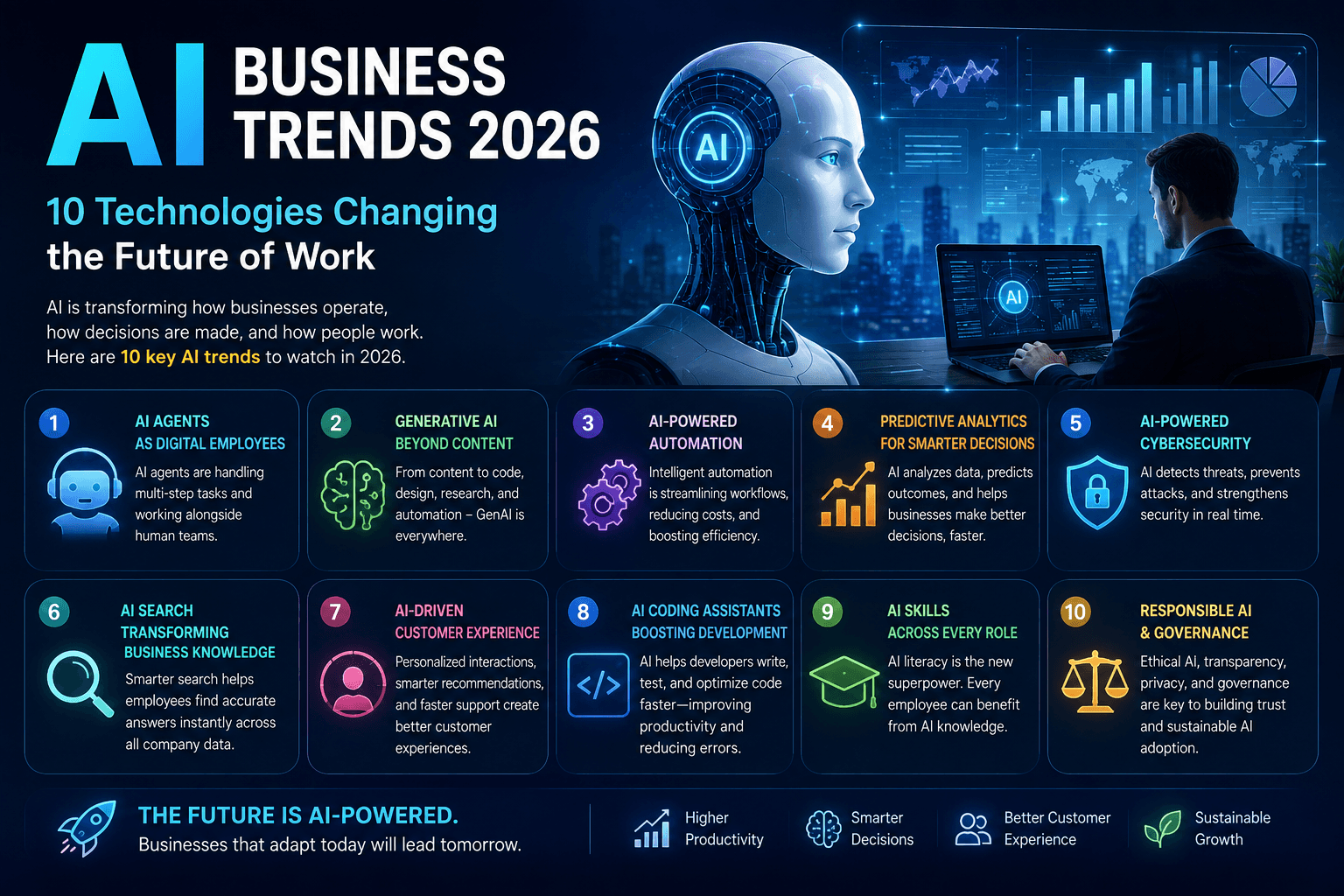
Here are 10 major AI business trends shaping the future of work in 2026.
1. AI Agents Are Becoming Digital Employees
One of the biggest AI business trends in 2026 is the rise of AI agents. Unlike traditional chatbots that mainly respond to questions, AI agents can perform multi-step tasks with limited human intervention.
Businesses are using AI agents to handle activities such as customer support, research, scheduling, data analysis, sales follow-ups, and internal workflows.
For example, an AI agent could receive a customer request, analyze the issue, find relevant information, prepare a response, and update a company's system.
This shift could allow employees to spend more time on creative and strategic work.
2. Generative AI Is Moving Beyond Content Creation
Generative AI became widely known for creating text and images, but its business applications are expanding rapidly.
In 2026, companies are using generative AI for software development, product research, business documentation, presentations, marketing, training materials, and customer communication.
The important change is that businesses are moving from experimenting with AI to integrating it into everyday workflows.
Organizations that create clear AI policies and workflows can gain more value while reducing risks associated with inaccurate or inappropriate AI-generated content.
3. AI-Powered Business Automation
Automation is becoming more intelligent as AI systems learn to understand unstructured information and make decisions based on business rules.
Instead of simply automating repetitive clicks, modern AI automation can process emails, documents, customer requests, invoices, and other business information.
This can help companies reduce repetitive manual work and improve operational efficiency.
Small businesses can benefit particularly because AI automation can provide capabilities that previously required larger teams.
4. Predictive Analytics Is Improving Business Decisions
Businesses have always used data to make decisions, but AI is making predictive analytics more powerful and accessible.
AI-powered analytics can identify patterns in large datasets and help businesses forecast demand, understand customer behavior, manage inventory, and identify potential risks.
For example, retailers can use predictive systems to estimate which products may become popular, while financial businesses can analyze patterns that could indicate potential problems.
The future of business intelligence is increasingly moving from simply showing what happened to helping companies understand what may happen next.
5. AI-Powered Cybersecurity Is Becoming Essential
As businesses become more digital, cybersecurity threats are also evolving. AI is now playing an increasingly important role in detecting suspicious activity and responding to potential threats.
AI-powered security systems can analyze huge amounts of activity and identify unusual patterns much faster than traditional manual processes.
Businesses are also exploring AI for threat detection, fraud prevention, identity protection, and automated security responses.
However, organizations must remember that AI can also be used by attackers. This makes strong cybersecurity strategies, employee training, and responsible AI governance increasingly important.
6. AI Search Is Transforming Business Knowledge
Traditional enterprise search often requires employees to find information using specific keywords. AI-powered search can understand natural-language questions and provide more relevant answers from company information.
Employees may be able to ask questions such as:
“Which customers reported this issue last quarter?”
or
“What are the latest changes to our internal policy?”
AI search can help employees access information faster and reduce the time spent searching through documents, emails, and databases.
7. AI Is Transforming Customer Experience
Customer expectations are changing rapidly. People increasingly expect quick, personalized, and convenient interactions with businesses.
AI can help companies deliver personalized recommendations, automated customer support, intelligent search, and faster responses.
AI systems can analyze customer interactions and identify preferences, allowing businesses to create more relevant experiences.
The strongest customer-service strategies, however, will likely combine AI efficiency with human support for complex or sensitive situations.
8. AI Coding Assistants Are Changing Software Development
Software development is another area being transformed by AI.
AI coding assistants can help developers generate code, explain existing code, identify potential errors, write tests, and accelerate routine development tasks.
This does not necessarily eliminate the need for developers. Instead, it can allow developers to focus more heavily on architecture, problem-solving, security, and product design.
For businesses, faster software development can mean quicker product launches and more efficient technology teams.
9. AI Skills Are Becoming Valuable Across Every Department
AI is not limited to technology departments anymore. Marketing teams, sales professionals, financial analysts, human resources teams, managers, and entrepreneurs are all beginning to use AI tools.
As a result, AI literacy is becoming an increasingly valuable workplace skill.
Employees who understand how to use AI effectively, verify its outputs, protect sensitive information, and integrate it into workflows may have a significant advantage.
Companies are also investing more attention in AI training so employees can use these technologies responsibly.
10. Responsible AI and AI Governance Are Growing
As businesses adopt AI at scale, governance is becoming just as important as innovation.
Companies need policies covering privacy, security, transparency, human oversight, intellectual property, and responsible AI usage.
AI governance helps organizations understand where AI can be used, what information it can access, and when human approval is required.
In 2026, responsible AI is becoming a business issue rather than simply a technical issue.
Companies that build trust around their AI systems may be better positioned for sustainable long-term adoption.
How AI Is Changing the Future of Work
The future workplace is unlikely to be simply “humans versus AI.” Instead, the bigger transformation is likely to involve humans working alongside increasingly capable AI systems.
AI can handle repetitive processes, analyze large quantities of information, and support decision-making. Humans continue to provide creativity, judgment, empathy, leadership, and strategic thinking.
This means many jobs may evolve rather than disappear completely. Employees may increasingly need a combination of traditional professional skills and AI literacy.
Businesses that prepare their workforce for this transition can potentially gain a competitive advantage.
What Businesses Should Do in 2026
Companies do not need to adopt every new AI technology immediately. A better approach is to identify areas where AI can solve genuine business problems.
Businesses should start by:
Identifying repetitive tasks that can be automated.
Training employees to use AI responsibly.
Protecting confidential and customer information.
Establishing clear AI governance policies.
Measuring the results of AI projects.
Keeping humans involved in important decisions.
Regularly reviewing AI tools for accuracy and security.
The goal should not be to use AI simply because it is trending. The goal should be to use AI where it creates measurable value.
Conclusion
AI business trends in 2026 are changing the way companies operate and employees work. AI agents, generative AI, automation, predictive analytics, cybersecurity, AI search, and intelligent customer experiences are becoming increasingly important parts of modern business.
The organizations most likely to benefit from AI will not necessarily be those that adopt the most tools. They will be the businesses that understand their problems, choose appropriate technologies, train their people, and build responsible systems around AI.
The future of work is already being shaped by artificial intelligence—and businesses that prepare today can be better positioned for what comes next.
Frequently Asked Questions
1. What are the biggest AI business trends in 2026?
Major trends include AI agents, generative AI, intelligent automation, predictive analytics, AI cybersecurity, AI search, AI-powered customer experience, and AI governance.
2. How is AI changing the workplace in 2026?
AI is automating repetitive tasks, supporting decision-making, improving productivity, and helping employees complete complex workflows more efficiently.
3. Are AI agents useful for small businesses?
Yes. AI agents can help small businesses automate customer service, research, scheduling, sales tasks, and other repetitive workflows.
4. Will AI replace human workers?
AI may automate some tasks and change certain roles, but many jobs will continue to require human creativity, judgment, communication, leadership, and expertise.
5. What AI skills should employees learn?
Employees can benefit from learning AI tool usage, prompt writing, data interpretation, AI output verification, automation concepts, and responsible AI practices.
6. How can AI help small businesses reduce costs?
AI can automate repetitive work, improve customer support, assist with content creation, analyze business data, and reduce the time required for routine processes.
7. Why is AI cybersecurity important?
AI can help businesses identify unusual activity, detect potential threats, monitor systems, and respond to security risks more quickly.
8. What is AI-powered predictive analytics?
It uses AI and historical data to identify patterns and generate forecasts that can support business planning and decision-making.
9. Why is AI governance important?
AI governance establishes rules for privacy, security, transparency, human oversight, and responsible use of AI within an organization.
10. What is the future of work with AI?
The workplace is likely to become increasingly collaborative, with AI handling more repetitive and analytical tasks while humans focus on creativity, judgment, relationships, and strategic decisions.