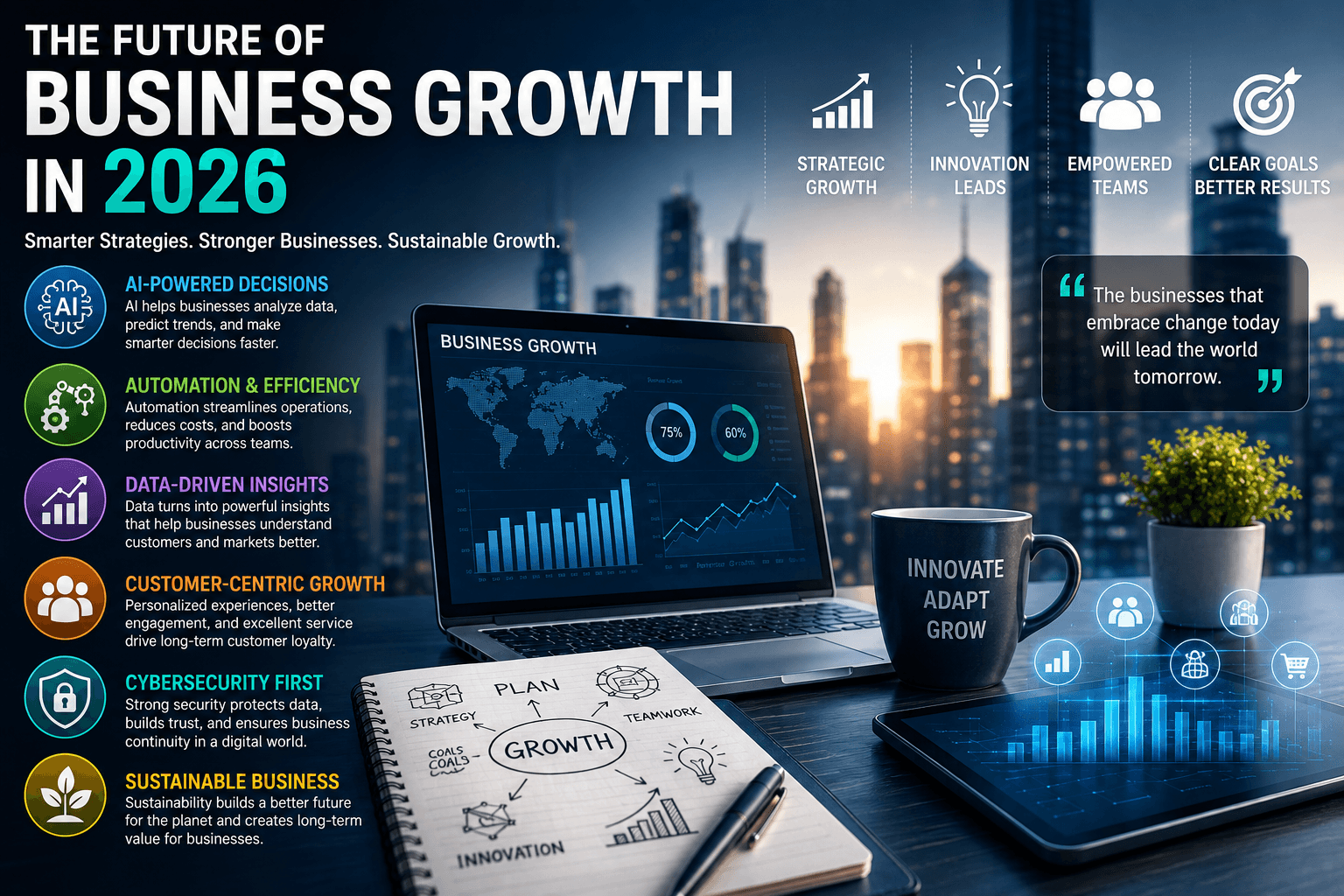

Business growth is entering a new phase in 2026. Companies are no longer competing only on products, prices, or traditional marketing. Increasingly, they are competing on how quickly they can use technology, understand customers, respond to market changes, and make better decisions.
Artificial intelligence, automation, data analytics, digital platforms, and changing customer expectations are reshaping how organizations operate. For businesses of every size, the challenge is no longer whether to embrace digital transformation, but how to turn technology investments into measurable business results.
AI Is Becoming a Core Business Capability
Artificial intelligence has moved beyond experimentation and is becoming part of everyday business operations.
Companies are using AI for customer service, marketing, forecasting, cybersecurity, product development, sales, and internal operations.
AI can analyze large volumes of information quickly and help employees identify patterns, generate content, summarize documents, and support decision-making.
However, successful businesses are focusing less on adopting AI simply because it is available and more on identifying specific problems where AI can deliver measurable value.
Automation Is Improving Business Efficiency
Many organizations still spend significant amounts of time on repetitive administrative processes.
Intelligent automation can help businesses streamline activities such as:
Data entry
Invoice processing
Customer support
Reporting
Document management
Scheduling
Inventory management
By automating repetitive tasks, employees can spend more time on creative, analytical, and strategic work.
The most effective automation strategies combine technology with human oversight rather than attempting to remove people from every process.
Data Is Becoming a Competitive Advantage
Modern businesses generate enormous amounts of data from websites, applications, customer interactions, transactions, and operational systems.
The challenge is turning this information into useful insights.
Businesses with strong data strategies can better understand customer behavior, identify market opportunities, predict demand, and monitor performance.
Data quality is particularly important. Poor or fragmented information can lead to unreliable analysis and ineffective decisions.
Customer Experience Is Becoming More Personalized
Customers increasingly expect companies to understand their needs and provide relevant experiences.
AI and data analytics allow businesses to personalize recommendations, marketing messages, product offerings, and customer support.
For example, an e-commerce company can analyze browsing and purchasing behavior to recommend products that are more relevant to individual customers.
Personalization can improve engagement, but companies must also respect privacy and maintain transparency about how customer information is used.
Businesses Are Moving Toward Real-Time Decision-Making
Traditional business planning often depends on reports generated weekly or monthly.
Modern digital systems can provide information much faster.
Real-time dashboards, automated alerts, predictive analytics, and AI-powered insights can help leaders identify changing conditions quickly.
This is particularly valuable in industries where customer demand, pricing, inventory, or market conditions can change rapidly.
Cybersecurity Is Now a Business Priority
As companies become more digital, cybersecurity is no longer simply an IT concern.
A cyberattack can interrupt operations, damage customer trust, create financial losses, and cause regulatory problems.
Businesses therefore need strong security practices covering systems, employees, customer data, cloud platforms, and AI applications.
Employee awareness is also critical because phishing and social engineering remain major security risks.
Digital Transformation Is Becoming More Strategic
Digital transformation used to be associated primarily with moving paper-based processes online.
Today, it is much broader.
Modern transformation can involve AI, cloud computing, automation, advanced analytics, digital customer experiences, cybersecurity, and integrated business platforms.
Successful transformation starts with business objectives.
Instead of asking, “What technology should we buy?” companies should ask:
“What business problem are we trying to solve?”
This approach can help organizations avoid unnecessary technology investments.
The Rise of Flexible Business Models
Digital technologies are also enabling new business models.
Companies can offer subscription services, digital products, marketplaces, on-demand services, and platform-based experiences.
Businesses can experiment with new offerings more quickly because digital infrastructure makes it easier to launch, measure, and modify products.
This flexibility can become an important advantage in rapidly changing markets.
Employees Need New Skills
Technology is changing the skills businesses need.
Employees increasingly need a combination of traditional expertise and digital capabilities.
Important skills include:
AI literacy
Data analysis
Digital communication
Cybersecurity awareness
Problem-solving
Strategic thinking
Automation skills
Businesses that invest in employee training can help their workforce adapt to technological change rather than treating automation as simply a replacement strategy.
Sustainability Is Influencing Business Strategy
Sustainability is increasingly connected to business operations, supply chains, technology infrastructure, and customer expectations.
Companies are exploring ways to reduce energy consumption, improve resource efficiency, minimize waste, and create more sustainable products.
Technology can support these efforts through smart monitoring, predictive analytics, automation, and better supply-chain visibility.
The Importance of Business Agility
One of the biggest advantages a company can have in 2026 is the ability to adapt quickly.
Markets can change because of economic conditions, technological developments, regulations, customer behavior, or new competitors.
Businesses that can quickly identify changes and adjust their strategies may be better positioned than organizations that rely on slow decision-making processes.
AI and predictive analytics can support agility by helping companies anticipate potential risks and opportunities.
Conclusion
Business growth in 2026 is increasingly driven by the combination of technology, data, people, and strategy.
AI can improve decision-making, automation can increase efficiency, data can reveal new opportunities, and digital platforms can create innovative customer experiences.
But technology alone does not guarantee success.
Businesses need clear objectives, strong leadership, reliable data, cybersecurity, skilled employees, and a willingness to continuously adapt.
The companies most likely to succeed in the coming years will be those that treat digital transformation not as a one-time technology project, but as an ongoing business strategy focused on innovation, agility, efficiency, and sustainable growth.
FAQs: The Future of Business Growth in 2026
1. What are the biggest business trends in 2026?
Major trends include AI adoption, intelligent automation, data-driven decision-making, personalized customer experiences, cybersecurity, digital transformation, and flexible business models.
2. How can AI help businesses grow?
AI can help businesses reduce costs, automate repetitive tasks, understand customers, improve forecasting, optimize operations, and identify new revenue opportunities.
3. Why is automation important for modern businesses?
Automation reduces manual work and allows employees to focus on higher-value activities such as strategy, innovation, customer relationships, and problem-solving.
4. How does data improve business decisions?
Data provides insights into customer behavior, sales performance, market trends, operational efficiency, and potential risks, helping leaders make more informed decisions.
5. What is digital transformation?
Digital transformation is the process of using modern technologies to improve business operations, customer experiences, decision-making, and business models.
6. How can businesses improve customer experience?
Companies can use AI, personalization, faster digital services, automated support, and customer analytics to create more convenient and relevant experiences.
7. What skills are most valuable for businesses in 2026?
AI literacy, data analysis, strategic thinking, cybersecurity awareness, creativity, problem-solving, and digital skills are becoming increasingly valuable.
8. Why is cybersecurity important for business growth?
Cybersecurity protects business systems, financial information, customer data, and company reputation. Strong security also helps maintain customer trust.
9. How can small businesses benefit from AI?
Small businesses can use affordable AI tools for marketing, customer service, content creation, data analysis, scheduling, and administrative tasks without requiring large technology teams.
10. What will determine business success in 2026?
Businesses that combine technology with strong strategy, skilled employees, reliable data, customer focus, cybersecurity, and the ability to adapt quickly are likely to have a stronger foundation for sustainable growth.