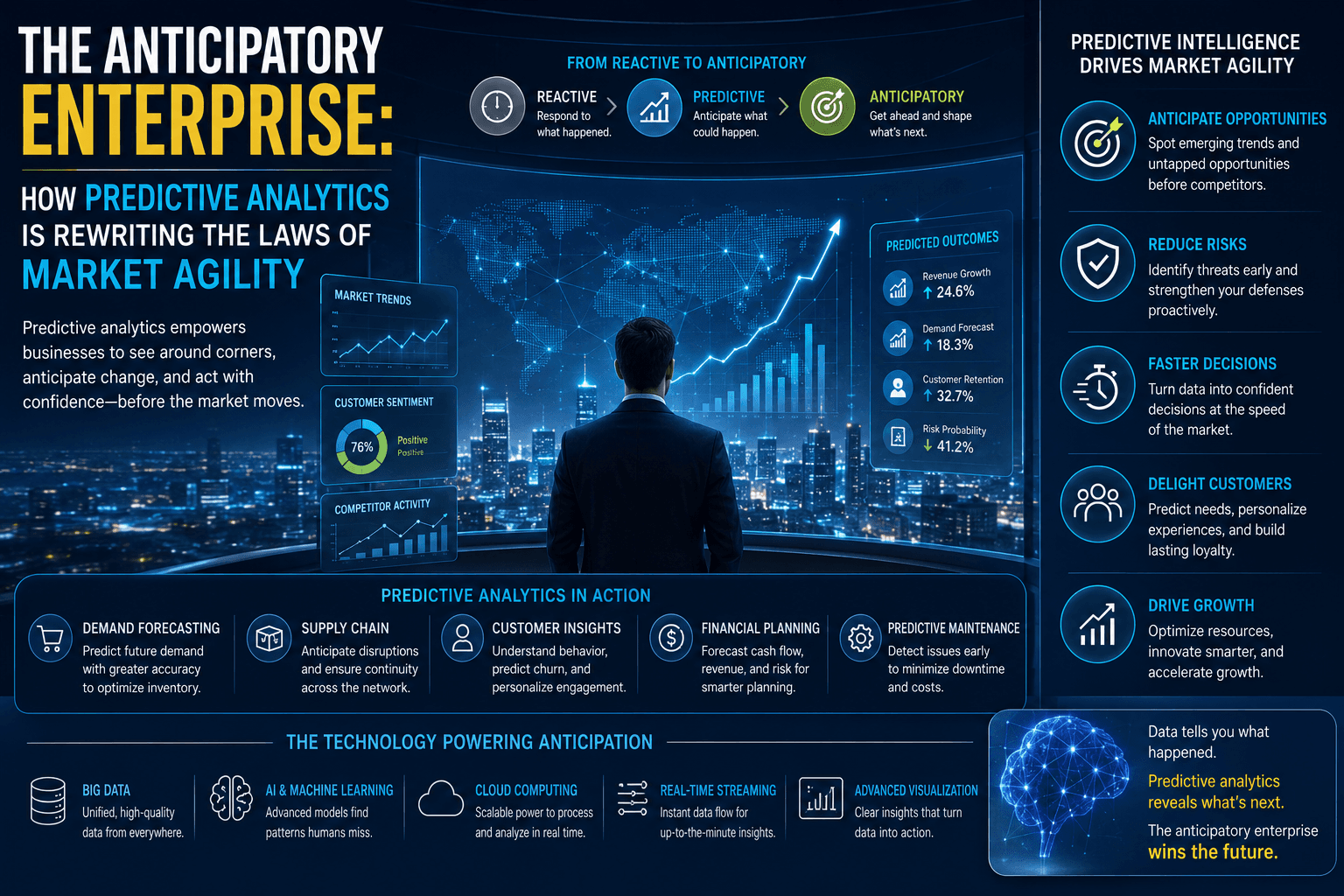

For generations, business strategy was an exercise in looking backward. Corporate leaders relied heavily on descriptive analytics—financial ledgers, quarterly sales reports, and historical market audits—to evaluate performance and chart their next moves. Operating a company this way was the functional equivalent of driving a vehicle by looking exclusively through the rearview mirror: it told you exactly where you had been and what obstacles you had already hit, but offered zero visibility into the road ahead.
The hyper-acceleration of the digital economy has made this retrospective model dangerous. Consumer preferences shift in days, supply chains fracture without warning, and economic indicators fluctuate wildly. In this volatile corporate landscape, waiting for end-of-month data to react to market changes means a company is already too late.
The global corporate ecosystem is undergoing a massive migration from reactive management to anticipatory orchestration, driven by the explosive growth of predictive analytics. Global IT spending on analytics software reflects this accelerated deployment, with the global predictive analytics market expanding rapidly. Companies are no longer asking "What happened?" or "Why did it happen?" Instead, they are leveraging advanced statistical algorithms, real-time machine learning, and vast internal data ecosystems to answer a far more valuable question: "What will happen next—and how can we capitalize on it before our competitors do?"
Moving Beyond Human Intuition: The Core Engine of Predictive Modeling
At its core, predictive analytics uncovers complex, non-linear patterns within historical and real-time data that are entirely invisible to human analysts squinting at standard spreadsheets. By processing thousands of independent variables simultaneously, predictive engines transform raw data pipelines into early-warning networks.
[Raw Enterprise Data] ──> [Mathematical Predictive Engine] ──> [Prescriptive Corporate Actions]
  • Customer Logs            • Time-Series Forecasting           • Optimized Stock Allocations
  • IoT Sensor Signals       • Gradient Boosted Classifiers      • Real-Time Risk Interventions
  • Telemetry Streams        • Regression Matrices               • Hyper-Targeted Ad Spend
Rather than executing a single, rigid forecast, modern predictive architectures utilize a specialized cocktail of mathematical modeling techniques tailored to unique operational problems:
Classification Models: These algorithms categorize data into distinct, predefined buckets. Financial institutions leverage them to evaluate transaction streams instantly, sorting routine consumer expenditures from fraudulent activity before a charge is authorized.
Time-Series Forecasting: This method evaluates continuous data points collected at regular intervals to map future trends. Supply chain networks rely heavily on time-series analysis to project future material demands based on seasonal shifts, macroeconomic trends, and cyclical weather variations.
Regression Models: These systems establish mathematical relationships between disparate variables. An e-commerce platform uses regression to calculate precisely how a slight change in product pricing, local weather, or social media sentiment will impact gross merchandise volume across specific regions.
Industry Deep Dives: Real-World Economic Impact
The companies outperforming their peers are targeting high-value operational pools where accurate predictions translate directly into millions of dollars in bottom-line savings or top-line revenue growth.
1. Retail: SKU-Level Demand Forecasting and Dynamic Pricing
Historically, retailers forecasted inventory demand at a broad category level, ordering batches of winter coats or summer apparel based on the prior year's performance. In 2026, predictive models operate at a hyper-granular Stock Keeping Unit (SKU) level.
By continuously ingesting localized real-time data—including municipal weather changes, localized economic data, and micro-influencer trends—predictive systems tell retailers exactly which items to stock down to the specific retail storefront or regional fulfillment hub. This continuous triage allows businesses to operate with incredibly tight inventory positions, drastically cutting warehouse holding costs while simultaneously driving down out-of-stock occurrences.
Concurrently, these platforms fuel dynamic pricing algorithms. If an engine predicts a localized surge in demand for an item combined with a tightening regional supply, it automatically adjusts pricing in real time, maximizing gross profit margins without alienating the consumer.
2. Manufacturing: Moving to True Zero-Downtime Predictive Maintenance
For industrial operations, unexpected machinery failure is one of the most expensive risks on the balance sheet, swallowing thousands of dollars per minute in lost output and emergency repair fees. Traditional maintenance was either reactive (fixing a machine after it broke) or preventative (replacing parts on a rigid schedule, often throwing away perfectly functional components).
Predictive analytics introduces an optimized third path: predictive maintenance. Industrial assets are now outfitted with thousands of Internet of Things (IoT) sensors tracking physical metrics like thermal output, vibration frequencies, and acoustic signatures.
Predictive algorithms ingest these live streams, mapping minor fluctuations against historical machine failure signatures. The moment an engine detects a micro-vibration indicating an internal bearing will fail within the next 48 hours, it automatically schedules a maintenance window, triggers a parts order in the ERP system, and reroutes production queues to alternative factory floor assets.
[IoT Sensor Telemetry] ──> [Vibration/Thermal Anomaly Detected] ──> [Automatic ERP Parts Order & Maintenance Schedule]
3. Financial Services: Active Risk Management and Credit Underwriting
The banking, financial services, and insurance (BFSI) sectors utilize predictive modeling to navigate economic uncertainty and combat highly sophisticated fraud networks. Traditional credit scoring relied heavily on historical, lagging records like credit bureau histories, which often locked younger or unbanked demographics out of the financial system.
Modern financial underwriting engines analyze thousands of alternative data points—including utility payment consistency, cashflow velocity, and business-to-business transaction logs—to project a borrower's default probability with staggering accuracy. Furthermore, by continuously monitoring broader systemic shifts, banks utilize predictive models to adjust their loan portfolios proactively, pulling back exposure to sectors showing subtle early indicators of real estate or credit contraction long before a full market correction manifests.
Moving From Periodic Analysis to Continuous Inference
One of the most profound structural changes in how predictive analytics is deployed is the transition from periodic reporting to continuous, real-time inference.
Historically, a corporate demand forecast or a customer churn projection was an event that happened once a quarter or once a month. A data team would spend weeks cleaning static datasets, running a model, and delivering a static PDF report to the executive suite. By the time leadership read the insights, the market dynamics had already evolved, making the findings obsolete.
Modern predictive architecture is built as a live cloud-native or edge infrastructure layer. The models do not sleep; they score incoming data streams continuously. If a SaaS platform's customer alters their software usage patterns, drops their login frequency by a specific percentage, or files a sequence of subtle customer service tickets, a predictive customer retention engine flags the account instantly. It calculates the exact probability of churn and delivers a prescriptive retention playbook directly to a customer success representative's dashboard, accompanied by an AI-generated personalized promotion designed to secure a contract renewal.
Dynamic Variable | Legacy Predictive Approach | Modern Continuous Approach |
Data Cadence | Batch-processed monthly or quarterly data pull. | Streaming, real-time data ingestion pipelines. |
Operational Speed | Insights delivered weeks after an event occurs. | Critical risks and opportunities surfaced in minutes. |
Strategic Stance | Reactive adaptation to historical data trends. | Proactive intervention to shape future outcomes. |
System Interface | Static dashboard displays and PDF slide decks. | Prescriptive workflows wired directly into operational APIs. |
Conclusion: The Ultimate Competitive Divide
Predictive analytics is no longer a luxury reserved for tech giants with massive R&D budgets. Cloud-native platforms and pre-built, production-ready models have democratized access, turning predictive foresight into an accessible baseline business requirement.
The primary business divide is no longer between companies that collect data and those that do not. The true divide is between historical enterprises and anticipatory organizations.
The businesses that thrive recognize that data is not a historical artifact to be neatly filed away in a database; it is a live engine of future corporate agility. By shifting their operational focus from tracking the past to forecasting the future, these forward-looking enterprises are successfully turning volatility into their primary competitive advantage—ensuring that when market disruptions inevitably hit, they are already positioned to lead.