
The commercial landscape of 2026 has brought a sudden, icy realism to the technology sector. The initial speculative euphoria surrounding artificial intelligence—characterized by unvetted budgets, isolated proof-of-concepts, and widespread experimentation—has officially given way to strict financial accountability. As we enter the second half of 2026, corporate boards and Chief Financial Officers are demanding concrete proof of return on investment (ROI). The question is no longer "What can this technology do?" but rather "How reliably does it execute under a full production load?"
The defining theme for the remainder of this year is the transition from individual productivity tools to institutional infrastructure. Organizations are realizing that competitive advantage does not stem from deploying standalone software tools, but from orchestrating deeply integrated, secure, and resilient computational ecosystems.
Five macroeconomic technology trends are fundamentally shaping business strategies, operational models, and market boundaries for the latter half of 2026.
1. The Operationalization of Agentic Workflows
The first wave of enterprise AI focused almost exclusively on conversational assistance—giving human employees chat-based "co-pilots" to write code, draft copy, or summarize documents. While valuable on an individual basis, this model preserved a significant bottleneck: a human still had to sit in front of a screen, issue prompts, evaluate outputs, and manually paste the results into other enterprise software systems.
In the final six months of 2026, the paradigm is shifting aggressively toward autonomous agentic workflows. These are self-directed software applications driven by large language models that do not merely suggest answers, but actively execute multi-step operations on behalf of the business. Gartner estimates that by the close of this year, nearly 40% of standard enterprise software workflows will feature task-specific AI agents.
[2024-2025: Co-Pilot Paradigm]
Human ---> Prompts AI Tool ---> Copies Output ---> Pastes into Legacy CRM/ERP

[H2 2026: Agentic Paradigm]
System Trigger ---> Agent 1 (Analyze) ---> Agent 2 (Verify) ---> Human Sign-off
Instead of a human manually driving the software, autonomous agents navigate software applications independently. For example, in an enterprise procurement environment, a modern agentic workflow automatically flags low supply, analyzes past vendor invoices, cross-references active contracts, drafts a new purchase order, and submits it directly into an ERP ledger like SAP or Workday, halting only for a final human electronic signature. Businesses are learning that the secret to scaling AI is not automating broken, isolated tasks, but redesigning end-to-end operational processes.
2. Cloud 3.0: The Rise of Inference Economics and Strategic Hybrid Infrastructure
For over a decade, the consensus corporate computing strategy was "cloud-first". Companies enthusiastically migrated their local servers to centralized public clouds to cut capital expenses. However, running complex AI models at massive scale has pushed classical public cloud architectures to their financial and technical breaking points.
The second half of 2026 marks the arrival of Cloud 3.0, characterized by a migration from public cloud monocultures to highly intentional, hybrid infrastructures driven by inference economics. While the cost of processing individual data units (tokens) has dropped over 200-fold in the past two years, massive enterprise usage has caused monthly public cloud bills to balloon into the millions.
To manage these costs, enterprise architects are segmenting their data processing based on cost, immediacy, and security:
Public Cloud: Reserved exclusively for highly elastic workloads or heavy model training.
On-Premises / Private Infrastructure: Used for running day-to-day model inferences consistently and predictably, avoiding volatile public cloud pricing.
Sovereign Clouds: Leveraged to satisfy tightening data privacy, compliance, and technological self-reliance mandates across different geographical regions.
By tailoring infrastructure to specific use cases, organizations are avoiding the financial traps of over-reliance on centralized public cloud compute.
3. "Ambient Intelligence" Replaces Point-Solution SaaS
The enterprise application market is experiencing a profound contraction. In the initial rush to adopt AI, organizations signed contracts with hundreds of narrow "point solutions"—specialized startups offering standalone tools for scheduling, copywriting, or video script generation.
By the latter half of 2026, these niche applications are facing rapid obsolescence. They are being replaced by Ambient Intelligence, a model where cognitive AI capability is quietly integrated as invisible infrastructure directly inside the massive software platforms enterprises already use.
[Early AI Wave]         Enterprise CRM <---> 12 Different Fragmented AI App Plugins
                                                   ↓
[Ambient AI Era]        Enterprise CRM (with Native, Invisible AI Engine Built-In)
Instead of requiring workers to log into a separate AI application to extract customer insights, platforms like Microsoft 365, Salesforce, and ServiceNow have embedded large language models deep within their native data layers. The software automatically surfaces insights, drafts emails, and populates fields contextually within the workflow itself. This shift hands a massive structural advantage to established, legacy software vendors over feature-light startups, as legacy giants possess both the distribution channels and the accumulated corporate data necessary to make AI genuinely useful.
4. Decentralized AI via Edge and Distributed Computing
As the volume of data generated by factory sensors, retail point-of-sale systems, connected vehicles, and mobile devices explodes, relying solely on centralized cloud centers to process that data has become unviable. Sending petabytes of raw data back and forth across oceans creates unacceptable network lag and prohibitive bandwidth expenses.
Consequently, the second half of 2026 is seeing an aggressive deployment of AI-enabled edge computing. Over 68% of global enterprises have initialized or planned edge computing strategies for this year.
By embedding lightweight, highly compressed AI models directly into localized hardware—such as on-site factory routers, localized hospital servers, or retail checkout terminals—businesses are reducing processing delays by up to 90%. In manufacturing environments, an edge-based AI system can identify a defective component on a high-speed assembly line within milliseconds, halting production immediately to prevent widespread waste. Furthermore, processing data locally cuts network transfer costs by roughly 30%, delivering a highly attractive double-win for corporate operations budgets.
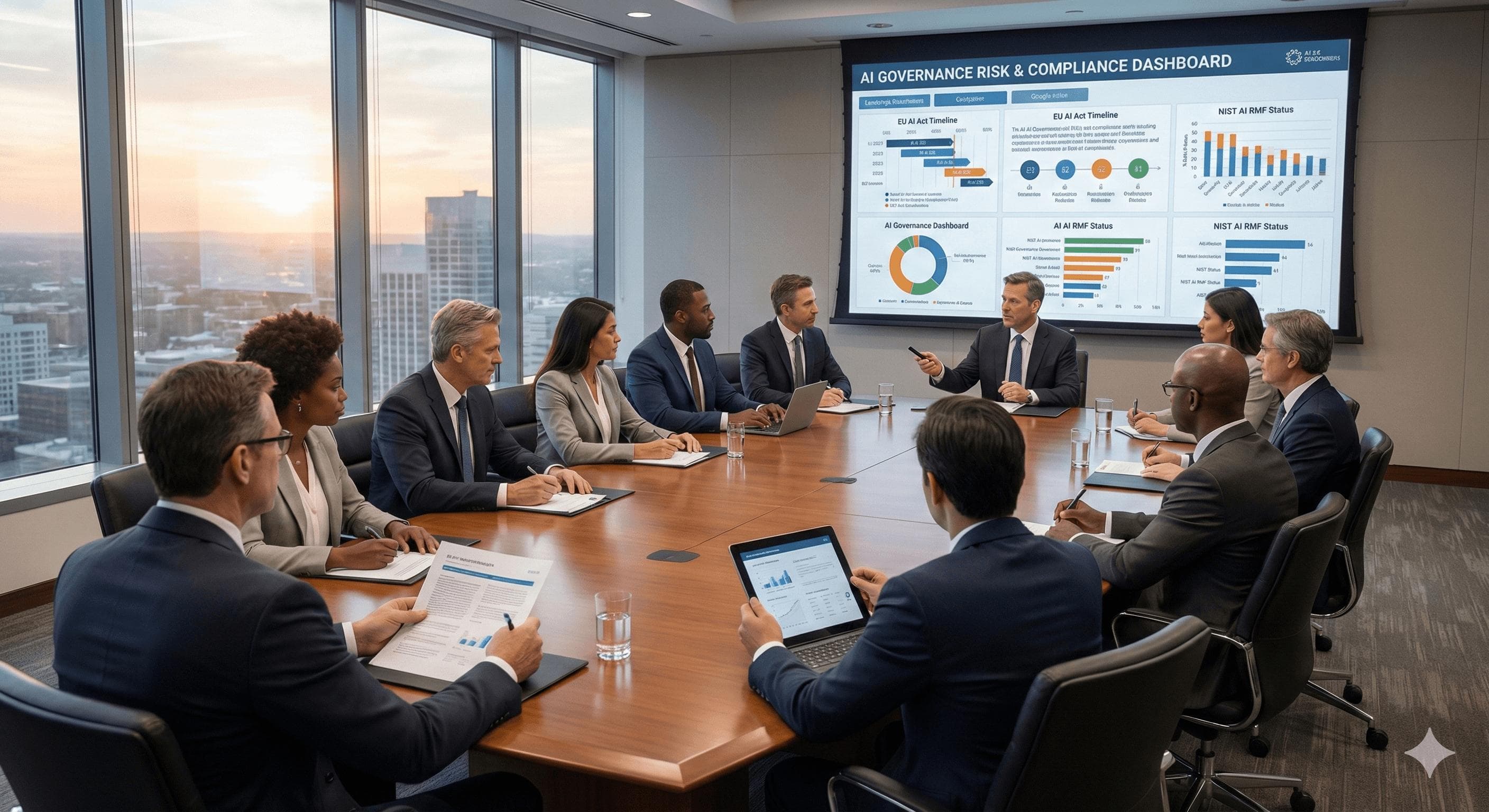
5. Algorithmic Control Planes: Identity, Privacy, and AI Governance
The rapid rise of automated systems and background AI agents has exposed a major flaw in traditional corporate security strategies. Legacy cybersecurity architectures were designed to protect human access points using passwords, multi-factor tokens, and firewall perimeters. However, when hundreds of independent software agents are autonomously traversing internal databases, querying APIs, and modifying files, the potential security vulnerabilities expand exponentially.
In response, enterprise security in late 2026 is reorganizing around algorithmic control planes and strict AI governance. Identity management has expanded from identifying human employees to identifying, auditing, and authorizing machine agents.
[Legacy Cybersecurity]        Verify Human Credentials ---> Grant Access to Application
[Modern AI Governance]         Verify Agent Token ---> Limit API Scope ---> Log Machine Behavior
Organizations are establishing multidisciplinary AI Centers of Excellence to rigorously enforce acceptable use policies, manage data privacy compliance, and continuously audit machine outputs for accuracy. Furthermore, with new international algorithmic regulatory frameworks taking effect, businesses are adopting zero-trust architectures specifically tailored to AI data ingestion. Ensuring that an autonomous agent cannot accidentally read sensitive payroll data, leak proprietary IP into public training loops, or act on corrupted information is a top strategic priority for enterprise technology leaders.
Conclusion: The Horizon of Reconfigured Operations
The second half of 2026 signals a definitive departure from tech-centric hype and a return to architectural discipline. The true digital divide of this year is not between companies that use AI and those that do not; it is between companies that deployed superficial, fragmented tools and those that successfully rebuilt their data infrastructure to support reliable, automated execution.
The enterprises outperforming their peers for the remainder of 2026 recognize that competitive advantage is no longer about manual execution or software volume. By turning their focus to autonomous workflows, hybrid infrastructures, edge-based execution, and rigid governance models, they are turning technology away from a novelty budget item and converting it into a predictable, scalable engine of core business growth.