

Business decisions have traditionally depended on scheduled reports, dashboards, meetings, and periodic analysis. Executives might review performance at the end of the day, managers might receive weekly reports, and analysts might prepare monthly forecasts.
That model is changing.
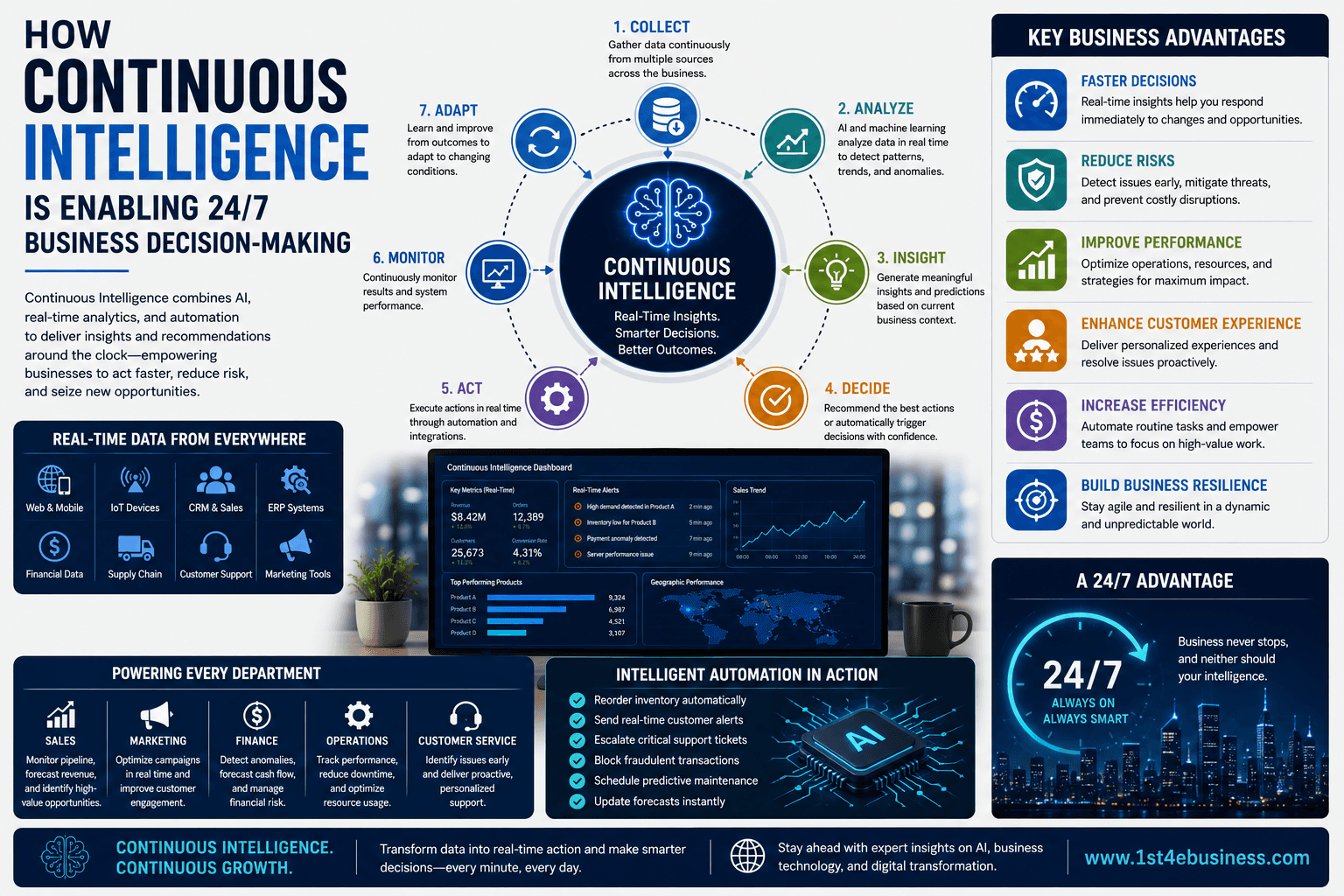
As businesses generate increasing amounts of real-time data, organizations are moving toward continuous intelligence—an approach that continuously collects, analyzes, and interprets data to help businesses make decisions as events happen.
Combined with artificial intelligence, machine learning, cloud computing, automation, and real-time analytics, continuous intelligence is creating a new model of business operations in which organizations can monitor conditions and respond 24/7.
What Is Continuous Intelligence?
Continuous intelligence is the ability to analyze business data continuously and provide insights or recommendations in near real time.
Traditional analytics often follows:
Collect data → Store data → Analyze data → Create report → Make decision
Continuous intelligence aims for:
Data event → Real-time analysis → Insight → Decision → Action → Feedback
Instead of waiting for a scheduled report, businesses can receive alerts and recommendations as important conditions change.
For example, an e-commerce company could detect an unexpected increase in demand for a product and automatically notify inventory managers before stock runs out.
Why 24/7 Decision-Making Matters
Modern businesses operate around the clock.
Customers shop at different times and across different time zones. Global supply chains operate continuously. Cybersecurity threats can occur at any hour. Financial markets move rapidly.
A decision-making process that depends entirely on office-hour reporting may therefore introduce unnecessary delays.
Continuous intelligence allows organizations to monitor critical signals even when employees aren't actively reviewing dashboards.
This creates a more responsive operating model.
The Role of Real-Time Data
Continuous intelligence depends on a steady flow of current information.
Potential data sources include:
Customer transactions
Website activity
IoT devices
Supply-chain systems
Financial systems
Customer-service platforms
Social media
Cybersecurity tools
Operational applications
Market data
Streaming data platforms can process these events and make relevant information available to analytics and AI systems.
The goal isn't simply to collect more data. It is to identify which signals require attention and what they mean for the business.
From Dashboards to Intelligent Alerts
Traditional dashboards require people to open them and interpret the information.
Continuous intelligence can make analytics more proactive.
Instead of waiting for a manager to notice a problem, an intelligent system can detect an unusual pattern and send an alert.
For example:
"Online conversion rates have dropped 18% over the past two hours compared with the expected range."
The system could potentially investigate related signals, identify likely causes, and recommend next steps.
This changes analytics from a passive reporting function into an active decision-support system.
AI Makes Continuous Intelligence More Powerful
Artificial intelligence can add an important reasoning layer to continuous intelligence.
Machine learning models can identify patterns, anomalies, and trends across large volumes of data.
Generative AI can help explain these findings in natural language.
AI agents can potentially take approved actions based on predefined policies.
Together, these technologies can create a workflow such as:
Detect → Understand → Recommend → Approve → Act → Monitor
For low-risk processes, some steps may be automated.
For high-impact decisions, human approval can remain part of the workflow.
Predictive Decision-Making
Continuous intelligence isn't limited to identifying what is happening right now.
Predictive models can estimate what may happen next.
For example, a retailer could use real-time sales information and historical patterns to predict inventory shortages.
A financial organization could identify unusual transaction patterns.
A manufacturer could detect signals associated with equipment failure.
The advantage is that organizations can potentially respond before a problem becomes significantly more expensive.
Continuous Intelligence in Retail
Retail is a natural application for real-time decision-making.
A retailer can monitor:
Sales
Inventory
Website traffic
Customer behavior
Pricing
Promotions
Product availability
Suppose a product suddenly becomes popular because of a social-media trend.
A continuous intelligence system could detect the increase in demand, compare it with inventory levels, and alert the relevant teams.
Businesses can then respond more quickly through inventory adjustments, pricing changes, marketing decisions, or supplier coordination.
Continuous Intelligence in Supply Chains
Global supply chains are vulnerable to delays, shortages, transportation disruptions, and changing demand.
Continuous intelligence can combine information from suppliers, logistics providers, warehouses, and sales systems to provide a more current view of operations.
If a shipment is delayed, the system can potentially identify which customers, production schedules, or inventory levels could be affected.
This allows organizations to respond before the disruption spreads throughout the business.
Continuous Intelligence in Cybersecurity
Cybersecurity is another area where 24/7 intelligence is critical.
Security teams cannot manually inspect every network event.
AI-powered systems can continuously monitor activity and identify unusual behavior.
Potential signals include:
Unexpected login patterns
Unusual network traffic
Abnormal account activity
Suspicious file behavior
Repeated authentication failures
When a potentially serious anomaly appears, automated systems can alert security professionals or initiate predefined protective actions.
Continuous Intelligence in Customer Experience
Customer expectations can change rapidly.
Businesses can use continuous intelligence to monitor customer behavior and identify emerging problems.
For example, a sudden increase in support requests after a product update may indicate a usability issue.
Instead of discovering the problem through a weekly report, the business can detect the signal quickly and investigate immediately.
This can help organizations improve customer experiences while reducing the duration and impact of service problems.
The Importance of Event-Driven Architecture
Continuous intelligence often relies on event-driven systems.
An event could be:
A purchase
A payment
A failed login
A shipment delay
A machine warning
A customer complaint
A market movement
Rather than waiting for data to be collected into a periodic report, systems can respond to events as they occur.
This architecture helps connect real-time data with automated decision workflows.
Human and AI Collaboration
24/7 decision-making doesn't mean humans become unnecessary.
Instead, organizations can divide responsibilities between machines and people.
AI can continuously monitor large amounts of information and identify potential issues.
Humans can focus on decisions requiring judgment, strategic thinking, ethics, negotiation, or organizational context.
A practical model is:
AI monitors → AI recommends → Human decides → Automation executes
Over time, businesses may automate more low-risk decisions while keeping humans involved in high-impact areas.
Challenges of Continuous Intelligence
Continuous intelligence also introduces challenges.
Data Quality
Bad or incomplete data can produce misleading insights. Real-time systems therefore require reliable data pipelines and strong data governance.
Alert Fatigue
If systems generate too many alerts, employees may begin ignoring them. Organizations need intelligent prioritization.
Integration
Continuous intelligence may require information from multiple systems to work together effectively.
Security
Real-time access to business data increases the importance of access controls and cybersecurity.
AI Governance
Organizations need safeguards around automated recommendations and actions, particularly when decisions have significant financial, legal, or customer consequences.
How Businesses Can Get Started
Organizations don't need to transform every business process at once.
A practical approach is to identify decisions where delays are particularly costly.
Potential starting points include:
Fraud detection
Inventory monitoring
Customer-service escalation
IT incident detection
Sales lead prioritization
Equipment monitoring
Financial anomaly detection
Businesses can then define which events matter, what thresholds should trigger alerts, and which actions can safely be automated.
The Future of Business Decision-Making
Continuous intelligence is moving organizations away from periodic decision-making toward an always-on model.
In the future, businesses may increasingly operate with intelligent systems that continuously monitor their environments, interpret new information, predict potential outcomes, and recommend or execute appropriate actions.
The competitive advantage won't simply come from having more data.
It will come from turning fresh data into useful decisions faster than competitors can.
Conclusion
Continuous intelligence is enabling businesses to make faster, more informed decisions around the clock.
By combining real-time data, analytics, AI, automation, and event-driven architectures, organizations can detect changes earlier and respond more quickly.
The most successful businesses will likely be those that balance automation with human judgment. AI can provide constant awareness, while people provide strategic direction and accountability.
As business environments become faster and more unpredictable, 24/7 intelligence may become less of a competitive advantage and more of an operational necessity.