Introduction
For more than two decades, Google Search has been the primary gateway to the internet. Businesses invested heavily in search engine optimization (SEO), content marketing, and backlink strategies to secure top rankings and attract organic traffic. A high-ranking webpage often translated into increased visibility, more visitors, and higher revenue.
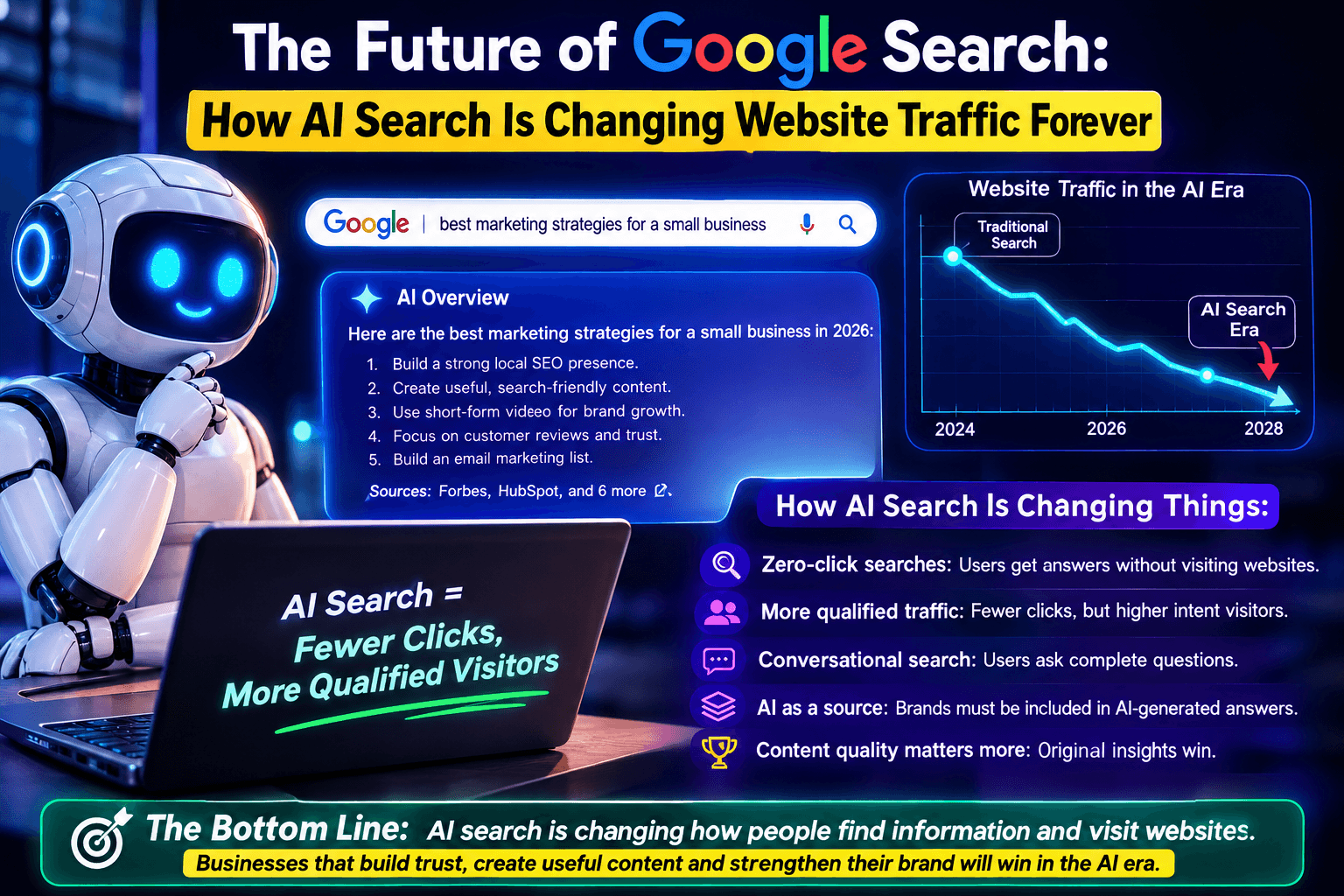
However, the search landscape is undergoing its biggest transformation since Google's launch. Artificial Intelligence (AI) is changing how users search, discover, and consume information. Instead of presenting a list of links, modern AI-powered search engines increasingly generate direct answers, summaries, and recommendations without requiring users to visit individual websites.
This shift has given rise to AI Search and Zero-Click Search, fundamentally changing website traffic patterns and forcing businesses to rethink their SEO strategies.
Organizations that adapt early to AI Search will continue attracting visibility, while those relying solely on traditional SEO techniques risk losing valuable organic traffic.
What Is AI Search?
AI Search refers to search experiences powered by artificial intelligence that understand user intent, analyze multiple sources, and generate conversational responses.
Instead of simply matching keywords, AI Search evaluates:
Search intent
Context
User behavior
Natural language
Semantic meaning
Multiple trusted sources
The result is a more personalized and accurate search experience.
Users increasingly receive complete answers directly within search results, reducing the need to click through multiple websites.
The Rise of Zero-Click Search
One of the biggest consequences of AI Search is the growth of Zero-Click Search.
A zero-click search occurs when users find the information they need directly on the search results page without visiting another website.
Examples include:
AI-generated summaries
Featured snippets
Knowledge panels
Maps
Weather information
Product comparisons
Instant calculations
Business profiles
While this improves user experience, it significantly reduces website traffic for many publishers.
Why Website Traffic Is Changing
Traditional SEO focused primarily on ranking high for keywords.
AI Search changes this model by prioritizing:
Information quality
Authority
Trustworthiness
Context
User intent
Content structure
Businesses may still appear in AI-generated answers even if users never click through to their websites.
Traffic is becoming more selective, but often higher in quality because visitors arriving from AI Search tend to have stronger purchase or engagement intent.
How AI Understands Content
Modern AI systems analyze content differently from traditional search engines.
Instead of counting keyword frequency, AI evaluates:
Topical Authority
Comprehensive coverage of a subject increases credibility.
Semantic Relationships
AI understands related concepts instead of relying solely on exact keywords.
Structured Content
Well-organized headings, bullet points, FAQs, and schema markup improve AI comprehension.
Expertise
Content written with demonstrated knowledge is more likely to be referenced.
Freshness
Updated information receives greater visibility for rapidly evolving topics.
How Businesses Should Adapt
The shift toward AI Search requires a modern SEO strategy.
Create High-Quality Content
Publish in-depth articles that answer real user questions.
Long-form content often performs better because it provides complete context.
Focus on User Intent
Rather than targeting individual keywords, create content that solves problems.
Understand why users are searching instead of simply what they are searching for.
Build Topical Authority
Develop clusters of related articles covering an entire subject.
This demonstrates expertise and improves AI visibility.
Use Structured Data
Schema markup helps search engines understand content more accurately.
Useful schema types include:
Article
FAQ
Organization
Breadcrumb
Product
Review
Optimize for AI Readability
Use:
Short paragraphs
Clear headings
Bullet points
Tables
FAQ sections
These formats improve both user experience and AI comprehension.
Why E-E-A-T Matters More Than Ever
Google increasingly emphasizes:
Experience
Expertise
Authoritativeness
Trustworthiness
Businesses should:
Publish original research
Cite reliable sources
Demonstrate industry expertise
Maintain accurate information
Keep content updated
Strong E-E-A-T signals increase the likelihood of appearing in AI-generated search results.
The Role of Brand Authority
As AI provides direct answers, brand recognition becomes increasingly valuable.
Users are more likely to trust companies with established reputations.
Businesses should invest in:
Digital PR
Thought leadership
Industry publications
Case studies
Customer testimonials
Social proof
Strong brands remain visible even as click patterns change.
AI Search and Content Marketing
Content marketing is becoming even more important.
Instead of producing hundreds of keyword-focused articles, businesses should create:
Comprehensive guides
Original research
Industry analysis
Expert opinions
Practical tutorials
AI systems prioritize valuable, trustworthy content over low-quality, repetitive pages.
Measuring Success Beyond Clicks
Traditional SEO measured success primarily through traffic.
AI Search requires businesses to monitor additional metrics:
Brand mentions
AI citations
Engagement rate
Conversion rate
Returning visitors
Customer retention
Organic revenue
Quality is becoming more important than quantity.
Common SEO Mistakes in the AI Era
Many businesses continue relying on outdated strategies.
Common mistakes include:
Keyword stuffing
Thin content
Duplicate articles
Ignoring search intent
Publishing without updates
Poor internal linking
Lack of structured data
These practices reduce visibility in AI-powered search environments.
Future Trends
Several developments will shape AI Search over the coming years.
Conversational Search
Users increasingly ask complete questions instead of typing keywords.
Voice Search
AI assistants continue driving natural language searches.
Personalized Search
AI customizes results based on user behavior and preferences.
Visual Search
Image recognition allows users to search using photos instead of text.
Multimodal AI
Future search experiences will combine text, images, audio, and video into unified responses.
Best Practices for Businesses
To remain competitive, organizations should:
Publish expert content regularly
Build topic clusters
Improve page experience
Optimize for conversational queries
Implement structured data
Earn high-quality backlinks
Strengthen brand authority
Monitor AI Search performance
Update content frequently
Focus on user value rather than algorithms
These practices position businesses for long-term success in the AI Search era.
Conclusion
AI Search represents one of the most significant changes in the history of Google Search. As artificial intelligence delivers direct answers and personalized experiences, website traffic patterns are changing rapidly. Businesses can no longer rely solely on traditional SEO techniques focused on rankings and keywords.
Success in 2026 depends on creating authoritative, trustworthy, and user-focused content that AI systems recognize as valuable. Organizations that embrace structured content, topical authority, E-E-A-T principles, and brand credibility will continue to thrive despite the rise of Zero-Click Search.
The future of search belongs to businesses that optimize not only for search engines but also for artificial intelligence and the evolving needs of users.
Frequently Asked Questions
What is AI Search?
AI Search uses artificial intelligence to understand search intent, analyze information from multiple sources, and generate conversational answers instead of displaying only a list of links.
What is Zero-Click Search?
Zero-Click Search occurs when users receive the information they need directly on the search results page without visiting a website.
How does AI Search affect SEO?
AI Search places greater emphasis on content quality, expertise, structured data, and user intent rather than keyword density alone.
How can businesses stay visible in AI Search?
Businesses should publish authoritative content, build topical expertise, use schema markup, optimize for conversational queries, and strengthen brand authority.
Is traditional SEO still important?
Yes. Traditional SEO remains essential, but it must now be combined with AI optimization, E-E-A-T principles, and high-quality content strategies to achieve long-term success.