
Introduction
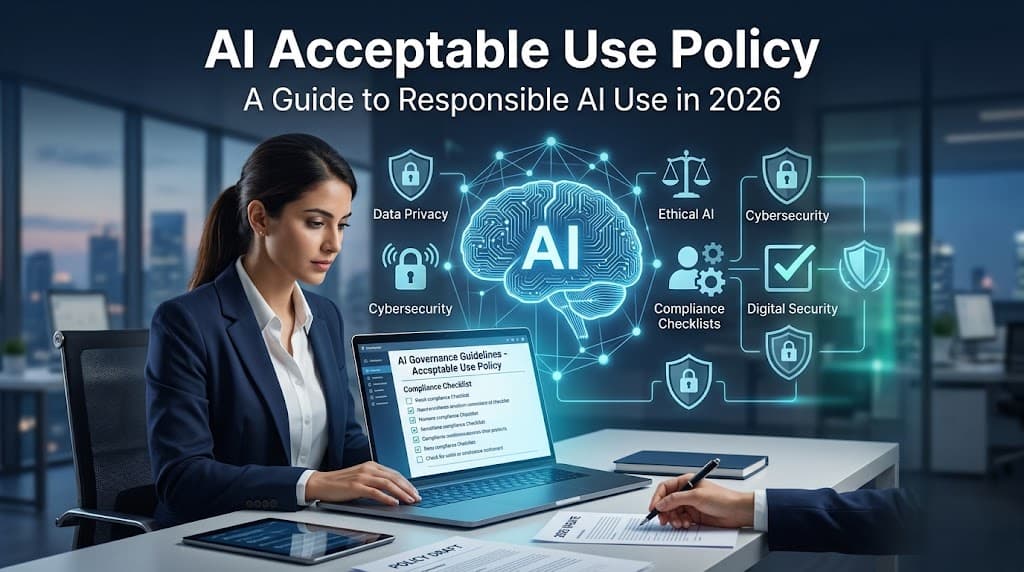
Artificial intelligence is transforming how businesses operate, how students learn, and how organizations manage information. From AI writing assistants and chatbots to automated data analysis and image generation, AI tools are becoming part of everyday work. However, their growing use also introduces challenges related to privacy, cybersecurity, accuracy, copyright, and ethical responsibility.
An AI Acceptable Use Policy (AI AUP) provides clear guidelines for using artificial intelligence safely, ethically, and responsibly. It explains which AI activities are permitted, which are prohibited, and what responsibilities users have when working with AI-generated content.
In 2026, organizations need practical AI policies that support innovation while reducing unnecessary risks. Whether a company is adopting AI for customer service or a school is establishing rules for AI-assisted assignments, an effective policy helps users understand their responsibilities.
This guide explains what an AI acceptable use policy is, why it matters, which rules it should include, and how organizations can develop one.
What Is an AI Acceptable Use Policy?
An AI Acceptable Use Policy is a formal set of rules governing how employees, students, contractors, and other authorized users may interact with AI systems.
It defines appropriate AI use, establishes boundaries, and identifies practices that may expose an organization or individual to security, legal, academic, or ethical problems.
For example, a business may permit employees to use an approved AI assistant to summarize public information or brainstorm marketing ideas. However, it may prohibit employees from uploading customer records, confidential contracts, or internal financial information into an unapproved AI platform.
Similarly, an educational institution may allow AI tools for brainstorming while requiring students to submit original work and disclose AI assistance when school rules demand it.
An effective policy should be easy to understand, relevant to actual activities, and updated as AI technologies and organizational needs change.
Why Is an AI Acceptable Use Policy Important in 2026?
AI adoption is increasing across industries, but not every organization has the same level of experience managing AI-related risks.
Without clear rules, users may unknowingly expose sensitive information, rely on inaccurate answers, violate copyright requirements, or use AI in ways that conflict with organizational expectations.
An AI acceptable use policy helps address these challenges in several ways.
1. Protects Confidential Information
AI tools may process information submitted by users. Depending on the provider, product, and settings, that information may be stored, reviewed, or used in different ways.
A policy should explain which data may be shared with approved tools and which information must remain confidential.
Employees should never assume that information entered into an AI system is private simply because the tool is easy to access.
2. Reduces Cybersecurity Risks
AI can assist with legitimate security work, but it can also be misused to generate phishing messages, malicious code, deceptive content, or instructions for unauthorized access.
An AI acceptable use policy should prohibit harmful activities and require users to follow established cybersecurity procedures.
Organizations should also assess AI applications before approving them for business use.
3. Improves Accuracy and Reliability
AI systems can generate incorrect information, fabricated references, outdated facts, and misleading conclusions.
A policy should require users to verify important claims against reliable sources, especially when AI outputs influence business decisions, financial reports, customer communications, or technical work.
AI-generated information should be treated as assistance rather than automatically accepted as fact.
4. Establishes Ethical Standards
Responsible AI use involves fairness, transparency, accountability, and respect for human rights.
Organizations should prohibit the use of AI to discriminate unlawfully, impersonate people deceptively, harass others, or manipulate individuals through harmful practices.
Clear rules help users recognize unacceptable behavior before it causes harm.
5. Supports Legal and Regulatory Compliance
AI use may involve privacy, employment, consumer protection, intellectual property, and sector-specific requirements.
An AI policy can help organizations identify relevant obligations and establish procedures for meeting them. However, having a policy does not automatically guarantee legal compliance.
Businesses should review applicable laws and seek qualified advice when AI applications create significant legal or regulatory risks.
Key Components of an AI Acceptable Use Policy
A useful policy should address the main risks associated with the organization's AI activities.
1. Approved AI Tools
The policy should identify which AI applications employees or students may use for particular tasks.
Organizations can maintain an approved-tool list and establish a review process for new applications.
Before approval, decision-makers should consider security controls, privacy practices, data retention, access management, reliability, and contractual terms.
Users should not install or adopt unapproved AI tools for sensitive work without authorization.
2. Data Privacy and Confidentiality
Data protection is one of the most important parts of an AI acceptable use policy.
The policy should classify information according to its sensitivity and explain which categories can be entered into AI systems.
For example:
Public information: May generally be used with approved tools, subject to relevant rules.
Internal information: Requires authorization and appropriate safeguards.
Confidential information: Should only be processed using specifically approved systems and procedures.
Sensitive personal information: Requires particular care and must be handled according to applicable privacy requirements.
Users should avoid submitting passwords, authentication codes, customer records, confidential business plans, or other sensitive information to unauthorized systems.
3. Human Review and Accountability
AI can support decision-making, but it should not automatically replace human judgment in situations where errors may cause significant harm.
Organizations should define when human approval is required and who is accountable for the final result.
For example, AI-generated financial analysis should be reviewed before being used in a major investment decision. Similarly, AI-generated customer communications should be checked for accuracy, tone, and privacy concerns before distribution.
Responsibility for a decision should remain clear even when AI tools contribute to the process.
4. Accuracy and Fact-Checking
An acceptable use policy should require users to verify information before publishing or relying on it.
Fact-checking is especially important for:
Medical and health-related information.
Financial calculations and business forecasts.
Legal explanations and compliance documents.
Research articles and academic references.
Public statements and news-related content.
Technical instructions that affect safety or security.
Users should confirm sources, check calculations, and correct misleading statements before using AI-generated material.
5. Transparency and Disclosure
Some situations require users to disclose that AI contributed to their work.
For example, an organization may require disclosure when AI generates substantial portions of a public report, customer-facing content, research, or an academic assignment.
The policy should explain when disclosure is necessary, how it should be made, and whether any specific format is required.
Disclosure requirements may depend on organizational rules, contractual obligations, professional standards, or applicable law.
6. Copyright and Intellectual Property
AI-generated content can raise questions about ownership, licensing, originality, and the use of third-party material.
An AI acceptable use policy should require users to respect copyright and other intellectual property rights. Users should not assume that every AI-generated image, article, code sample, or design is automatically free of restrictions.
Organizations should establish procedures for checking licenses, reviewing generated code, protecting confidential intellectual property, and obtaining permission when necessary.
7. Prohibited AI Activities
A policy should clearly identify activities that are not allowed.
Common examples include:
Using AI to create or distribute fraudulent content.
Generating deceptive impersonations for harmful purposes.
Uploading confidential information to unauthorized AI systems.
Using AI to facilitate cyberattacks or unauthorized access.
Producing discriminatory decisions or content that violates organizational rules.
Submitting AI-generated academic work in violation of school requirements.
Using AI to evade security controls or monitoring systems.
Making high-impact decisions without required human review.
Prohibited activities should be described clearly enough that users can understand what is unacceptable.
AI Acceptable Use Policy for Schools and Students
Schools and colleges face a different set of challenges because AI tools can support learning while also making academic misconduct easier.
A student-focused policy should explain when AI assistance is allowed and when independent work is required.
For example, teachers may allow students to use AI to understand difficult concepts, brainstorm essay topics, practice questions, or identify grammar mistakes. They may restrict AI use during examinations or prohibit submitting generated assignments as entirely original work.
An effective educational policy should:
Explain permitted and prohibited uses.
Require students to follow assignment-specific instructions.
Encourage students to verify AI-generated information.
Address plagiarism and appropriate attribution.
Protect student data and privacy.
Provide fair procedures for reviewing suspected violations.
Teach students to evaluate AI outputs critically.
Rules should be communicated before assignments are completed so students understand expectations.
How to Create an AI Acceptable Use Policy
Developing a practical policy requires more than copying a general template. Organizations should adapt their rules to their size, industry, data sensitivity, and AI use cases.
Step 1: Identify Existing AI Use
Determine which AI tools employees or students currently use and what tasks they perform with them.
This review may reveal unapproved applications, privacy concerns, or opportunities for responsible AI adoption.
Step 2: Assess Risks
Identify potential risks involving confidential data, inaccurate outputs, intellectual property, discrimination, cybersecurity, and regulatory obligations.
Prioritize risks according to their likelihood and potential impact.
Step 3: Define Permitted Uses
Specify which AI activities are approved and under what conditions.
For example, drafting a general marketing outline may be permitted, while generating a legally binding contract without professional review may be restricted.
Step 4: Establish Clear Prohibitions
Explain which actions are prohibited and why. Avoid vague wording that leaves users uncertain about their responsibilities.
Step 5: Assign Responsibilities
Identify who approves AI tools, reviews high-risk use cases, manages security concerns, and handles policy questions.
Employees and students should also understand their individual responsibilities.
Step 6: Train Users
Provide practical examples of acceptable and unacceptable AI use.
Training should cover privacy, fact-checking, cybersecurity, disclosure, and the process for reporting mistakes or suspected misuse.
Step 7: Review and Update the Policy
AI technology changes rapidly, so policies should be reviewed periodically and whenever significant changes occur in tools, risks, laws, or organizational practices.
AI Acceptable Use Policy Template
Organizations can use the following example as a starting point and adapt it to their requirements.
Purpose: This policy establishes rules for the safe, ethical, and responsible use of artificial intelligence tools.
Scope: It applies to employees, contractors, and other authorized users who access AI systems for organizational activities.
Approved tools: Users may use AI applications approved for their intended tasks.
Data protection: Users must not enter confidential or sensitive information into unauthorized AI systems.
Accuracy: AI-generated content must be reviewed for factual accuracy, relevance, and potential bias before use.
Transparency: Users must disclose AI assistance when required by organizational rules, contractual obligations, or applicable standards.
Security: AI must not be used to facilitate fraud, unauthorized access, malicious activity, or other prohibited conduct.
Human oversight: Decisions with significant consequences must receive the level of human review required by the organization.
Accountability: Users remain responsible for complying with this policy and for the work they submit or approve.
Reporting: Suspected policy violations, data exposure, or harmful AI outputs should be reported through the organization's established reporting channels.
Review: The policy should be reviewed periodically and updated when necessary.
This template is not a substitute for legal review. Organizations should adapt it to applicable requirements and their actual AI systems.
Common Mistakes When Implementing an AI Policy
Even well-intentioned policies can fail when they are difficult to understand or impractical to follow.
Creating Rules That Are Too Broad
A blanket prohibition on every AI tool may prevent useful applications without addressing the real risks. Clear distinctions between low-risk and high-risk activities are generally more practical.
Ignoring Employee Training
A written policy is not enough if users do not understand it. Short training sessions and realistic examples can improve compliance.
Failing to Address Data Protection
Organizations should explain which information can be shared, which systems are approved, and what to do if confidential data is accidentally disclosed.
Relying Entirely on AI Detection Tools
Automated AI detectors can make mistakes. Their results should not be treated as definitive proof of misconduct without appropriate review and supporting evidence.
Leaving the Policy Unchanged
An outdated policy may fail to address new AI capabilities, emerging security threats, or changing legal requirements.
How to Measure AI Policy Effectiveness
Organizations should assess whether their policy reduces risk while allowing appropriate innovation.
Useful indicators include:
Percentage of relevant users who complete AI training.
Number of unapproved AI applications identified.
Frequency of privacy or security incidents involving AI.
Compliance with required disclosure and review procedures.
Time taken to resolve reported AI-related concerns.
Feedback from users about policy clarity and practicality.
These indicators should be interpreted in context. A rise in reported incidents, for example, may reflect better reporting rather than worsening behavior.
Regular assessments help organizations improve their policies and focus resources where they are most needed.
Conclusion
An AI Acceptable Use Policy is an important foundation for responsible artificial intelligence adoption in 2026. It establishes clear rules for approved tools, data protection, accuracy, transparency, cybersecurity, intellectual property, and human oversight.
For businesses, these guidelines can reduce avoidable risks while supporting productivity and innovation. For schools and colleges, they can clarify the difference between helpful AI assistance and academic misconduct.
The most effective policy is practical, easy to understand, and tailored to the organization's actual needs. By combining clear rules, user training, appropriate safeguards, and regular reviews, organizations can make better use of AI while maintaining accountability and trust.