
Introduction
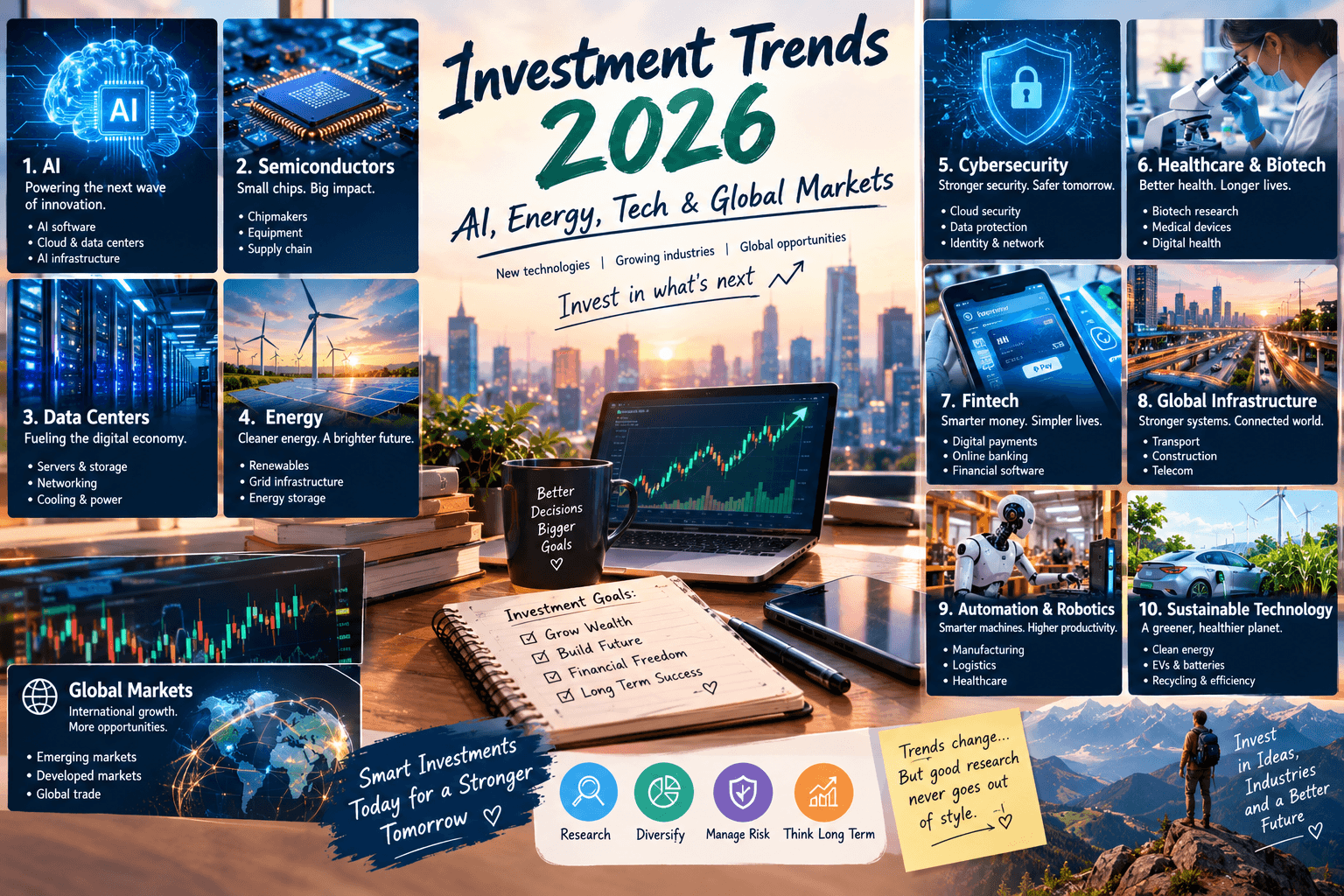
The investment landscape in 2026 is being shaped by technological innovation, artificial intelligence, energy demand, infrastructure development, changing economic conditions, and global market trends.
Investors are paying attention to several sectors that could influence businesses and financial markets, including AI infrastructure, semiconductors, cybersecurity, renewable energy, healthcare, and digital finance.
However, every investment involves risk, and trends alone do not guarantee future returns. Understanding the underlying businesses, valuations, economic environment, and potential risks is essential.
1. Artificial Intelligence Investment
Artificial intelligence remains one of the major technology themes of 2026.
AI development requires a broad ecosystem that includes:
Semiconductors
Data centers
Cloud computing
Networking equipment
AI software
Cybersecurity
Electricity and cooling infrastructure
This means AI-related investment is not limited to companies developing AI models. Businesses throughout the technology supply chain can also be affected by growing AI demand.
2. Semiconductor Industry
Semiconductors are essential for smartphones, computers, vehicles, cloud infrastructure, and AI systems.
Advanced AI applications require increasingly powerful computing hardware, making chip manufacturing and semiconductor equipment important areas to monitor.
Investors following this sector may examine factors such as:
Revenue growth
Manufacturing capacity
Research and development
Competition
Supply-chain conditions
Demand from AI and data centers
3. Data Centers and Digital Infrastructure
The expansion of cloud computing and AI requires substantial computing infrastructure.
Data centers need servers, networking equipment, cooling systems, storage, and reliable electricity.
This creates opportunities across multiple industries rather than just traditional technology companies.
4. Energy and Electricity Demand
AI and data-center expansion are increasing attention on electricity infrastructure.
Investment themes can include:
Electricity generation
Power grids
Energy storage
Renewable energy
Nuclear energy
Grid modernization
Energy-efficiency technology
The transition toward more efficient and reliable energy systems is becoming increasingly relevant as digital infrastructure expands.
5. Cybersecurity
As businesses become more dependent on digital systems, cybersecurity remains an important industry.
Companies are investing in technologies designed to protect:
Cloud platforms
Customer data
Corporate networks
Digital identities
Applications
Connected devices
The growth of AI also creates new cybersecurity challenges, increasing demand for security tools and expertise.
6. Healthcare and Biotechnology
Healthcare remains a major investment sector because of continued research into medicines, medical devices, diagnostics, and biotechnology.
Potential areas of interest include:
Biotechnology
Pharmaceutical research
Medical devices
Digital health
Diagnostics
AI-assisted healthcare
Healthcare investments can carry substantial risks, particularly for biotechnology companies whose valuations may depend on clinical-trial results or regulatory decisions.
7. Financial Technology
Digital payments, online banking, financial software, and other fintech services continue to change the financial sector.
Technology is being used for:
Digital payments
Fraud detection
Financial analysis
Online banking
Automated services
Customer support
Investors may examine both the growth potential and regulatory environment surrounding financial technology companies.
8. Global Infrastructure
Infrastructure investment extends beyond technology.
Transportation networks, energy systems, telecommunications, construction, and industrial equipment can all benefit from infrastructure spending.
Modernizing aging infrastructure can create demand for companies that provide construction materials, engineering services, equipment, and technology.
9. Automation and Robotics
Businesses are increasingly exploring automation to improve productivity and manage repetitive processes.
Robotics can be used in:
Manufacturing
Warehousing
Logistics
Healthcare
Agriculture
Retail
The combination of robotics and AI could expand the number of tasks that machines can perform, although adoption varies significantly by industry.
10. Sustainable Technology
Sustainable technology continues to attract attention across energy, transportation, manufacturing, and construction.
Areas include:
Renewable energy
Battery technology
Electric transportation
Energy-efficient buildings
Recycling technologies
Smart energy systems
Investors should distinguish between companies with established business models and early-stage technologies that may still face significant commercial and technological uncertainty.
11. Interest Rates and the Investment Environment
Interest rates can influence investment markets in several ways.
Higher borrowing costs can affect corporate investment, consumer spending, housing activity, and company valuations.
Changes in monetary policy can therefore influence both stock and bond markets.
Investors often monitor central-bank decisions alongside inflation, employment, economic growth, and other indicators.
12. Diversification and Risk Management
Following investment trends does not mean concentrating an entire portfolio in one popular sector.
Diversification can involve spreading exposure across:
Different companies
Industries
Geographic markets
Asset classes
Investment strategies
Diversification cannot eliminate losses, but it can reduce the impact of a single investment performing poorly.
What Investors Should Research
Before considering an investment, it can be useful to examine several factors.
Company Fundamentals
Look at revenue, earnings, cash flow, debt, competitive position, and business strategy.
Valuation
A company can have strong growth prospects while its stock price is already reflecting high expectations.
Industry Conditions
Understand competition, demand, regulations, technological changes, and supply-chain conditions.
Risk
Consider what could cause the investment thesis to fail.
Time Horizon
Short-term market movements can differ significantly from long-term business performance.
Conclusion
Investment trends in 2026 are being influenced by AI, semiconductors, data centers, energy infrastructure, cybersecurity, healthcare, fintech, robotics, and sustainable technology.
These themes can provide useful areas for research, but a popular trend does not automatically make an investment suitable for every investor.
Careful research, diversification, awareness of valuation, and an understanding of risk remain important when evaluating investment opportunities.
FAQs
1. What are the major investment trends in 2026?
Major themes include AI, semiconductors, data centers, energy infrastructure, cybersecurity, healthcare, fintech, robotics, and sustainable technology.
2. Why is AI important for investors?
AI is creating demand for computing hardware, software, cloud services, data centers, networking, and energy infrastructure.
3. Are AI stocks guaranteed to rise?
No. Stock prices can decline regardless of industry growth, and investors should consider valuation, competition, earnings, and broader market conditions.
4. Why are semiconductor companies important?
Semiconductors power many modern technologies, including AI systems, smartphones, vehicles, and data centers.
5. What is digital infrastructure?
Digital infrastructure includes data centers, cloud systems, telecommunications networks, servers, storage, and related technology.
6. Why is energy becoming an investment theme?
Growing electricity demand from data centers, industry, transportation, and other technologies is increasing attention on energy generation and grid infrastructure.
7. What is cybersecurity investing?
It involves companies that provide technologies and services designed to protect digital systems, networks, applications, and information.
8. Is healthcare a major investment sector?
Healthcare remains a large global industry spanning pharmaceuticals, biotechnology, medical devices, diagnostics, and digital health.
9. What is fintech?
Fintech refers to technology-based financial services such as digital payments, online banking, financial software, and automated financial tools.
10. Why is robotics attracting investment?
Robotics can automate physical tasks in manufacturing, logistics, agriculture, healthcare, and other industries.
11. What is sustainable technology?
It includes technologies designed to improve energy efficiency, support renewable energy, reduce waste, or lower resource consumption.
12. How do interest rates affect investments?
Interest rates can influence borrowing costs, economic activity, bond yields, and how investors value future corporate earnings.
13. What is diversification?
Diversification means spreading investments across different assets, sectors, companies, or markets to reduce concentration risk.
14. Does diversification guarantee profits?
No. Diversification can reduce concentration risk but cannot eliminate market losses.
15. What should investors check before buying a stock?
Important factors include financial performance, valuation, debt, competition, industry conditions, growth prospects, and risks.
16. Why does valuation matter?
A stock can belong to a strong industry but still be expensive relative to its expected future earnings.
17. Are renewable-energy investments risk-free?
No. Renewable-energy companies can face technology, financing, regulatory, competition, and supply-chain risks.
18. What is infrastructure investing?
Infrastructure investing focuses on assets and companies involved in areas such as energy, transportation, telecommunications, construction, and utilities.
19. Is long-term investing different from short-term trading?
Yes. Long-term investing generally focuses more on business fundamentals and extended time horizons, while short-term trading may focus more on price movements and near-term market events.
20. What is the most important investment principle?
There is no single principle that guarantees success. Understanding risk, researching investments, considering valuation, and maintaining an appropriate level of diversification are important parts of informed investing.