
Introduction
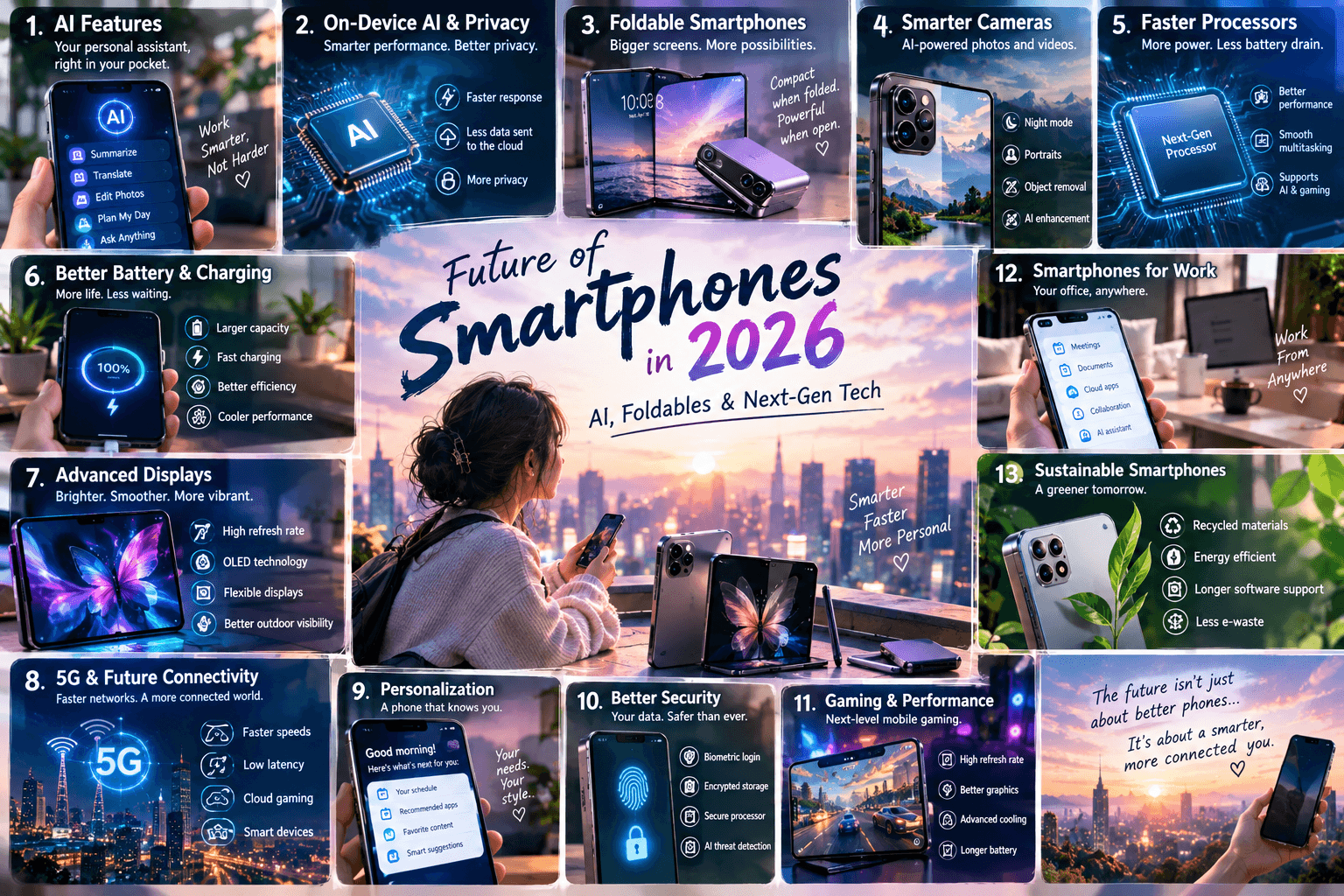
Smartphones continue to evolve rapidly in 2026, with artificial intelligence, foldable displays, improved cameras, faster processors, and smarter software shaping the next generation of mobile technology. Modern smartphones are no longer just communication devices—they are becoming powerful personal assistants, productivity tools, entertainment systems, and AI-powered companions.
From on-device AI to more durable foldable phones, the smartphone industry is focusing on making devices smarter, faster, more personalized, and more useful in everyday life.
1. AI Is Becoming a Major Smartphone Feature
Artificial intelligence is one of the biggest developments in smartphones. Manufacturers are increasingly integrating AI directly into mobile operating systems and applications.
AI-powered smartphones can help users summarize messages, edit photographs, translate conversations, organize information, generate text, and perform tasks through natural-language commands.
Instead of opening several applications manually, users can increasingly ask their phones to complete multiple steps for them.
2. On-Device AI and Privacy
One important direction is processing AI tasks directly on the smartphone rather than sending every request to the cloud.
Modern mobile processors are being designed with dedicated AI capabilities that can handle certain tasks locally. This can improve response times and may provide privacy advantages because some information can remain on the device.
Features such as real-time translation, photo enhancement, voice recognition, and personalized recommendations can benefit from on-device processing.
3. Foldable Smartphones Are Evolving
Foldable phones continue to attract attention in 2026. Earlier foldable devices faced challenges involving durability, thickness, battery life, and high prices.
Newer generations are focusing on thinner designs, stronger hinges, improved displays, and more practical software.
Book-style foldables can provide a larger screen while remaining relatively compact when folded, while flip-style devices offer a smaller folded footprint.
4. Smartphone Cameras Are Getting Smarter
Camera improvements remain an important part of smartphone development.
Instead of relying only on larger camera sensors, manufacturers are using computational photography and AI to improve images.
Modern camera systems can automatically recognize scenes, improve low-light photographs, remove unwanted objects, enhance portraits, and process video more intelligently.
Future smartphones are likely to place even greater emphasis on AI-assisted photography and video creation.
5. Faster Mobile Processors
Smartphone processors are becoming increasingly powerful and energy-efficient.
New chip generations are designed to deliver better performance while controlling battery consumption. This is particularly important because AI features require significant processing power.
Improved processors can support gaming, video editing, multitasking, AI applications, augmented reality, and other demanding tasks.
6. Better Battery Technology and Charging
Battery life remains one of the most important factors when choosing a smartphone.
Manufacturers are working on improvements in battery capacity, charging technology, power efficiency, and thermal management.
Fast charging can reduce the time users need to keep their phones connected to a charger, while more efficient processors can help devices operate longer between charges.
7. More Advanced Smartphone Displays
Displays are becoming brighter, smoother, and more energy-efficient.
High refresh-rate screens provide smoother scrolling and animations, while advanced OLED technologies can deliver strong contrast and vivid visuals.
Foldable devices are also pushing manufacturers to develop flexible display technologies that can withstand repeated folding and unfolding.
8. 5G and Future Connectivity
5G continues to support faster mobile connections, lower latency, and better network capacity.
As network infrastructure develops, smartphones can take advantage of improved connectivity for cloud gaming, high-quality video streaming, connected devices, remote collaboration, and AI-powered services.
Future connectivity technologies may further improve the way smartphones interact with nearby devices and networks.
9. Smartphones Are Becoming More Personalized
AI is helping smartphones become more personalized.
Instead of offering the same experience to every user, future devices can learn preferences such as frequently used applications, communication patterns, schedules, and content preferences.
Personalization can make smartphones more useful by presenting relevant information at the right time.
10. Better Security Features
Security remains a major concern as smartphones store increasing amounts of personal and financial information.
Modern devices use technologies such as biometric authentication, encrypted storage, secure processors, application permissions, and threat detection.
AI may also help identify suspicious activities and potential security threats more quickly.
11. Smartphone Gaming Continues to Grow
Mobile gaming has become increasingly sophisticated.
Powerful processors, high-refresh-rate displays, advanced cooling systems, and improved graphics capabilities allow smartphones to run demanding games.
Gaming-focused smartphones may continue to offer features such as enhanced cooling, customizable controls, large batteries, and specialized displays.
12. Smartphones and the Future of Work
Smartphones are also becoming important productivity devices.
AI assistants, cloud applications, document editing, video meetings, collaboration platforms, and mobile productivity tools allow users to complete many work and study tasks from their phones.
With better processors and larger foldable screens, smartphones could become even more capable replacements for traditional computing devices for certain tasks.
13. More Sustainable Smartphones
Sustainability is becoming increasingly relevant in the technology industry.
Manufacturers are exploring recycled materials, improved energy efficiency, longer software support, repairability, and more efficient manufacturing processes.
Longer-lasting smartphones can also reduce electronic waste by allowing users to keep their devices for more years.
14. What Will Smartphones Look Like in the Future?
The smartphone of the future may be thinner, smarter, more personalized, and increasingly connected to other devices.
AI could become an invisible layer operating throughout the phone, helping with communication, photography, productivity, security, and entertainment.
Foldable and flexible designs could also provide larger displays without requiring users to carry much larger devices.
Conclusion
The future of smartphones in 2026 is being shaped by several major technologies, including artificial intelligence, foldable displays, advanced processors, smarter cameras, faster connectivity, and improved battery technology.
Rather than simply becoming more powerful, smartphones are becoming more intelligent and personalized. The biggest transformation may be the shift from smartphones being tools that users operate manually to devices that can understand context and assist users more naturally.
As these technologies continue to develop, smartphones are likely to remain one of the most important pieces of everyday technology.
FAQs
1. What is the biggest smartphone trend in 2026?
Artificial intelligence is one of the major smartphone trends, with AI being integrated into cameras, assistants, productivity tools, and operating systems.
2. Are foldable phones improving in 2026?
Yes. Newer foldable smartphones are focusing on thinner designs, stronger hinges, improved displays, and better software experiences.
3. What is an AI smartphone?
An AI smartphone is a device that uses artificial intelligence to provide features such as intelligent assistants, photo enhancement, translation, summarization, personalization, and automated tasks.
4. Is on-device AI better for privacy?
On-device processing can provide privacy benefits for certain tasks because some information can be processed locally instead of being sent to remote servers.
5. Will smartphones replace laptops?
For some users and tasks, increasingly capable smartphones—especially foldable models—can perform many functions traditionally associated with laptops. They are unlikely to completely replace laptops for every use case.
6. Are smartphone cameras getting better?
Yes. Improvements in sensors, computational photography, image processing, and AI are helping smartphones produce better photographs and videos.
7. Why are smartphone processors becoming more powerful?
Modern processors need to handle demanding applications, gaming, AI workloads, photography, video processing, and multitasking while maintaining energy efficiency.
8. Will smartphone batteries last longer?
Improved processors, software optimization, battery technology, and power management can help increase battery endurance, although actual battery life varies by device and usage.
9. What are the benefits of foldable smartphones?
Foldables can provide a larger display while maintaining a more compact form factor when folded.
10. Will 5G remain important in 2026?
Yes. 5G continues to support high-speed connectivity and low-latency applications such as streaming, gaming, cloud services, and connected devices.
11. How is AI changing smartphone cameras?
AI can assist with scene recognition, image enhancement, object removal, portrait effects, low-light processing, and video optimization.
12. Are smartphones becoming more secure?
Smartphone security continues to improve through biometric authentication, encryption, secure hardware, software updates, and improved threat detection.
13. What is on-device AI?
On-device AI means certain artificial intelligence tasks are processed directly on the smartphone instead of relying entirely on cloud servers.
14. Will smartphones become thinner?
Manufacturers continue to explore thinner components and more efficient internal designs, although the final thickness depends on battery, camera, cooling, and other hardware requirements.
15. What smartphone display technology is popular?
OLED-based displays remain widely used, while manufacturers continue developing brighter, more efficient, and flexible display technologies.
16. Are smartphones becoming better for gaming?
Yes. Faster processors, high-refresh-rate displays, improved graphics, and advanced cooling systems are making smartphones increasingly capable gaming devices.
17. How will AI assistants change smartphones?
AI assistants may become more capable of understanding natural language, managing information, summarizing content, and helping users complete multi-step tasks.
18. Are smartphone manufacturers focusing on sustainability?
Many manufacturers are working on areas such as recycled materials, energy efficiency, longer software support, and reducing electronic waste.
19. What features should users look for in a modern smartphone?
Important considerations include performance, battery life, camera quality, software support, display quality, connectivity, security, and the device's price.
20. What is the future of smartphones?
The future is likely to involve more AI integration, advanced cameras, foldable or flexible displays, powerful processors, improved connectivity, stronger security, and greater personalization.