Introduction
The workplace is changing rapidly in 2026 as artificial intelligence, automation, remote collaboration, and digital tools become increasingly integrated into everyday work.
AI is helping employees complete repetitive tasks, analyze information, create content, write software, and support customers. At the same time, employers are placing greater emphasis on adaptability, communication, problem-solving, digital literacy, and specialized expertise.
The future of work is therefore not simply about replacing human workers with technology. It is increasingly about how people and technology can work together effectively.
1. AI Is Becoming Part of Everyday Work
AI tools are being integrated into many professional workflows.
Employees can use AI to assist with:
Research
Writing and editing
Data analysis
Customer support
Scheduling
Coding
Presentations
Business reporting
The role of AI varies by industry, but its growing availability means digital and AI literacy are becoming increasingly useful workplace skills.
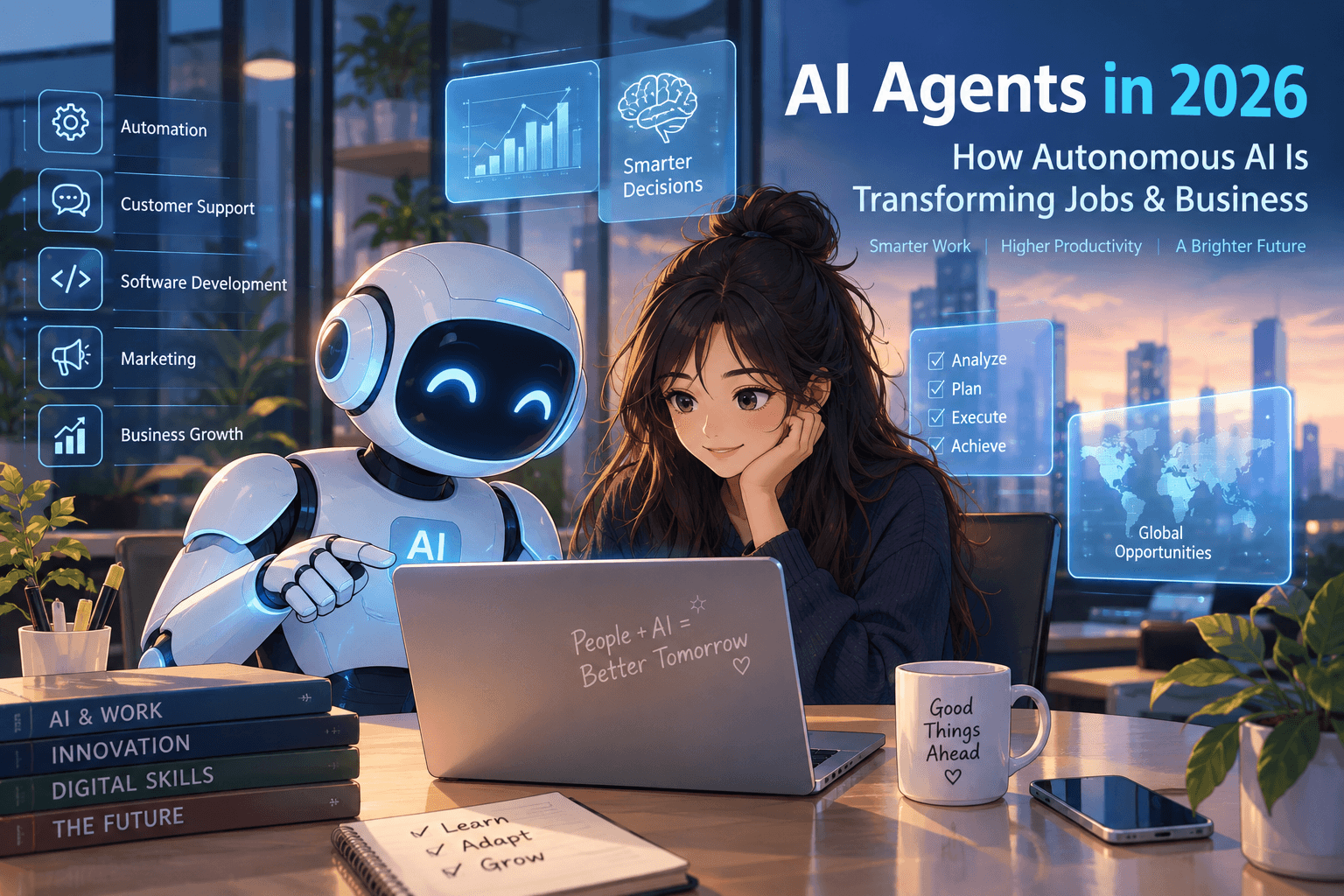
2. AI Agents Are Automating Workflows
AI agents go beyond generating individual responses. Depending on their design and permissions, they can perform multiple steps in a workflow.
For example, an AI system could help collect information, organize data, prepare a report, and send it for human review.
This can reduce the amount of time employees spend on repetitive digital tasks while leaving important decisions and oversight to people.
3. Remote and Hybrid Work Continue to Evolve
Remote work has changed how many organizations think about workplace collaboration.
Hybrid arrangements allow employees to divide their time between home and physical offices, while fully remote teams can work across different locations.
Successful remote work often depends on:
Reliable internet
Clear communication
Collaboration software
Defined responsibilities
Effective time management
Strong cybersecurity practices
Different organizations continue to use different workplace models depending on their industry and operational needs.
4. Human Skills Are Becoming More Important
As automation handles more routine activities, human capabilities remain important.
Employers may value skills such as:
Communication
Clear written and verbal communication helps employees collaborate with colleagues, customers, and managers.
Critical Thinking
Workers need to evaluate information, identify problems, and question inaccurate or incomplete AI-generated results.
Creativity
Creative thinking can help employees develop new ideas, products, campaigns, and solutions.
Adaptability
Technology changes quickly, making the ability to learn new tools increasingly valuable.
Problem-Solving
Employees who can understand complex problems and develop practical solutions remain valuable across many industries.
5. AI Literacy Is Becoming a Workplace Skill
AI literacy does not necessarily mean becoming a computer scientist.
For many workers, it means understanding how to use AI tools effectively, recognize their limitations, protect sensitive information, and review their outputs.
Employees may increasingly need to know how to:
Write clear instructions for AI systems
Check AI-generated information
Combine AI with existing software
Protect confidential data
Identify potential errors
Decide when human review is necessary
6. New Types of Digital Work
The expansion of AI and automation is also creating demand for new areas of expertise.
Examples include:
AI implementation
AI safety and governance
Data analysis
Cybersecurity
Automation management
Cloud computing
Machine learning
Digital product development
Some existing professions are also changing as workers incorporate AI tools into their normal responsibilities.
7. The Importance of Continuous Learning
A single set of skills may not remain sufficient throughout an entire career.
Employees can benefit from continuously learning new technologies and updating their professional knowledge.
Online courses, certifications, practical projects, workshops, and workplace training can all help workers adapt.
8. Freelancing and the Creator Economy
Digital platforms continue to provide opportunities for freelancers and independent creators.
People can offer services such as:
Graphic design
Video editing
Writing
Programming
Digital marketing
Web development
Social media management
Online education
AI tools can help freelancers increase productivity, but quality, originality, communication, and specialized expertise remain important.
9. Cybersecurity and Digital Responsibility
As more work takes place online, employees have an important role in protecting organizational information.
Basic cybersecurity practices include:
Using strong passwords
Enabling multi-factor authentication
Avoiding suspicious links
Protecting confidential information
Keeping software updated
Following company security policies
AI adoption also creates new questions about how organizations should manage data and access permissions.
10. Education and Careers Are Changing
Students entering the workforce in the coming years may encounter workplaces that use AI much more extensively than previous generations.
Building strong foundations in subjects such as mathematics, computing, communication, business, and problem-solving can provide useful preparation.
Students can also benefit from learning how to use modern digital tools responsibly rather than relying on technology without understanding the underlying concepts.
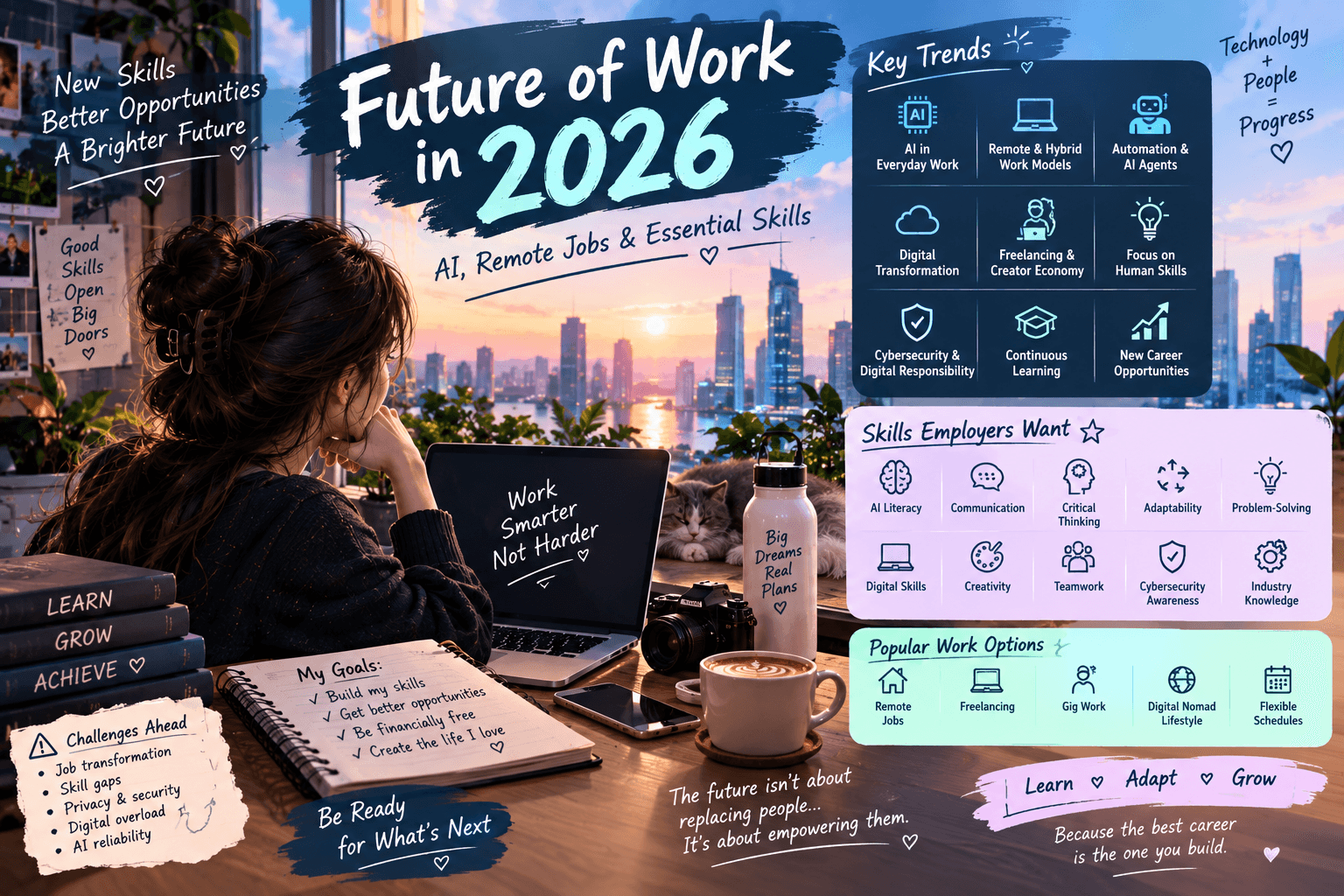
Skills Employers Want in 2026
A strong modern skill set can combine technical and human abilities.
Skill | Why It Matters |
|---|---|
AI Literacy | Helps employees use AI effectively |
Communication | Supports collaboration |
Critical Thinking | Helps evaluate information |
Adaptability | Makes learning new tools easier |
Problem-Solving | Supports complex decision-making |
Digital Skills | Enables effective technology use |
Creativity | Supports innovation |
Cybersecurity Awareness | Helps protect information |
Industry Knowledge | Provides specialized expertise |
Collaboration | Supports teamwork |
Challenges of the Future Workplace
The changing workplace also creates challenges.
Job Transformation
Some tasks may become automated, while other jobs may change significantly.
Skill Gaps
Workers who lack access to training may find it harder to adapt to new technologies.
Privacy
Employees and organizations need to understand how workplace AI systems collect, process, and store information.
Digital Overload
Constant connectivity can make it harder to maintain clear boundaries between professional and personal time.
AI Reliability
AI systems can make mistakes, so human review remains important for many tasks.
How Students Can Prepare for the Future of Work
Students can start developing future-ready skills before entering the professional world.
A useful approach is to combine technical knowledge + communication + critical thinking + practical experience.
Students can:
Learn basic AI and computer skills.
Build projects instead of relying only on theoretical knowledge.
Improve English and communication skills.
Practice problem-solving.
Learn how to verify online information.
Explore digital tools relevant to their field.
Develop a habit of continuous learning.
Conclusion
The future of work in 2026 is being shaped by AI, automation, remote collaboration, digital platforms, and rapidly changing skill requirements.
Technology may automate some tasks, but human abilities such as creativity, judgment, communication, adaptability, and problem-solving remain important.
For students and professionals, the most useful approach is to keep learning and understand how technology can complement human abilities. The workplace of the future is likely to involve a combination of people, intelligent software, and increasingly automated workflows.
FAQs
1. What is the future of work in 2026?
The future of work is increasingly shaped by AI, automation, remote collaboration, digital tools, and continuous skill development.
2. Will AI replace human workers?
AI may automate certain tasks and change some job responsibilities, but the impact varies by occupation and industry.
3. What skills do employers want in 2026?
Important skills include AI literacy, communication, critical thinking, adaptability, creativity, problem-solving, and digital skills.
4. Is remote work still relevant?
Yes. Organizations continue to use different combinations of remote, hybrid, and office-based work depending on their needs.
5. What is AI literacy?
AI literacy involves understanding how to use AI tools, evaluate their outputs, recognize limitations, and use them responsibly.
6. What are AI agents?
AI agents are systems designed to perform multi-step tasks or workflows with varying levels of human supervision.
7. Why is critical thinking important with AI?
AI can produce inaccurate or incomplete information, so workers need to evaluate and verify important outputs.
8. Will new jobs be created by AI?
AI adoption can create demand for skills related to AI implementation, data, cybersecurity, governance, automation, and specialized technology applications.
9. How can students prepare for future careers?
Students can develop digital skills, AI literacy, communication, problem-solving abilities, and practical experience.
10. Is coding still useful in 2026?
Programming remains relevant across many technology-related fields, although AI tools are changing how software development is performed.
11. What is hybrid work?
Hybrid work combines remote work with working from a physical workplace.
12. What is the creator economy?
The creator economy includes people earning income through digital content, online services, social platforms, courses, products, and other internet-based activities.
13. Why is adaptability important?
Technology and workplace requirements can change quickly, so adaptable workers can more easily learn new tools and processes.
14. How can AI improve productivity?
AI can assist with tasks such as research, drafting, summarization, analysis, coding, and routine workflow management.
15. What are the risks of using AI at work?
Potential risks include inaccurate outputs, privacy problems, security issues, inappropriate automation, and overreliance on AI.
16. Why is communication important in an AI-driven workplace?
People still need to collaborate, explain ideas, manage relationships, communicate with customers, and make decisions.
17. What is continuous learning?
Continuous learning means regularly developing new knowledge and skills throughout a person's education or career.
18. Will remote jobs increase?
Remote-work opportunities vary by industry and employer, so there is no single outcome across all occupations.
19. What digital skills should students learn?
Useful areas include computer fundamentals, productivity software, AI tools, cybersecurity awareness, data skills, and online research.
20. What will workplaces look like in the future?
Many workplaces are likely to combine human expertise with AI assistants, automation, cloud software, digital collaboration, and increasingly intelligent workflows.