GSGoogle Search in 2026: How AI Is Changing What People See Online
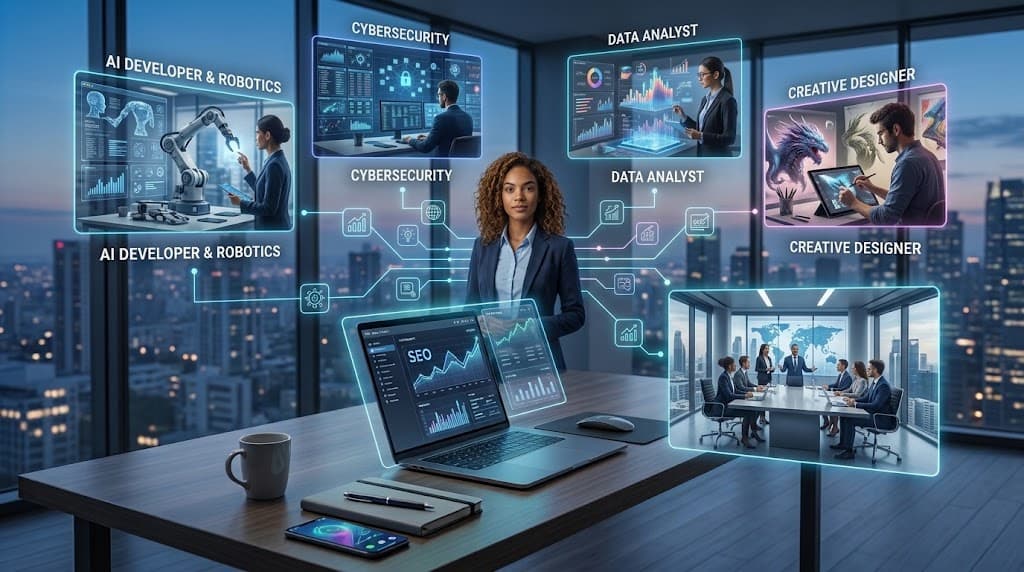
The world of work is changing rapidly in 2026. Artificial intelligence, automation, remote work, cybersecurity, digital platforms, and new technologies are transforming the skills employers need.
Some repetitive tasks are becoming automated, while demand is growing for people who can work with technology, solve complex problems, communicate effectively, and adapt to change.
This doesn't mean every traditional job will disappear. Instead, many jobs are likely to evolve, with technology becoming part of everyday work.
The Biggest Changes in Jobs in 2026
Several trends are shaping the modern workplace:
AI-assisted work
Automation of repetitive tasks
Remote and hybrid employment
Growth of cybersecurity
Expansion of digital businesses
Increasing demand for specialized skills
Continuous learning and reskilling
Human-AI collaboration
The most valuable workers may not simply be those who know the latest technology. They may be those who can combine technology with strong human judgment.
1. Artificial Intelligence Skills
AI is one of the most important forces affecting employment.
Companies are using AI for:
Data analysis
Customer service
Marketing
Software development
Research
Content production
Business operations
Document processing
Workers who understand how to use AI effectively can become more productive.
Valuable AI Skills
AI-assisted research
Prompting and workflow design
AI tool evaluation
Automation
Data interpretation
AI ethics and responsible use
Human-AI collaboration
You don't necessarily need to become an AI engineer. Understanding how to use AI within your own profession can already be valuable.
2. Data Analysis
Businesses generate enormous amounts of data.
They need professionals who can turn that information into useful decisions.
Data-related skills include:
Statistics
Data visualization
Spreadsheet analysis
SQL
Business intelligence
Data interpretation
Machine learning fundamentals
AI can help analyze data, but humans still need to determine what the results mean and what decisions should follow.
3. Cybersecurity
As more businesses move online, protecting digital systems becomes increasingly important.
Cybersecurity professionals help organizations protect:
Customer information
Financial systems
Networks
Cloud infrastructure
Websites
Applications
Company devices
Potential career paths include:
Security analyst
Security engineer
Penetration tester
Cloud security specialist
Security consultant
Incident response specialist
Cybersecurity is likely to remain important as organizations face increasingly sophisticated digital threats.
4. Software Development
Software remains at the center of modern businesses.
AI coding tools are changing programming, but they don't eliminate the need for software professionals.
Developers still need to understand:
Programming concepts
System design
Databases
APIs
Testing
Security
Debugging
Software architecture
AI can help developers write code faster, but understanding what the code should do—and verifying that it works correctly—remains essential.
5. Cloud Computing
Businesses increasingly rely on cloud infrastructure for applications, storage, collaboration, and computing.
Important cloud skills include:
Cloud architecture
Cloud security
Infrastructure management
DevOps
Containers
Serverless technologies
Cloud databases
Professionals who understand cloud systems can work across many industries.
6. Digital Marketing
Digital marketing continues to evolve as consumers spend more time online.
Businesses need people who understand:
SEO
Social media
Content marketing
Email marketing
Analytics
Paid advertising
Conversion optimization
AI-assisted marketing
AI can generate marketing material, but successful campaigns still require strategy, creativity, audience understanding, and experimentation.
7. Communication Skills
Technology skills aren't enough.
Communication remains one of the most valuable workplace abilities.
Strong communication includes:
Writing clearly
Presenting ideas
Listening
Explaining complex concepts
Negotiating
Working with clients
Giving useful feedback
A technically skilled employee who cannot communicate effectively may struggle to turn their knowledge into business value.
8. Critical Thinking
AI can generate answers quickly, but not every answer is correct.
That's why critical thinking is becoming even more important.
Professionals should be able to:
Evaluate information.
Identify weak assumptions.
Check sources.
Compare alternatives.
Recognize errors.
Make informed decisions.
As AI becomes more common, the ability to question AI output rather than blindly trust it becomes a valuable skill.
9. Creativity
Creative thinking is difficult to reduce to a simple automated process.
Companies need people who can develop:
New products
Marketing campaigns
Brand ideas
Designs
Stories
Business strategies
Innovative solutions
AI can generate possibilities, but humans can provide cultural understanding, taste, context, and original direction.
10. Leadership and Management
Technology doesn't eliminate the need for leadership.
Managers still need to:
Motivate teams
Set goals
Resolve conflicts
Make decisions
Manage projects
Communicate priorities
Develop employees
AI may help managers analyze information, but leadership requires human relationships and judgment.
Jobs That May Change the Most
Automation is particularly relevant to repetitive, predictable tasks.
Jobs involving significant amounts of:
Data entry
Basic document processing
Routine customer support
Repetitive administrative work
Simple content production
Basic information classification
may experience greater technological transformation.
However, a job is rarely just one task.
Many occupations contain a mixture of routine and complex activities, meaning technology may change individual responsibilities rather than eliminate the entire occupation.
Human Skills That AI Can't Easily Replace
Some abilities remain particularly valuable:
Empathy
Understanding people's emotions and needs.
Judgment
Making decisions when situations are uncertain.
Creativity
Developing genuinely useful new ideas.
Leadership
Helping people work toward shared goals.
Relationship Building
Creating trust with customers, colleagues, and partners.
Adaptability
Learning and adjusting when circumstances change.
These skills become especially important when technology handles more routine work.
The Rise of Human-AI Collaboration
The future workplace may not simply be:
Humans vs. AI
Instead, it may increasingly become:
Humans + AI
For example, a marketing professional could use AI to analyze customer data, generate campaign ideas, and summarize research while the human decides which strategy makes sense.
A programmer might use AI to generate code while reviewing architecture, testing the software, and fixing errors.
A teacher could use AI to create practice materials while providing personal guidance to students.
Best Skills to Learn in 2026
If you're preparing for the future, consider developing a combination of technical and human skills.
Skill | Importance |
|---|---|
AI literacy | Very High |
Communication | Very High |
Critical thinking | Very High |
Data analysis | High |
Cybersecurity | High |
Programming | High |
Digital marketing | High |
Creativity | High |
Leadership | High |
Adaptability | Very High |
The strongest combination is often technical knowledge + human skills.
How Students Can Prepare for Future Jobs
Students don't need to master everything immediately.
A better approach is to build skills gradually.
Step 1: Learn Digital Fundamentals
Become comfortable with computers, online research, productivity tools, and digital communication.
Step 2: Learn AI Basics
Understand what modern AI tools can and cannot do.
Step 3: Develop One Strong Skill
Choose something such as:
Programming
Writing
Graphic design
Video editing
Data analysis
Digital marketing
Step 4: Build Projects
Projects demonstrate what you can actually do.
Create websites, presentations, apps, articles, designs, data dashboards, or other useful work.
Step 5: Keep Learning
Technology changes quickly, so continuous learning can become a career advantage.
Is College Still Important in 2026?
Education remains valuable, but employers increasingly care about what candidates can actually do.
Depending on the profession, employers may consider:
Education
Skills
Experience
Portfolio
Certifications
Projects
Communication
Problem-solving ability
Some professions require formal qualifications, while others place greater emphasis on demonstrable skills and experience.
The strongest approach is often to combine education with practical skills.
Remote Work and the Global Job Market
Digital technology has made it easier for some professionals to work with organizations outside their local area.
Remote opportunities can exist in fields such as:
Software development
Design
Writing
Marketing
Customer support
Data analysis
Consulting
Online education
However, remote work also increases competition because workers may compete globally.
Strong communication, reliability, time management, and specialized skills can help candidates stand out.
How AI Can Help You Build a Career
AI can become a personal productivity assistant.
You can use it to:
Practice interviews
Learn difficult concepts
Brainstorm projects
Improve writing
Analyze data
Study programming
Create learning plans
Research career paths
Prepare presentations
The important principle is to use AI to improve your abilities rather than become dependent on it.
Career Skills That May Have the Highest Value
Rather than focusing on one "perfect" career, consider building a skill stack.
For example:
Programming + AI + Communication
or
Marketing + SEO + Analytics + AI
or
Design + Branding + AI Tools
Combining several complementary skills can make your professional profile more distinctive.
What Employers May Look for in 2026
Employers may increasingly value candidates who can:
Learn quickly
Work with AI
Solve unfamiliar problems
Communicate clearly
Collaborate effectively
Analyze information
Take initiative
Adapt to new technologies
A candidate who demonstrates these abilities through real projects can have an advantage over someone who only lists tools on a resume.
Final Thoughts
The future of jobs in 2026 isn't simply about which professions will disappear.
It's about how work itself is changing.
AI and automation are taking over some repetitive tasks, while technology is creating demand for new skills and changing existing careers.
The safest career strategy isn't trying to predict exactly which job will exist decades from now.
Instead, develop skills that remain valuable across changing technologies:
AI literacy + critical thinking + communication + creativity + adaptability.
People who continuously learn and know how to work effectively with technology may be better prepared for the rapidly changing job market.
20 FAQs
1. What are the most valuable job skills in 2026?
AI literacy, critical thinking, communication, adaptability, data skills, creativity, and problem-solving are among the most valuable.
2. Will AI replace jobs in 2026?
AI may automate some tasks and transform certain roles, but many jobs are likely to evolve rather than disappear completely.
3. What jobs are growing because of AI?
AI-related roles, data-related positions, cybersecurity, software development, and AI implementation roles are areas of strong interest.
4. Is coding still worth learning?
Yes. Programming remains valuable, especially when combined with AI tools, system design, security, and problem-solving.
5. Is cybersecurity a good career?
Cybersecurity remains an important field because organizations need to protect increasingly digital systems and information.
6. What should students learn for future jobs?
Students can focus on digital literacy, AI fundamentals, communication, critical thinking, and one or more specialized skills.
7. Will AI replace programmers?
AI can automate parts of programming, but software development still requires architecture, testing, security, debugging, and human decision-making.
8. Are soft skills important in 2026?
Yes. Communication, leadership, teamwork, empathy, and adaptability remain highly valuable.
9. What is human-AI collaboration?
It means people use AI to assist with tasks while humans provide judgment, direction, creativity, and accountability.
10. Is remote work still relevant?
Yes. Remote work remains an important option for many digital professions, although availability varies by industry and employer.
11. What is the best skill to learn in 2026?
There isn't one universal best skill. AI literacy combined with a specialized professional skill is a strong general strategy.
12. Can AI help students prepare for careers?
Yes. AI can support learning, research, practice, brainstorming, and project development.
13. Is digital marketing a good career?
Digital marketing continues to offer opportunities because businesses need to attract and retain customers online.
14. Why is critical thinking important with AI?
AI can produce incorrect or misleading information, so users need to evaluate and verify important outputs.
15. Will creativity remain important?
Yes. Creative thinking can help businesses develop new products, campaigns, solutions, and ideas.
16. Do employers care about portfolios?
For many skill-based professions, a portfolio can demonstrate practical ability and complement formal education.
17. Should I learn several AI tools?
It's usually better to master a few useful tools and workflows before trying to learn every new AI product.
18. What is a skill stack?
A skill stack is a combination of complementary abilities that together create a distinctive professional profile.
19. How can workers stay relevant?
Continuous learning, adapting to new technology, developing specialized expertise, and strengthening human skills can help.
20. What is the future of work?
The future of work is likely to involve increasing automation, AI-assisted tasks, continuous learning, and closer collaboration between humans and technology.