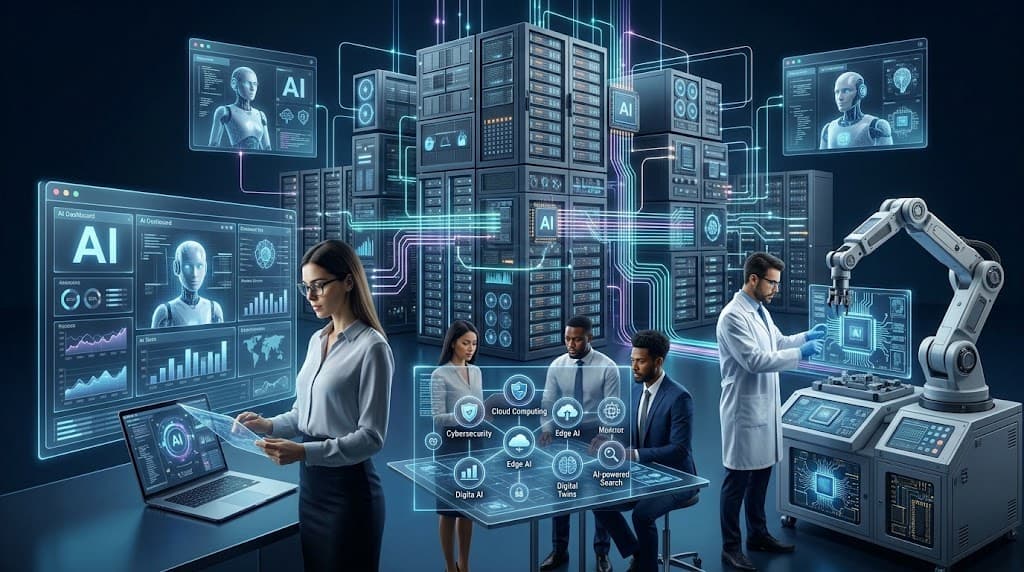
Technology is moving at an extraordinary pace, and businesses are entering a period where AI, automation, cybersecurity, robotics, and cloud infrastructure are becoming increasingly interconnected.
As companies prepare for 2027, understanding the technology trends gaining momentum can help business leaders identify opportunities, reduce risks, and prepare their organizations for a rapidly changing digital environment.
1. AI Agents and Autonomous Workflows
AI is moving beyond simple question-and-answer systems toward AI agents capable of completing multi-step tasks.
Businesses can use agentic AI to support research, customer service, software development, administration, sales, and other workflows.
Instead of asking AI to perform one task at a time, companies can increasingly give systems a broader objective and allow them to coordinate multiple steps.
2. Generative AI Becomes Part of Everyday Business
Generative AI is becoming integrated into ordinary business software.
Companies are using it for:
Content creation
Marketing
Document analysis
Customer support
Product development
Data analysis
Internal communications
Software development
The next stage will likely focus less on experimenting with AI and more on measuring its actual business value.
3. AI-Powered Cybersecurity
As businesses adopt more AI, cybersecurity threats are also becoming more sophisticated.
AI can help security teams identify unusual activity, analyze large amounts of data, detect threats, and respond more quickly.
At the same time, criminals can use AI to create more convincing phishing campaigns, automate attacks, and discover vulnerabilities.
This creates an ongoing AI-versus-AI cybersecurity race.
4. Robotics and Physical AI
AI is increasingly moving from screens into the physical world.
Advances in computer vision, machine learning, sensors, and robotics are enabling machines to perform increasingly complex tasks.
Potential applications include:
Warehousing
Manufacturing
Logistics
Healthcare
Agriculture
Retail
Delivery
Businesses are watching this area closely because robotics could eventually automate physical tasks that traditional software cannot.
5. AI Data Centers
Modern AI requires enormous computing resources.
This is driving demand for advanced data centers, specialized processors, networking equipment, cooling systems, and electricity.
The growth of AI therefore creates opportunities beyond software companies. Infrastructure providers could become an increasingly important part of the AI economy.
6. Edge AI
Not every AI task needs to happen in a centralized cloud.
Edge AI allows AI processing to occur closer to where data is generated, such as smartphones, vehicles, cameras, industrial equipment, and other connected devices.
This can reduce latency and potentially improve privacy and reliability for certain applications.
7. AI-Powered Search
Search is undergoing a major transformation.
Traditional search engines primarily return lists of websites, while AI-powered search experiences can provide conversational answers, summaries, comparisons, and follow-up interactions.
For businesses, this creates an important challenge: how will customers discover their websites and products when search behavior changes?
Companies may need to rethink SEO and digital visibility for an AI-driven search environment.
8. Cloud and Hybrid Computing
Cloud computing remains essential for modern businesses, but organizations increasingly need flexible approaches that combine cloud infrastructure with on-premises systems and edge computing.
This hybrid approach can help companies balance performance, cost, compliance, and data requirements.
AI workloads are likely to accelerate investment in computing infrastructure.
9. Digital Twins and Simulation
Digital twins create virtual representations of physical products, systems, or environments.
Businesses can use simulations to test scenarios before making expensive real-world changes.
Potential applications include:
Manufacturing
Buildings
Transportation
Energy
Infrastructure
Product development
As computing and AI improve, digital twins could become more powerful business-planning tools.
10. AI-Powered Personalization
Businesses are increasingly using AI to understand customer behavior and deliver more personalized experiences.
AI can help companies analyze customer data, recommend products, customize marketing, and predict potential needs.
The challenge is balancing personalization with privacy and responsible data usage.
Why These Trends Matter
These technologies aren't developing independently.
They are increasingly converging.
For example, an autonomous warehouse could combine:
AI agents + robotics + edge computing + cloud infrastructure + cybersecurity + real-time data
This convergence could produce much larger changes than any individual technology alone.
What Businesses Should Do Now
Companies don't necessarily need to adopt every emerging technology.
A better approach is to identify where technology can solve a real business problem.
Step 1: Identify Repetitive Tasks
Find processes that consume significant employee time and determine whether automation could improve them.
Step 2: Experiment With AI
Start with controlled projects rather than attempting an organization-wide transformation immediately.
Step 3: Strengthen Cybersecurity
As digital systems become more interconnected, cybersecurity should be treated as a core business requirement.
Step 4: Train Employees
Technology adoption works best when employees understand how to use new tools effectively.
Step 5: Measure Results
Track productivity, costs, revenue, customer satisfaction, and other measurable outcomes.
Final Thoughts
The technology landscape heading toward 2027 will likely be defined by AI, automation, intelligent infrastructure, robotics, and cybersecurity.
Businesses that experiment thoughtfully and build strong digital foundations may be better positioned to take advantage of these changes.
The goal shouldn't be to adopt technology simply because it is trending. Instead, companies should focus on technologies that create measurable value while managing security, privacy, cost, and operational risks.
Technology develops rapidly, so businesses should evaluate current capabilities, pricing, regulations, and security requirements before adopting emerging solutions.
FAQs
1. What is the biggest technology trend for businesses in 2026?
AI remains one of the most significant technology trends, particularly generative AI and AI agents.
2. What are AI agents?
AI agents are systems designed to perform tasks and coordinate multiple steps toward a broader objective with varying levels of human supervision.
3. Will AI replace businesses' employees?
AI may automate some tasks and change job responsibilities, but many roles will continue to require human judgment and expertise.
4. Why is cybersecurity becoming more important?
As businesses become more digitally connected, the potential impact of cyberattacks increases.
5. What is Edge AI?
Edge AI processes AI workloads closer to the device or location where data is generated instead of relying entirely on centralized cloud systems.
6. Why are data centers important for AI?
AI applications require significant computing power and storage, creating growing demand for specialized data-center infrastructure.
7. How is AI changing search?
AI search can provide conversational answers, summaries, and synthesized information rather than relying exclusively on traditional search-result pages.
8. What industries could benefit from robotics?
Manufacturing, logistics, healthcare, agriculture, retail, and warehousing are among the industries exploring robotics.
9. What is a digital twin?
A digital twin is a virtual representation of a physical object, system, or environment that can be used for monitoring and simulation.
10. Why is AI personalization important?
AI can analyze customer behavior and help businesses deliver more relevant products, recommendations, and experiences.
11. Should every business adopt AI?
No. Businesses should evaluate whether AI addresses a genuine need and produces measurable benefits.
12. How can small businesses use AI?
Small businesses can use AI for customer support, content creation, marketing, research, scheduling, data analysis, and administrative tasks.
13. What is hybrid cloud computing?
Hybrid cloud computing combines private or on-premises infrastructure with public cloud services.
14. How can companies prepare for AI adoption?
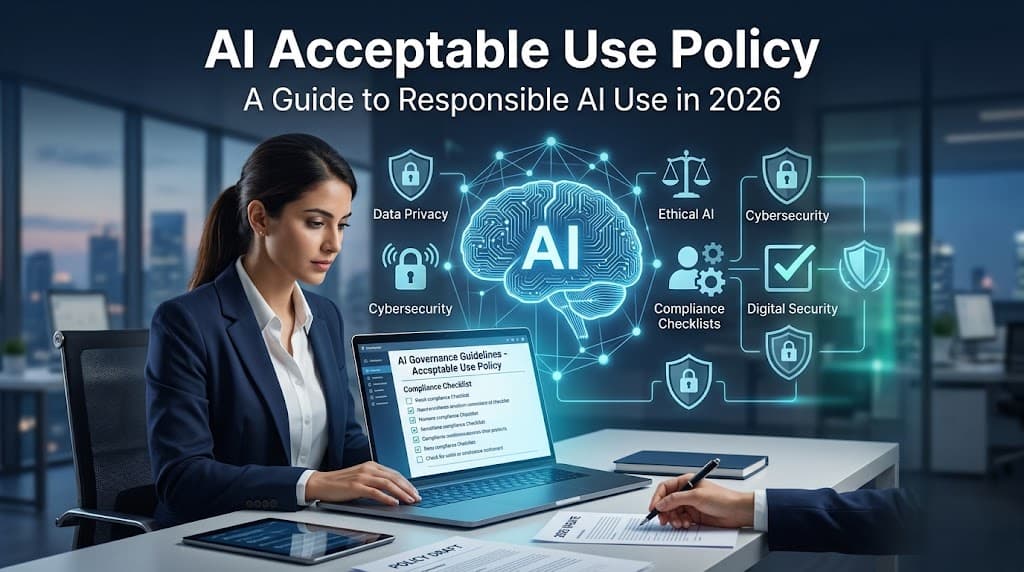
They can begin by identifying suitable use cases, improving data infrastructure, training employees, and establishing AI governance policies.
15. What is the biggest risk of adopting AI?
Potential risks include inaccurate outputs, privacy problems, cybersecurity threats, excessive costs, regulatory challenges, and poor implementation.
16. Will AI agents become more common?
AI agents are expected to become increasingly important as businesses look for ways to automate multi-step workflows.
17. How can AI improve productivity?
AI can automate repetitive work, summarize information, generate drafts, analyze data, and assist employees with decision-making.
18. Is AI cybersecurity reliable?
AI can strengthen cybersecurity, but it should complement broader security processes rather than replace human oversight.
19. What skills will businesses need in the future?
AI literacy, cybersecurity awareness, data analysis, critical thinking, creativity, communication, and adaptability are likely to remain valuable.
20. What technology should businesses invest in first?
The best starting point depends on the organization's specific challenges, budget, infrastructure, and strategic goals.