
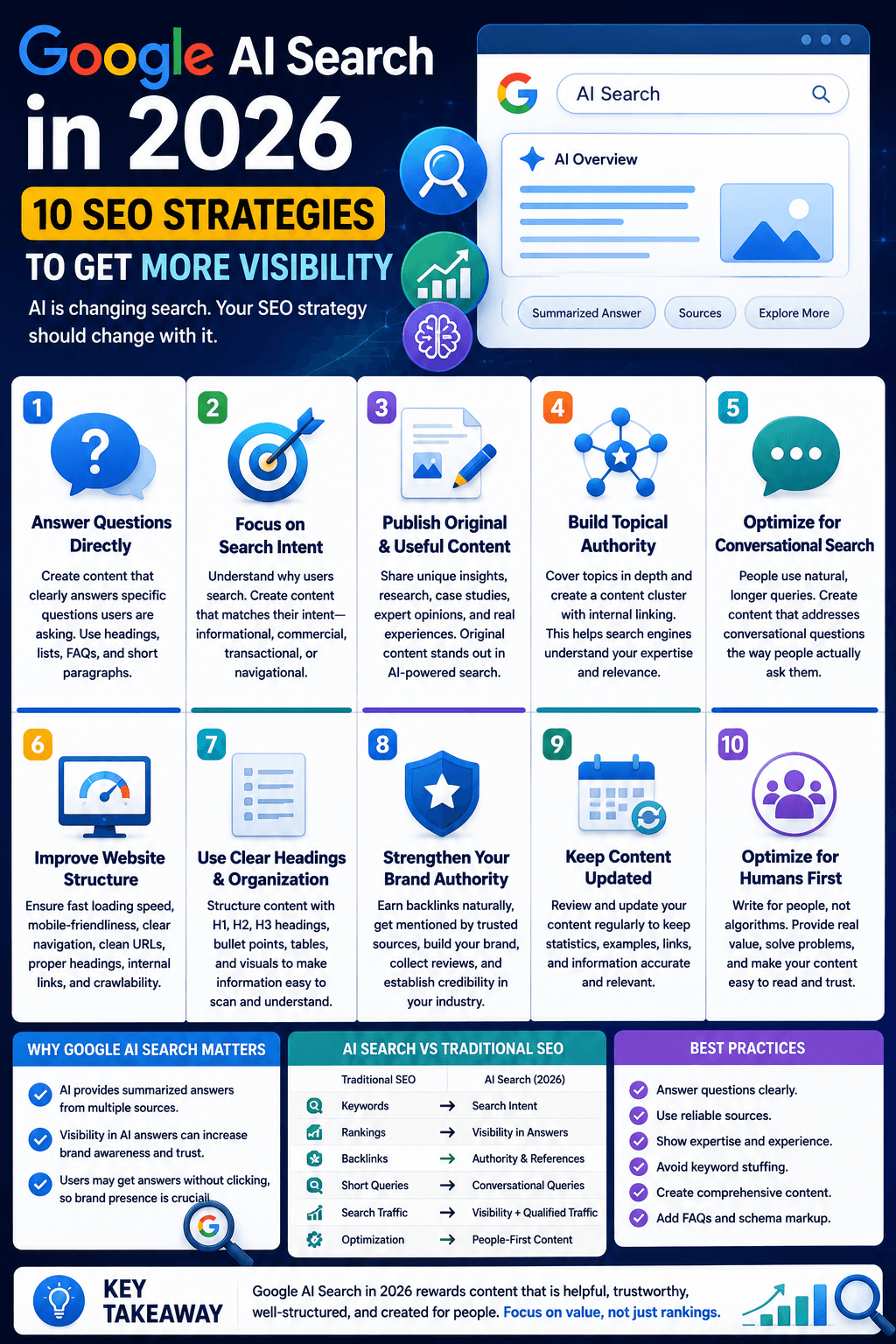

Search engine optimization is changing rapidly in 2026. Google Search is increasingly using artificial intelligence to understand questions, summarize information, and provide users with more direct answers.
For businesses and website owners, this creates a major opportunity—but also a new challenge. Ranking for traditional keywords is no longer the only goal. Websites need to create content that is useful, trustworthy, easy to understand, and valuable enough to be discovered through AI-powered search experiences.
1. Create Content That Directly Answers Questions
People are increasingly searching with complete questions instead of short keywords.
For example, instead of searching:
“AI marketing tools”
a user might search:
“What are the best AI marketing tools for a small business in 2026?”
Create content that answers these detailed questions directly.
Use clear headings, short paragraphs, examples, lists, and FAQs to make important information easy to understand.
2. Focus on Search Intent
Keywords are still useful, but understanding why someone is searching is even more important.
Search intent generally falls into categories such as:
Informational
Commercial
Transactional
Navigational
If someone searches for “best AI writing tools,” they may be researching options before making a purchase.
Your content should match that intent instead of simply repeating the keyword.
3. Publish Original and Useful Information
AI can generate generic content quickly. Because of this, original information can become an important competitive advantage.
Consider adding:
Original research
Expert opinions
Case studies
First-hand experiences
Data
Product testing
Unique examples
Industry insights
Content that offers something genuinely useful can stand out from thousands of similar articles.
4. Build Topical Authority
Instead of publishing random articles about unrelated keywords, create a collection of high-quality content around your main subject.
For example, a website focused on AI business could cover:
AI tools
AI automation
AI marketing
AI agents
AI cybersecurity
AI entrepreneurship
AI SEO
AI business trends
Then connect related articles with internal links.
This helps create a clear content structure and gives readers more useful resources.
5. Optimize for Conversational Search
AI-powered search encourages longer, more conversational queries.
Your content should naturally address questions people might ask.
For example:
“How can a small business use AI to reduce marketing costs?”
A strong article could answer that question with practical examples rather than simply targeting the phrase “AI marketing.”
Think about the questions your customers would ask a knowledgeable expert and create content around those questions.
6. Improve Website Structure
Technical SEO still matters.
Make sure your website:
Loads quickly
Works well on mobile devices
Uses clear navigation
Has logical URLs
Uses descriptive page titles
Has properly structured headings
Contains useful internal links
Is accessible to search engines
A technically strong website gives your content a better foundation.
7. Use Clear Headings and Content Organization
Well-structured content is easier for people to read and understand.
Instead of creating one long block of text, divide articles into logical sections.
For example:
What Is AI Search?
Why AI Search Matters
10 SEO Strategies
Common SEO Mistakes
FAQs
This structure makes it easier for readers to find the information they need.
8. Strengthen Your Brand Authority
SEO is increasingly connected with overall online reputation.
Businesses can build authority by consistently publishing useful content and developing a recognizable brand.
Other valuable signals can include legitimate mentions, industry relationships, customer reviews, expert contributions, and references from reputable websites.
Don't focus on obtaining links simply for SEO. Focus on becoming a business or publication that other people genuinely want to reference.
9. Keep Important Content Updated
Search behavior and AI technologies are changing quickly.
An article that was accurate last year may become outdated.
Review important pages regularly and update:
Statistics
Product information
Examples
Screenshots
Links
Industry developments
Dates
Recommendations
Adding a visible “Last Updated” date can also help readers understand whether information is current, provided the content is genuinely maintained.
10. Optimize for Humans First
One of the biggest SEO mistakes is writing exclusively for search engines.
Instead, write for real people.
Ask:
Does this article answer the user's question?
Is the information accurate?
Does it provide something unique?
Is it easy to read?
Does it solve a real problem?
Would I recommend this article to someone?
If the answer is yes, you're building content around genuine user value.
Why Google AI Search Matters for Businesses
Traditional search results often required users to open several websites to find an answer.
AI-powered search can provide more direct responses by combining information from multiple sources.
This means businesses need to think beyond simply getting clicks.
Visibility inside an AI-generated answer can potentially introduce a brand to users who might otherwise never discover it.
However, AI search also creates concerns for publishers because users may receive information without clicking through to the original website.
This makes brand recognition and conversion optimization increasingly important.
SEO vs. AI Search Optimization
Traditional SEO and AI search optimization should not be treated as completely separate strategies.
Many fundamentals overlap.
Traditional SEO | AI Search |
|---|---|
Keywords | Search intent |
Rankings | Visibility in answers |
Backlinks | Authority and references |
Website structure | Clear information |
Content quality | Helpful, original content |
Search traffic | Visibility + qualified traffic |
Short queries | Conversational questions |
A strong strategy combines both approaches.
How to Make Your Content More AI-Friendly
There is no guaranteed formula for appearing in an AI-generated answer.
However, businesses can improve the usefulness and clarity of their content by:
Answering Questions Clearly
Give direct answers before adding lengthy explanations.
Using Reliable Sources
Support important claims with trustworthy information.
Demonstrating Expertise
Add genuine experience, examples, research, or expert insights.
Avoiding Keyword Stuffing
Use keywords naturally rather than repeating them unnecessarily.
Creating Comprehensive Content
Cover the important aspects of a topic while avoiding unnecessary filler.
Adding FAQs
FAQs can address common questions related to your topic and improve the usefulness of the page.
Common AI SEO Mistakes to Avoid
Publishing Large Amounts of Generic AI Content
AI can help with content production, but publishing large quantities of low-value material can make your website less useful.
Copying Competitors
Simply rewriting what other websites already say does not create a strong reason for users to visit your page.
Ignoring Human Review
AI-generated information can contain errors. Important facts should be reviewed before publication.
Chasing Every New SEO Trend
SEO changes constantly. Focus on fundamentals such as useful content, technical quality, authority, and user satisfaction.
Forgetting Conversions
Traffic is useful only when it supports your business goals.
Track metrics such as:
Leads
Sales
Sign-ups
Engagement
Returning visitors
Revenue
The Future of SEO in 2026 and Beyond
Search is becoming more conversational and AI-driven, but websites are not disappearing.
People still need detailed information, original research, products, services, tools, and expert perspectives.
The role of SEO is evolving from simply ranking pages to building visibility, authority, and trust across multiple discovery experiences.
Businesses that adapt early can position themselves for a changing search environment.
Conclusion
Google AI search is changing how people discover information online in 2026.
Businesses should continue investing in traditional SEO while adapting their content strategy for conversational queries, AI-powered answers, and changing user behavior.
The most effective approach is straightforward:
Create useful content. Answer real questions. Demonstrate expertise. Build authority. Keep information updated. Optimize for people first.
SEO may continue to evolve, but providing genuine value to users remains one of the strongest long-term strategies.
FAQs
1. What is Google AI Search?
Google AI Search refers to AI-powered features within Google's search experience that can understand complex queries and provide more direct, conversational information.
2. Is traditional SEO still important in 2026?
Yes. Technical SEO, useful content, site structure, relevance, and authority remain important even as AI changes how search results are presented.
3. How can I optimize my website for Google AI Search?
Create accurate, original, well-structured content that directly answers user questions and demonstrates genuine expertise.
4. Does AI search replace Google rankings?
Not necessarily. AI-powered features can change how information is presented, but traditional search results and website visibility remain important.
5. Are keywords still important?
Yes, but businesses should focus on keyword relevance and search intent rather than repeating keywords excessively.
6. What type of content is best for AI search?
Useful guides, original research, expert analysis, comparisons, FAQs, case studies, and detailed answers to real questions can provide strong value.
7. Can AI-generated content rank on Google?
AI-assisted content can potentially appear in search results, but quality, originality, accuracy, usefulness, and compliance with search-engine guidelines matter more than simply how content was produced.
8. What is GEO in SEO?
GEO, or Generative Engine Optimization, is a term used for strategies intended to improve visibility in generative AI and answer-engine experiences.
9. Will AI search reduce website traffic?
It can reduce clicks for some informational searches because users may receive answers directly. However, websites offering unique information, products, services, and deeper resources can still attract valuable traffic.
10. What is the most important SEO strategy in 2026?
Focus on creating genuinely useful content that satisfies user intent, demonstrates expertise, and provides information people cannot easily get from generic sources.