Introduction: What Is Saivom Crypto?
Saivom is a cryptocurrency project promoting a multi-asset decentralized finance (DeFi) ecosystem. Its vision, described in promotional articles, involves bringing cryptocurrencies together with tokenized equities, commodities, foreign exchange, and exchange-traded funds (ETFs).
The concept targets investors interested in accessing different asset classes through blockchain-based financial infrastructure. However, ambitious plans and promotional announcements do not automatically establish that a platform is secure, operational, or a suitable investment.
Saivom deserves closer examination of its published claims, technical documentation, token economics, and independent verification. Investors should understand what the project has demonstrably delivered, what remains under development, and which claims originate from paid promotional material.
This investigation examines the available public information without treating unverified allegations as established facts.
1. Understanding Saivom's Multi-Asset DeFi Claims
Saivom's promotional coverage describes an ecosystem intended to support multiple types of financial assets rather than limiting users to cryptocurrency trading.
In principle, this approach could offer a broader range of blockchain-based financial services. However, investors need to distinguish between a proposed product and a fully operational platform.
Several questions remain essential:
Which features are available to ordinary users today?
Can users independently test the platform's advertised functionality?
Are tokenized assets backed by identifiable underlying assets?
Which legal entities issue or custody those assets?
Can users withdraw, transfer, or redeem their holdings under clearly documented conditions?
These questions matter because a token representing a traditional financial asset is not necessarily equivalent to owning that asset directly.
A credible project should provide technical documentation, transparent legal arrangements, and independently verifiable evidence of the services it claims to offer.
2. Why Promotional Coverage Should Be Examined Carefully
Recent articles discussing Saivom's development and ecosystem ambitions have appeared on third-party publishing websites. At least some of this coverage is explicitly identified as paid press-release content.
Paid distribution is a legitimate marketing method and does not prove that a cryptocurrency project is fraudulent. However, a paid announcement should not be treated as independent confirmation of its claims.
Investors should seek additional evidence from unrelated technical reviewers, verifiable blockchain records, identifiable business partners, and reputable sources that independently assess the project.
Key distinction: An article reporting what a project claims is not the same as an independent investigation proving those claims are accurate.
3. Can Investors Independently Verify the $SAI Token?
Before purchasing a cryptocurrency, investors should be able to identify the correct token and verify its activity on the relevant blockchain.
For Saivom, prospective investors should locate and verify:
The official $SAI contract address and blockchain network.
The total token supply and circulating supply.
The distribution of tokens among founders, early investors, and public buyers.
Any vesting periods, lockups, or restrictions on transfers.
The smart-contract permissions held by the project team.
The availability and depth of trading liquidity.
These details help determine whether the token's structure matches the project's public statements.
For example, a large allocation controlled by a small number of wallets could create concentration risk. Likewise, a token may be technically transferable but difficult to sell if trading liquidity is insufficient.
Investors should verify these details directly rather than relying exclusively on screenshots, promotional graphics, or statements published by the project.
This investigation has not independently established every aspect of Saivom's contract, ownership structure, or liquidity. Those details should therefore be treated as items requiring verification, not as confirmed misconduct.
4. Is Saivom's Technology Operational?
A project's roadmap can describe ambitious future functionality, but investors should assess its present capabilities separately.
For a multi-asset DeFi platform, meaningful evidence could include a publicly accessible application, documented smart contracts, verifiable transactions, clear user documentation, and independent security assessments.
If the platform supports tokenized stocks, commodities, or ETFs, investors should also investigate the legal and technical mechanisms through which those assets are represented.
A tokenized asset may provide economic exposure through a particular arrangement without granting direct ownership of the underlying security or commodity. The rights depend on the product's legal structure and terms.
Investors should therefore ask for documentation explaining how assets are issued, priced, held, transferred, and redeemed.
A roadmap or demonstration video cannot substitute for independently verifiable product functionality.
5. What Are the Main Investment Risks?
Even if a cryptocurrency project is legitimate, its token can still be a high-risk investment.
Market and liquidity risk
New tokens can experience extreme price fluctuations. A quoted price does not guarantee that investors can sell their holdings at that price, especially when liquidity is limited.
Smart-contract risk
Errors in token or platform contracts can expose funds to theft, frozen transactions, or unexpected losses. An audit may reduce certain risks but cannot eliminate them.
Tokenomics risk
Large insider allocations, future token unlocks, additional issuance, or concentrated ownership may create selling pressure.
Regulatory risk
Products involving tokenized equities, commodities, or other financial instruments may raise legal and regulatory questions across different jurisdictions.
Information risk
Investors may make decisions based on promotional claims that have not been independently confirmed.
These risks should be assessed using project-specific evidence rather than assumptions based on branding or marketing language.
6. Warning Signs Investors Should Watch For
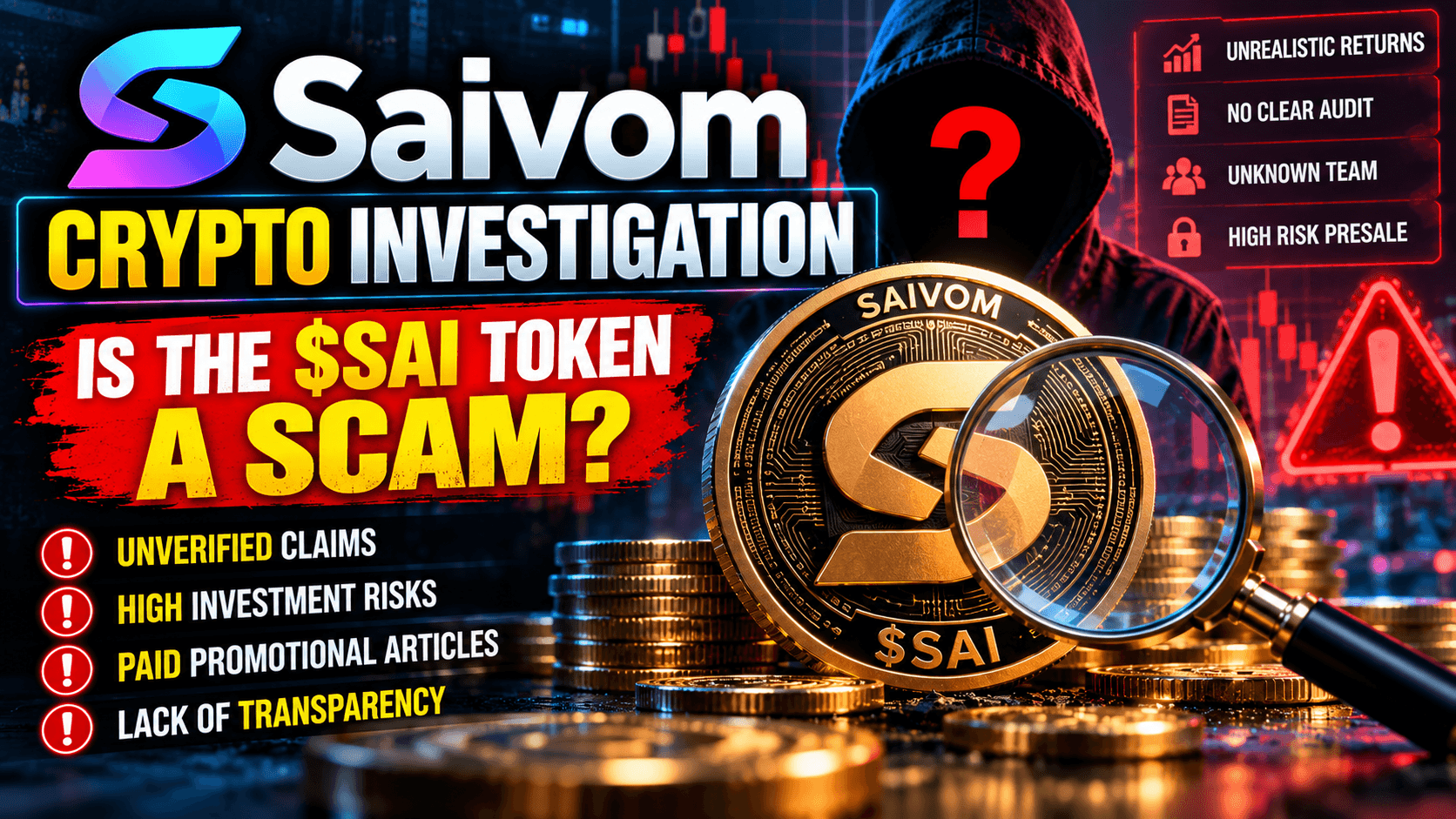
Saivom's promotional coverage alone does not establish that it is a scam. Nevertheless, investors should be alert to common cryptocurrency investment warning signs.
The U.S. Securities and Exchange Commission warns that fraudsters may use emerging technologies such as artificial intelligence, impressive marketing, fabricated testimonials, and promises of exceptional returns to attract investors.
Source: Investor.gov — Crypto Investment Scam Warning.
Before investing in Saivom or any similar project, be cautious if you encounter:
Guaranteed returns or claims of risk-free profits.
Pressure to purchase tokens before a countdown expires.
Unverifiable claims about partnerships, audits, or exchange listings.
Requests to send funds to personal wallets without clear documentation.
Unexplained restrictions on withdrawals or token transfers.
Demands for additional payments to release funds supposedly already earned.
These are general warning signs, not findings that each practice has occurred in Saivom's case.
If a platform refuses to provide basic technical or financial documentation, investors should consider avoiding the investment until the information can be independently verified.
7. A Practical Due-Diligence Checklist for Saivom
Before purchasing $SAI, investors should complete the following checks.
Contract verification: Find the official contract address and inspect it through the relevant blockchain explorer.
Security review: Obtain any published audit report and confirm that it covers the exact deployed contracts.
Liquidity assessment: Verify whether the token trades on recognized markets and whether the available liquidity is sufficient for realistic selling.
Team verification: Confirm the identities, experience, and professional histories of the people responsible for the project.
Product testing: Determine which features are operational and which remain planned.
Token distribution: Examine insider allocations, vesting schedules, token unlocks, and any administrative powers.
Independent confirmation: Seek evidence from sources that are not paid by the project to promote its investment opportunity.
Withdrawal testing: If already participating, verify the platform's documented withdrawal process without committing additional funds just to test an unverified promise.
Never disclose your wallet's recovery phrase or private keys. Be particularly cautious if anyone claims that you must pay an additional tax, security deposit, or release fee before you can withdraw cryptocurrency.
Conclusion: Is Saivom a Scam?
Saivom promotes a multi-asset DeFi concept that aims to connect blockchain-based finance with a broader range of asset classes. However, its stated ambitions and promotional coverage should not be confused with independent proof of technical performance, financial backing, or investment safety.
The available sources reviewed for this article include promotional material and paid press-release coverage. They do not, by themselves, establish that Saivom is a fraudulent project. Equally, they are insufficient to prove that every advertised feature or investment claim is accurate.
A responsible assessment requires further verification of the $SAI contract, token distribution, liquidity, security audits, team credentials, and the operational status of the platform.
Until those details are independently confirmed, prospective investors should treat the token as speculative and avoid relying on promotional claims when making financial decisions.
The central question is not whether Saivom's marketing sounds convincing. It is whether its technology, token structure, and financial claims can withstand independent verification.
Editorial disclosure: This article is an informational investigation based on publicly accessible sources. It is not a legal finding of fraud or personalized financial advice. New independently verifiable evidence may change the assessment.