
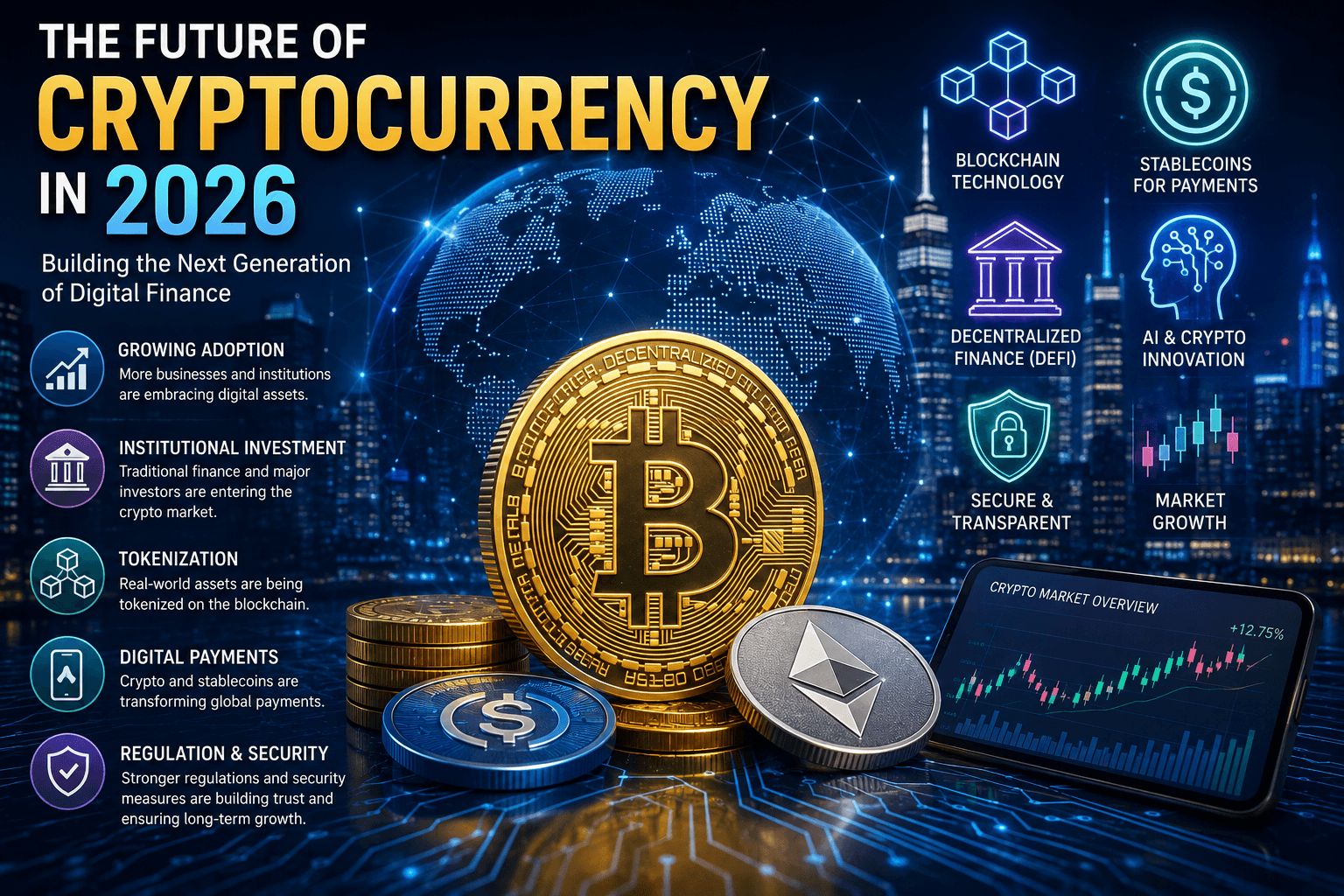

Cryptocurrency has evolved from a niche digital experiment into an increasingly important part of the global financial ecosystem. What began with Bitcoin has expanded into a broader digital-asset economy involving stablecoins, decentralized finance, tokenized assets, blockchain applications, and institutional investment.
In 2026, the cryptocurrency industry is entering a more mature phase. Businesses, financial institutions, governments, and investors are increasingly focused on practical applications, regulatory compliance, security, and long-term value rather than speculation alone.
What Is Cryptocurrency?
Cryptocurrency is a form of digital asset that uses blockchain technology to record and verify transactions.
Unlike traditional currencies issued by central banks, many cryptocurrencies operate on decentralized networks. Bitcoin and other blockchain-based assets can be transferred digitally without requiring a traditional financial intermediary for every transaction.
Blockchain technology provides a distributed record of transactions, helping participants verify ownership and activity.
Bitcoin Continues to Shape the Crypto Market
Bitcoin remains one of the most recognized digital assets and continues to influence the wider cryptocurrency market.
Its limited supply and decentralized design have contributed to its reputation as a potential alternative digital store of value.
Businesses and institutional investors are increasingly evaluating Bitcoin as part of broader digital-asset strategies. However, Bitcoin remains a volatile asset, and investors need to carefully consider market risk.
Stablecoins Are Expanding Digital Payments
Stablecoins are cryptocurrencies designed to maintain a relatively stable value, often by being linked to an underlying asset such as a fiat currency.
Their potential usefulness extends beyond cryptocurrency trading.
Stablecoins can support faster digital transfers, cross-border payments, and settlement between businesses and financial institutions.
For companies operating internationally, blockchain-based payment systems could potentially reduce some of the friction associated with traditional cross-border transactions.
Tokenization Is Creating New Opportunities
One of the most significant developments in digital assets is tokenization.
Tokenization involves representing ownership or rights to an asset digitally on a blockchain.
Potentially tokenized assets include:
Real estate
Bonds
Investment funds
Commodities
Collectibles
Private-market assets
Tokenization could make certain financial assets easier to transfer, track, and manage digitally.
It may also enable fractional ownership, although the legal and regulatory framework surrounding tokenized assets remains important.
The Growth of Decentralized Finance
Decentralized finance, commonly known as DeFi, uses blockchain-based applications to provide financial services through smart contracts and decentralized networks.
DeFi applications can support activities such as lending, borrowing, trading, and asset management.
The technology has the potential to expand access to financial services, but users also face risks involving smart-contract vulnerabilities, market volatility, liquidity, and regulatory uncertainty.
Cryptocurrency and Artificial Intelligence
AI and cryptocurrency are increasingly intersecting.
Artificial intelligence can be used to analyze blockchain data, detect suspicious transactions, improve cybersecurity, and support market research.
AI-powered systems can identify unusual patterns in transaction activity and potentially help businesses detect fraud or security threats.
At the same time, blockchain technology can provide verifiable records that may support certain AI applications requiring data integrity and digital ownership.
Crypto Is Becoming More Relevant to Businesses
Businesses are exploring cryptocurrency for more than investment.
Potential applications include digital payments, international settlements, loyalty programs, tokenized assets, and blockchain-based supply-chain systems.
For some companies, accepting digital assets can provide additional payment options for customers.
However, businesses need to consider accounting, taxation, compliance, custody, cybersecurity, and regulatory requirements before adopting cryptocurrency.
The Importance of Regulation
Regulation is becoming one of the most important factors shaping the future of cryptocurrency.
As digital assets become more connected to mainstream financial systems, governments and regulators are developing frameworks covering areas such as consumer protection, anti-money-laundering requirements, taxation, stablecoins, and digital-asset businesses.
Clearer rules could provide greater confidence for legitimate businesses and investors while helping reduce certain forms of financial abuse.
Companies entering the cryptocurrency market should therefore treat compliance as a core part of their strategy.
Crypto Security Remains a Major Challenge
Security continues to be one of the biggest concerns in the cryptocurrency ecosystem.
Digital assets can be targeted through phishing attacks, wallet theft, compromised exchanges, smart-contract vulnerabilities, and other cyber threats.
Businesses and individuals should use strong security practices, including secure custody solutions, multi-factor authentication, hardware wallets where appropriate, and careful verification of transactions.
Technology can reduce certain risks, but users still need to understand how digital-asset security works.
Cryptocurrency and Cross-Border Finance
Traditional international payments can involve multiple financial institutions, currencies, and settlement processes.
Blockchain-based payment systems have the potential to simplify certain cross-border transactions.
Stablecoins and other digital assets can enable transfers that operate on blockchain networks rather than traditional payment rails.
This could be particularly relevant for businesses operating across multiple markets, although regulatory and banking considerations remain important.
The Role of Central Bank Digital Currencies
Cryptocurrencies are not the only form of digital money being developed.
Central banks in different parts of the world have explored Central Bank Digital Currencies (CBDCs).
Unlike decentralized cryptocurrencies, CBDCs are issued and controlled by central banks.
CBDCs could potentially modernize payment infrastructure while providing governments with new tools for managing digital payments.
The development of CBDCs may influence how consumers and businesses interact with both traditional money and privately issued digital assets.
What Investors Should Consider
Cryptocurrency can offer opportunities, but it also involves substantial risks.
Prices can change rapidly, and individual digital assets can experience significant volatility.
Before investing, individuals should consider:
Market volatility
Regulatory changes
Security risks
Liquidity
Project fundamentals
Custody arrangements
Potential losses
Investors should avoid treating cryptocurrency as a guaranteed source of returns.
The Future of Crypto in 2026 and Beyond
The cryptocurrency industry is gradually moving toward practical applications.
The next stage of growth may depend less on hype and more on whether blockchain technology can solve real problems in payments, asset management, financial infrastructure, identity, and digital ownership.
Stablecoins, tokenization, institutional adoption, blockchain-based payments, and regulatory clarity could all play important roles in this transition.
The strongest crypto projects will likely be those that combine useful technology with security, transparency, compliance, and sustainable business models.
Conclusion
Cryptocurrency is becoming an increasingly significant component of the evolving digital financial system.
Bitcoin continues to influence the market, while stablecoins, tokenized assets, DeFi, and blockchain-based payment solutions are expanding the range of possible applications.
However, the future of crypto will not depend on technology alone. Regulation, cybersecurity, consumer protection, scalability, and real-world utility will be equally important.
In 2026 and beyond, cryptocurrency is likely to become less about simply creating new digital coins and more about building a broader digital financial infrastructure for businesses, investors, and consumers.
FAQs: The Future of Cryptocurrency in 2026
1. What is cryptocurrency?
Cryptocurrency is a digital asset that uses blockchain technology to record and verify transactions. Many cryptocurrencies operate on decentralized networks without relying entirely on traditional financial institutions.
2. Is cryptocurrency still relevant in 2026?
Yes. Cryptocurrency continues to evolve beyond speculation, with growing interest in digital payments, stablecoins, tokenization, decentralized finance, and institutional digital-asset strategies.
3. What is Bitcoin used for?
Bitcoin can be used for digital transactions and is also viewed by some investors as a potential store of value. Its limited supply and decentralized structure are major features of the asset.
4. What are stablecoins?
Stablecoins are digital assets designed to maintain a relatively stable value, often by being linked to a fiat currency or another underlying asset. They can be useful for payments, transfers, and digital-asset settlement.
5. How can businesses use cryptocurrency?
Businesses may use cryptocurrency for digital payments, international transactions, tokenized assets, loyalty programs, and certain blockchain-based financial applications.
6. What is cryptocurrency tokenization?
Tokenization involves representing ownership or rights to an asset digitally on a blockchain. Real estate, bonds, investment funds, and other assets can potentially be represented through digital tokens.
7. What is DeFi?
DeFi, or decentralized finance, refers to blockchain-based applications that provide financial services such as lending, borrowing, trading, and asset management through smart contracts and decentralized networks.
8. Is cryptocurrency safe?
Cryptocurrency involves significant risks, including price volatility, scams, cyberattacks, wallet theft, and smart-contract vulnerabilities. Strong security practices and careful research are essential.
9. How does AI affect cryptocurrency?
AI can help analyze blockchain data, detect unusual transactions, identify potential fraud, improve cybersecurity, and support market analysis. AI and blockchain may also increasingly work together in digital financial applications.
10. What is the future of cryptocurrency?
The future of cryptocurrency is likely to focus increasingly on practical applications such as digital payments, stablecoins, tokenization, financial infrastructure, and institutional adoption. Regulation, security, and real-world utility will strongly influence its long-term development.