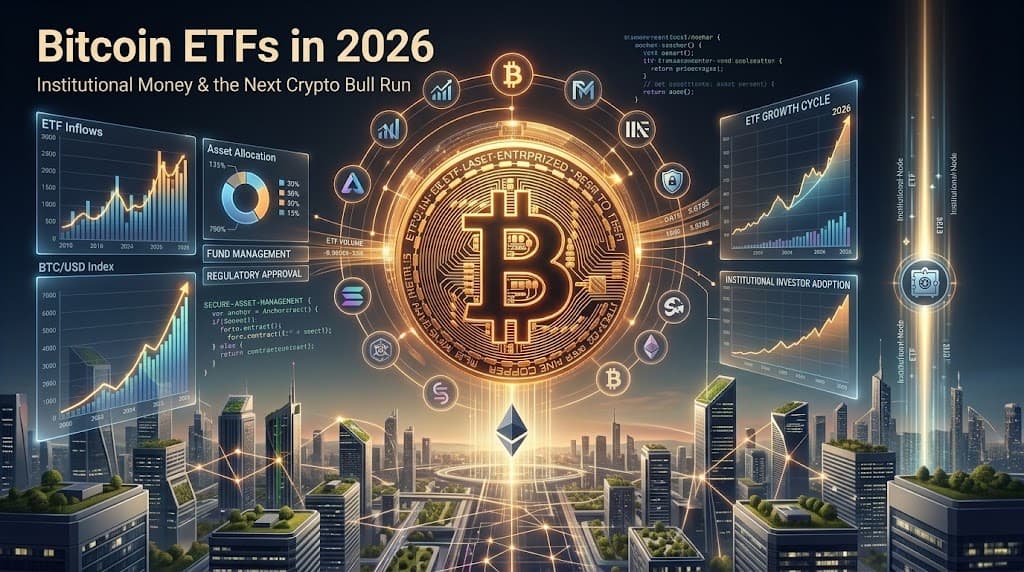
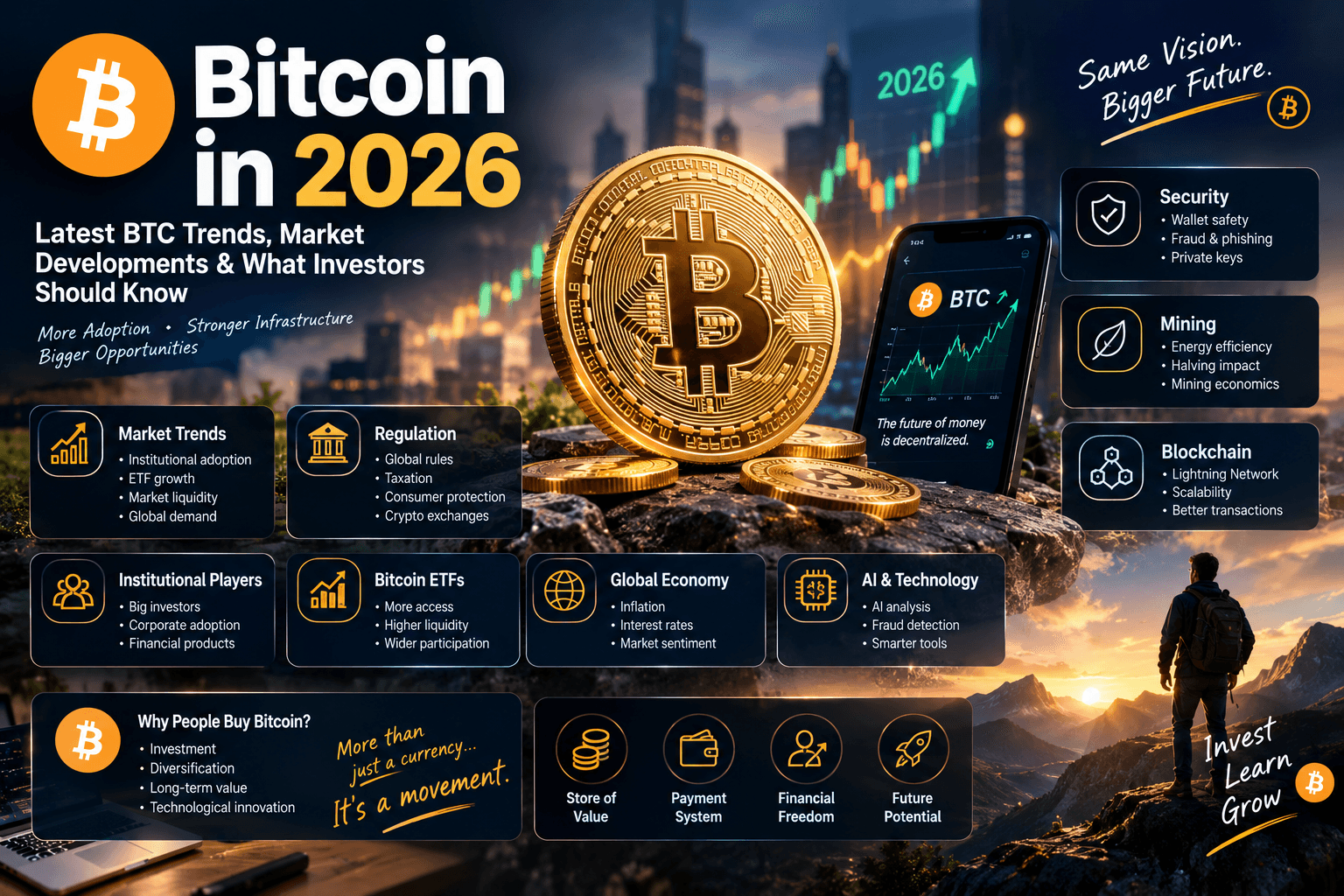
B&Bitcoin & Crypto Market Update 2026: Key Trends, Risks & What Investors Should Watch
Note: Bitcoin prices and market conditions change continuously. I can’t verify live September 2026 market data in this chat, so this article focuses on major Bitcoin trends and factors to watch rather than claiming a current BTC price or market ranking.
Bitcoin remains one of the most closely followed digital assets in the world. In 2026, attention around BTC continues to focus on institutional adoption, regulation, market liquidity, ETF activity, blockchain development, and the broader relationship between cryptocurrency and the global economy.
For anyone researching Bitcoin, understanding these underlying factors can be more useful than focusing only on short-term price movements.
What Is Bitcoin?
Bitcoin is a decentralized digital asset that operates on a blockchain network. Unlike traditional currencies, Bitcoin is not issued by a central bank.
Transactions are recorded on a distributed ledger, while the network uses cryptographic mechanisms and a consensus system to validate transactions.
One of Bitcoin's defining characteristics is its limited supply. The protocol is designed around a maximum supply of 21 million BTC.
Bitcoin in 2026
Bitcoin's role in the financial and technology landscape continues to evolve.
Several themes are particularly important:
Institutional participation
Regulatory developments
Bitcoin investment products
Market liquidity
Mining economics
Network security
Global economic conditions
Adoption by businesses and individuals
These factors can influence Bitcoin's demand, market behavior, and long-term development.
Institutional Bitcoin Adoption
Institutional involvement has become an important part of Bitcoin's market structure.
Financial institutions, investment companies, and other professional market participants can gain Bitcoin exposure through different investment products and services.
Institutional participation can increase market liquidity and broaden access, although it does not eliminate Bitcoin's characteristic price volatility.
Bitcoin ETFs and Investment Products
Bitcoin exchange-traded products have made cryptocurrency exposure more accessible to some traditional investors.
Instead of directly managing Bitcoin through a cryptocurrency wallet, eligible investors can gain exposure through regulated financial products available in their market.
The impact of these products depends on factors such as:
Investor demand
Fund inflows and outflows
Market conditions
Regulatory developments
Institutional sentiment
Bitcoin's Limited Supply
Bitcoin's 21-million maximum supply is one of its most discussed characteristics.
New bitcoins are introduced through the mining process, but the rate of new issuance decreases over time through programmed supply reductions known as halvings.
The combination of limited maximum supply and changing demand is central to many discussions about Bitcoin's long-term economics.
Bitcoin Mining in 2026
Bitcoin mining involves specialized computers competing to process transactions and secure the network.
Mining economics depend on several variables, including:
Bitcoin market price
Electricity costs
Mining hardware efficiency
Network difficulty
Transaction fees
Competition among miners
When operating costs rise, less-efficient mining operations can face greater financial pressure.
Bitcoin and Regulation
Regulation remains an important issue for the cryptocurrency industry.
Governments and financial regulators around the world continue to develop rules concerning:
Cryptocurrency exchanges
Taxation
Consumer protection
Stablecoins
Digital asset custody
Anti-money-laundering requirements
Investment products
Regulatory approaches differ significantly between countries, making local rules especially important for users and businesses.
Bitcoin and Global Economic Conditions
Bitcoin does not operate independently from the broader financial system.
Factors such as interest rates, inflation expectations, liquidity, currency movements, economic growth, and investor risk appetite can influence cryptocurrency markets.
However, the relationship between these variables and Bitcoin can change over time, so investors should avoid assuming that one economic indicator will always produce the same Bitcoin response.
Bitcoin as a Store of Value
Some Bitcoin supporters view BTC as a potential long-term store of value because of its limited supply and decentralized structure.
Others emphasize its volatility and argue that its price behavior makes it substantially different from traditional defensive assets.
Whether Bitcoin fits a particular investor's financial strategy depends on factors such as risk tolerance, time horizon, financial goals, and local regulations.
Bitcoin and the Lightning Network
The Lightning Network is a layer-2 technology designed to enable faster and potentially lower-cost Bitcoin transactions.
Rather than recording every transaction directly on Bitcoin's base layer, Lightning can process transactions through payment channels and later settle relevant information on the blockchain.
The technology is part of ongoing efforts to improve Bitcoin's usefulness for smaller and more frequent payments.
Bitcoin and Institutional Custody
Secure custody is another important development in the cryptocurrency industry.
Institutional participants require systems for:
Asset security
Key management
Compliance
Transaction authorization
Risk management
Auditing
As professional participation grows, custody infrastructure becomes increasingly important to the broader digital-asset ecosystem.
Bitcoin Security
Bitcoin's blockchain has strong cryptographic foundations, but users can still face risks.
Common threats include:
Phishing
Fake investment platforms
Exchange account compromises
Wallet theft
Malware
Social engineering
Fraudulent cryptocurrency schemes
Bitcoin transactions generally cannot simply be reversed after confirmation, making wallet and account security extremely important.
Bitcoin and Artificial Intelligence
AI and cryptocurrency are increasingly intersecting in several areas.
AI can be used for:
Market analysis
Fraud detection
Blockchain analytics
Customer support
Security monitoring
Trading research
However, AI-generated trading predictions are not guaranteed to be accurate. Automated systems can also amplify losses when markets move unexpectedly.
Bitcoin's Environmental Debate
Bitcoin mining requires electricity, which has led to continuing debate about its environmental impact.
The overall environmental footprint depends on factors such as:
Electricity sources
Mining hardware
Geographic location
Energy efficiency
Changes in the electricity mix
Some mining operations use renewable or otherwise underutilized energy sources, while others rely on fossil-fuel-based electricity.
What Could Influence Bitcoin Markets?
Several factors can affect Bitcoin's market behavior:
1. Investor Demand
Changes in buying and selling activity can affect market prices.
2. Regulation
New regulations can influence exchanges, investment products, and adoption.
3. Institutional Activity
Large financial participants can affect liquidity and market structure.
4. Macroeconomic Conditions
Interest rates, liquidity, inflation expectations, and economic conditions can influence risk assets.
5. Bitcoin Supply
Bitcoin's programmed issuance schedule affects the rate at which new BTC enters circulation.
6. Market Sentiment
Investor expectations can contribute to substantial short-term volatility.
Bitcoin Risks Investors Should Understand
Bitcoin can experience significant price movements.
Important risks include:
High volatility
Regulatory uncertainty
Cybersecurity threats
Exchange failures
Loss of private keys
Market manipulation
Liquidity risks
Tax complications
Investors should research these risks before buying or holding cryptocurrency.
Bitcoin in the Future
Bitcoin's future will depend on a combination of technology, regulation, adoption, financial infrastructure, and market demand.
Its development is no longer limited to cryptocurrency enthusiasts. Traditional financial institutions, technology companies, regulators, businesses, and governments are all increasingly involved in discussions about digital assets.
At the same time, Bitcoin remains a highly volatile asset, and future performance cannot be reliably determined from past price movements alone.
Conclusion
Bitcoin in 2026 remains an important part of the digital-asset landscape. Institutional participation, investment products, regulation, mining, scalability, and blockchain infrastructure are among the key areas shaping its development.
For people researching BTC, looking beyond daily price movements can provide a more complete understanding of the cryptocurrency market.
FAQs
1. What is Bitcoin?
Bitcoin is a decentralized digital asset that operates on a blockchain network without being controlled by a central bank.
2. How many Bitcoins can exist?
Bitcoin's protocol is designed around a maximum supply of 21 million BTC.
3. What affects Bitcoin's price?
Supply and demand, market liquidity, investor sentiment, macroeconomic conditions, regulation, institutional activity, and other factors can influence Bitcoin's price.
4. Is Bitcoin still relevant in 2026?
Bitcoin remains a major digital asset and continues to receive attention from individual and institutional market participants.
5. What is Bitcoin mining?
Mining is the process through which specialized computers help secure the Bitcoin network and process transactions.
6. What is a Bitcoin halving?
A halving reduces the amount of new Bitcoin issued as mining rewards according to Bitcoin's programmed monetary schedule.
7. Is Bitcoin a cryptocurrency?
Yes. Bitcoin is the first and most widely recognized cryptocurrency.
8. What is a Bitcoin ETF?
A Bitcoin exchange-traded product can provide eligible investors with exposure to Bitcoin through a traditional financial-market structure.
9. Is Bitcoin safe?
The Bitcoin network uses cryptographic security, but users can still face risks from scams, phishing, stolen credentials, compromised exchanges, and lost private keys.
10. Can Bitcoin transactions be reversed?
Confirmed Bitcoin transactions generally cannot simply be reversed like a conventional card payment.
11. What is the Lightning Network?
The Lightning Network is a layer-2 system designed to facilitate faster and potentially cheaper Bitcoin transactions.
12. Is Bitcoin legal?
Its legal and regulatory status varies by country. Users should check the rules that apply in their jurisdiction.
13. Can Bitcoin be used for payments?
Yes. Bitcoin can be used for payments where merchants and payment services accept it.
14. Why is Bitcoin's supply limited?
Bitcoin's protocol was designed with a maximum supply of 21 million coins.
15. Does Bitcoin have a central bank?
No. Bitcoin operates through a decentralized network rather than a central bank.
16. Can Bitcoin lose value?
Yes. Bitcoin can experience substantial price declines as well as increases.
17. What is Bitcoin's blockchain?
The blockchain is the distributed ledger that records Bitcoin transactions.
18. Can governments regulate Bitcoin?
Governments can regulate cryptocurrency exchanges, businesses, taxation, investment products, and other activities according to their laws.
19. Is Bitcoin environmentally friendly?
Bitcoin mining uses electricity, and its environmental impact depends partly on the energy sources and infrastructure used by miners.
20. Can AI predict Bitcoin prices?
AI can analyze market data and generate forecasts, but no AI system can reliably guarantee future Bitcoin prices.
21. What is Bitcoin custody?
Custody refers to the systems and methods used to securely hold and manage Bitcoin and its private keys.
22. What are Bitcoin private keys?
Private keys are cryptographic credentials that allow users to authorize transactions involving their Bitcoin.
23. Can Bitcoin be hacked?
The Bitcoin protocol uses cryptography, but individual wallets, exchanges, accounts, and devices can be compromised.
24. Why do people buy Bitcoin?
Reasons can include speculation, long-term investment, diversification, technological interest, and interest in decentralized digital assets.
25. Is Bitcoin the same as Ethereum?
No. Bitcoin and Ethereum are separate blockchain networks with different designs and primary use cases.
26. What is Bitcoin's maximum supply?
The maximum supply specified by Bitcoin's protocol is 21 million BTC.
27. Does Bitcoin have physical coins?
No. Bitcoin exists digitally on its blockchain network.
28. What is Bitcoin volatility?
Volatility refers to the size and speed of price changes. Bitcoin can experience significant price movements over relatively short periods.
29. What should investors research before buying Bitcoin?
They should consider volatility, fees, custody, security, taxes, regulations, investment goals, and the possibility of losing money.
30. What is the future of Bitcoin?
Bitcoin's future will depend on adoption, regulation, technology, market demand, financial infrastructure, and broader economic conditions.