Business insolvency can happen when a company struggles to pay its debts or cannot meet its financial obligations. While insolvency can result from a sudden financial shock, it often develops gradually through a combination of cash-flow problems, excessive debt, declining sales, and rising costs.
Understanding the causes and warning signs of business insolvency can help business owners identify financial problems earlier and explore appropriate solutions.
Important: Insolvency laws and procedures differ by country. Businesses facing actual financial distress should obtain advice from qualified professionals in their jurisdiction.
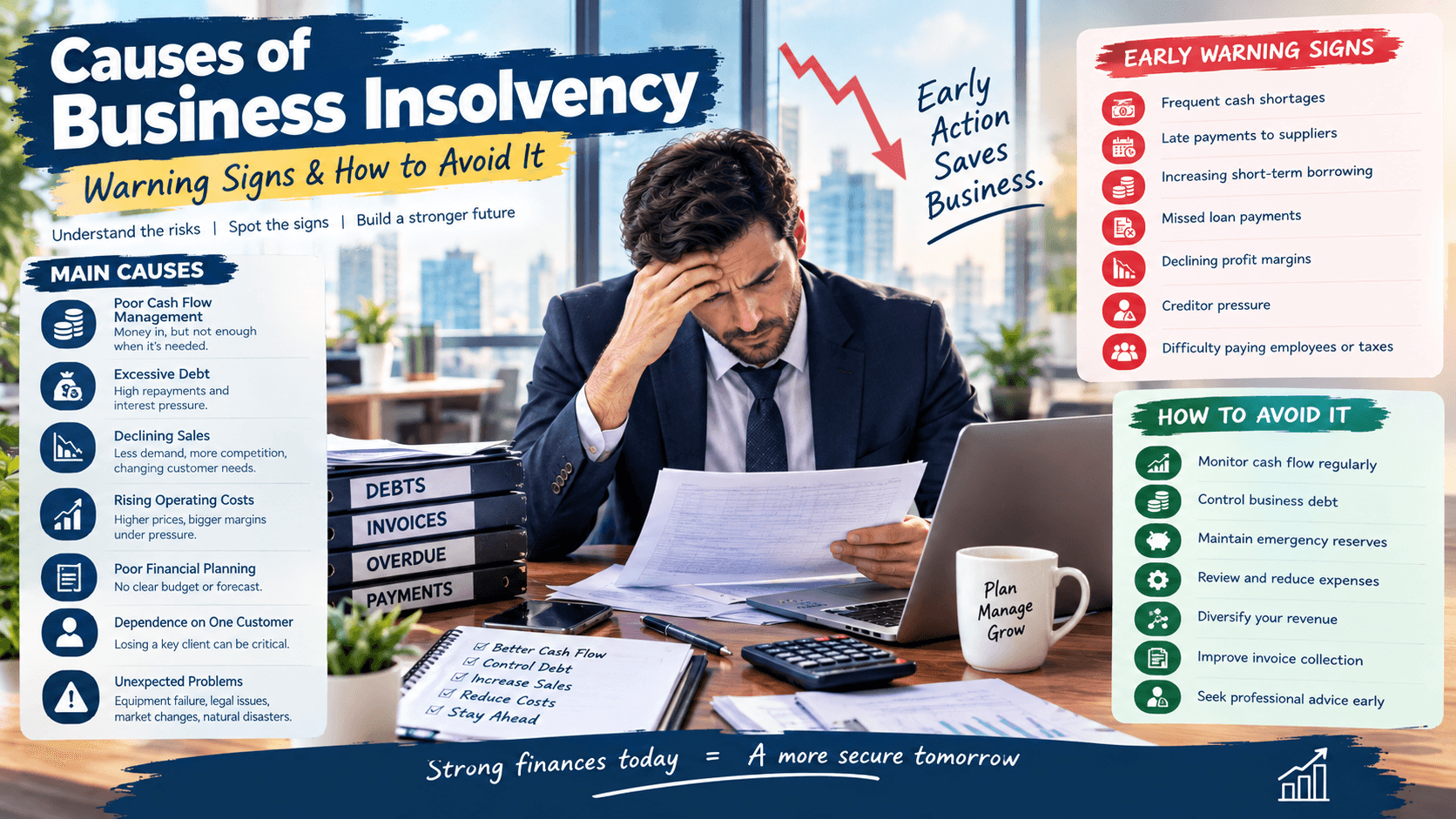
What Causes Business Insolvency?
There is rarely one single reason why a business becomes insolvent. Several financial and operational problems can occur at the same time.
1. Poor Cash-Flow Management
A business may have strong sales but still struggle if money does not arrive when payments are due.
For example, customers may take 60 or 90 days to pay invoices while the company must pay employees, suppliers, rent, and lenders much sooner.
Regular cash-flow forecasting can help identify potential shortages before they become serious.
2. Excessive Business Debt
Borrowing can help businesses expand, purchase equipment, or manage temporary cash shortages. However, excessive debt can create large repayment and interest obligations.
When revenue falls, these fixed payments can become difficult to maintain.
3. Declining Sales
A sustained reduction in sales can quickly affect a company's ability to cover operating expenses.
Declining demand may result from:
Changing customer preferences
New competitors
Economic conditions
Pricing problems
Outdated products
Loss of major customers
4. Rising Operating Costs
Increasing expenses can reduce profit margins and put pressure on cash flow.
Businesses may face higher costs for:
Raw materials
Energy
Rent
Transportation
Salaries
Insurance
Technology
Financing
If prices cannot be adjusted appropriately, rising costs can contribute to financial distress.
5. Poor Financial Planning
Businesses need realistic budgets and financial forecasts.
Failing to monitor expenses, revenue, debt obligations, and cash reserves can make it difficult for management to recognize problems early.
6. Dependence on One Major Customer
A company that relies heavily on a single customer can face significant financial problems if that customer leaves, reduces orders, or delays payments.
Diversifying customers can reduce this concentration risk.
7. Unexpected Financial Problems
Unexpected events can put pressure on even an otherwise stable business.
Examples include:
Major equipment failure
Legal disputes
Supply disruptions
Sudden loss of contracts
Significant unexpected expenses
Natural disasters
Maintaining appropriate financial reserves can provide some protection against unexpected events.
Early Warning Signs of Business Insolvency
Recognizing warning signs early is important because financial distress can become more difficult to resolve as debts accumulate.
1. Frequent Cash Shortages
Repeatedly running short of cash can indicate that the company's incoming funds are not sufficient to cover its obligations.
2. Late Payments to Suppliers
Regularly paying suppliers late may indicate growing financial pressure.
3. Increasing Reliance on Short-Term Borrowing
Using new borrowing to repeatedly cover existing operating expenses can become unsustainable if the underlying cash-flow problem is not addressed.
4. Missed Loan Payments
Missed or delayed loan payments are an important sign that a company may need to review its financial position.
5. Declining Profit Margins
A company may continue generating revenue while becoming less profitable because expenses are increasing faster than sales.
6. Creditor Pressure
Increasing demands for payment, collection actions, or legal notices from creditors can indicate serious financial difficulties.
7. Difficulty Paying Employees or Taxes
Problems meeting payroll or tax obligations can be particularly significant and may require immediate professional advice.
How Can Businesses Avoid Insolvency?
Monitor Cash Flow Regularly
A business should maintain accurate cash-flow forecasts and update them when financial conditions change.
Control Business Debt
Before taking on additional borrowing, management should consider repayment obligations, interest costs, and realistic future revenue.
Maintain Emergency Reserves
Appropriate cash reserves can help businesses handle temporary revenue declines or unexpected expenses.
Review Expenses
Regularly reviewing operating expenses can reveal areas where costs can be reduced without damaging essential operations.
Diversify Revenue
Depending too heavily on one customer, product, or market can increase financial risk. Developing multiple revenue sources can provide greater resilience.
Improve Invoice Collection
Businesses can establish clear payment terms and monitor outstanding invoices to reduce unnecessary delays in receiving customer payments.
Seek Professional Advice Early
Accountants, restructuring advisers, insolvency practitioners, and lawyers can help businesses understand their financial and legal options when serious problems arise.
What Should a Business Do When Warning Signs Appear?
A business should not ignore persistent financial problems.
A practical first step is to create an accurate overview of:
Cash available
Outstanding debts
Customer receivables
Supplier obligations
Loans
Taxes
Employee costs
Business assets
Expected future revenue
Management can then assess whether the problem is temporary or whether more significant restructuring may be necessary.
Can Insolvency Be Prevented?
Not every insolvency situation can be prevented. However, businesses can reduce financial risk through effective cash-flow management, responsible borrowing, financial forecasting, cost control, and early intervention.
The earlier a company identifies serious financial difficulties, the more opportunity it may have to evaluate available options.
Final Thoughts
Business insolvency can result from many factors, including poor cash-flow management, excessive debt, declining sales, rising expenses, and unexpected financial problems.
The key warning signs include persistent cash shortages, missed payments, creditor pressure, increasing debt, and declining profitability.
Businesses that monitor their finances regularly and seek appropriate professional advice when problems emerge may have more options for addressing financial distress.
Frequently Asked Questions
1. What is business insolvency?
Business insolvency generally means that a company cannot meet its financial obligations or meets another applicable legal test for insolvency.
2. What is the most common cause of business insolvency?
There is no single cause. Cash-flow problems, excessive debt, declining sales, rising costs, and poor financial management can all contribute.
3. Can poor cash flow cause insolvency?
Yes. A business can experience serious financial difficulties when it does not have enough available cash to pay obligations when they become due.
4. Can a profitable business become insolvent?
Yes. Accounting profit does not necessarily mean that a business has enough cash available to meet immediate payments.
5. What are the early warning signs of insolvency?
Common warning signs include late payments, cash shortages, increasing debt, creditor pressure, declining sales, and difficulty meeting payroll or tax obligations.
6. Can too much debt cause insolvency?
Yes. Large debt obligations and interest payments can put significant pressure on a company's cash flow.
7. How does declining revenue affect a business?
Declining revenue can reduce the money available to cover fixed costs, debt repayments, salaries, and other operating expenses.
8. Can rising costs lead to insolvency?
Yes. If operating costs increase significantly while revenue remains unchanged, profit margins and cash flow can come under pressure.
9. How can businesses improve cash flow?
Businesses can monitor cash-flow forecasts, manage expenses, improve legitimate invoice collection, control inventory, and negotiate appropriate payment arrangements.
10. Why is cash-flow forecasting important?
It helps businesses estimate future cash inflows and outflows and identify potential shortages before they become critical.
11. Can late-paying customers cause financial problems?
Yes. Delayed customer payments can create a cash-flow gap even when the business has substantial outstanding invoices.
12. How can a company reduce customer payment delays?
Clear payment terms, accurate invoices, timely follow-ups, and appropriate credit-control procedures can help improve collections.
13. Can losing one major customer cause insolvency?
It can, particularly when a company depends heavily on that customer's revenue and does not have sufficient reserves or alternative sources of income.
14. How does poor financial planning affect businesses?
Poor planning can cause companies to underestimate expenses, overestimate revenue, accumulate excessive debt, and fail to prepare for cash shortages.
15. Can a business avoid insolvency through restructuring?
In some circumstances, restructuring may help address financial difficulties by changing debt, operations, costs, or other arrangements.
16. Should a business borrow more money to avoid insolvency?
Additional borrowing is not automatically a solution. Businesses should carefully assess whether new debt is sustainable and seek appropriate professional advice.
17. What happens if a company cannot pay its suppliers?
Suppliers may pursue contractual or legal remedies. If formal insolvency begins, they may become creditors within the applicable process.
18. Can insolvency affect employees?
Yes. Employees may experience delayed wages, changes to employment arrangements, or redundancies, depending on the circumstances and applicable law.
19. Can directors be personally responsible for business debts?
Company debts are generally separate from directors' personal debts, but personal guarantees, misconduct, or other legal exceptions may create personal liability.
20. Can an insolvent business continue operating?
In some circumstances, yes. Certain restructuring or rescue procedures may allow a financially distressed business to continue trading.
21. What is the difference between insolvency and liquidation?
Insolvency generally describes a financial condition, while liquidation is a process used to wind up a company and deal with its assets and liabilities.
22. Does insolvency always mean the business will close?
No. Depending on the circumstances and local law, a business may have restructuring or other rescue options.
23. How can businesses prepare for unexpected financial problems?
Maintaining appropriate reserves, diversifying customers, monitoring financial forecasts, and controlling debt can help improve financial resilience.
24. When should a business seek professional insolvency advice?
A business should consider professional advice when it repeatedly struggles to pay debts, receives serious creditor demands, or faces persistent cash-flow problems.
25. Can creditors help a struggling business?
Creditors may sometimes agree to revised payment arrangements or restructuring proposals, although they are not necessarily required to do so.
26. How does insolvency affect business credit?
Financial distress and formal insolvency proceedings can make future borrowing more difficult and may affect a company's credit profile.
27. What is debt restructuring?
Debt restructuring involves changing existing debt arrangements, such as repayment schedules or other agreed terms, to address financial difficulties.
28. Can selling business assets help with financial problems?
Selling non-essential assets may generate funds, but transactions involving financially distressed businesses can be subject to legal restrictions and should be considered carefully.
29. Can business insolvency be completely prevented?
Not always. External events and unexpected financial shocks can occur, but effective financial management may reduce the risk and help identify problems earlier.
30. What is the first step when a business shows signs of insolvency?
The business should establish an accurate picture of its financial position and consider obtaining advice from qualified financial, restructuring, or legal professionals.