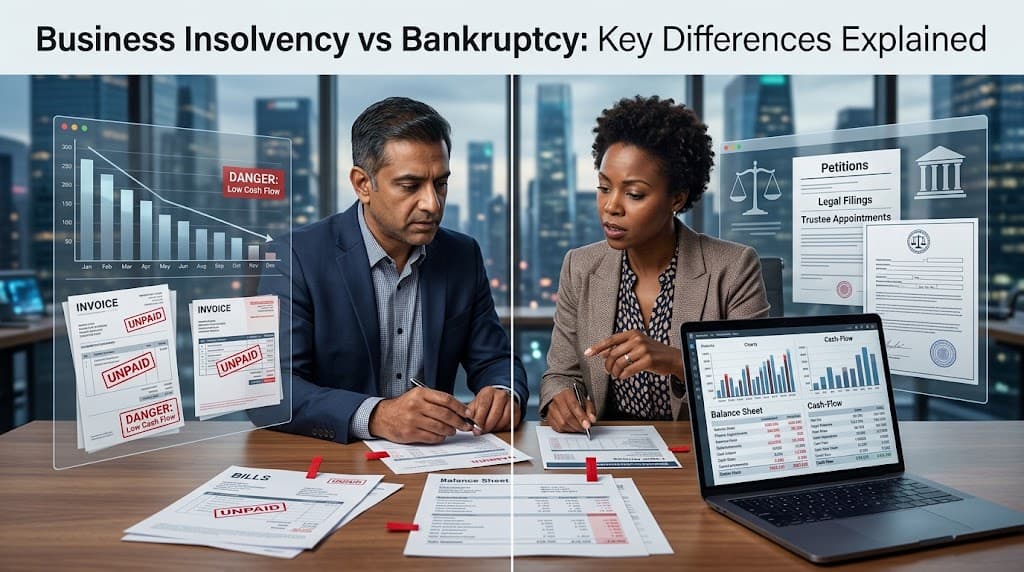

Insolvency and bankruptcy are often used as if they mean the same thing, but they can describe different concepts depending on the country and legal system. Understanding the distinction is important for business owners, creditors, employees, and investors dealing with financial distress.
What Is Business Insolvency?
Business insolvency generally describes a financial condition in which a company is unable to meet its financial obligations or, under a balance-sheet test, has liabilities exceeding its assets.
Two common concepts are:
Cash-flow insolvency: The business cannot pay debts when they become due.
Balance-sheet insolvency: The company's liabilities exceed the value of its assets under the applicable legal or accounting framework.
What Is Bankruptcy?
Bankruptcy is generally a formal legal procedure used in jurisdictions where bankruptcy law applies. It establishes a structured process for dealing with debts and assets.
The exact meaning of bankruptcy differs significantly between countries. Some legal systems use different terms and procedures for companies, while others use bankruptcy primarily in relation to individuals.
Insolvency vs Bankruptcy: Main Difference
The simplest way to understand the distinction is:
Insolvency | Bankruptcy |
|---|---|
Describes a financial condition | Usually refers to a formal legal process |
Can exist without a court proceeding | Generally involves a legally defined procedure |
May be temporary or addressable through restructuring | Has specific legal consequences |
Can involve cash-flow or balance-sheet problems | Depends on the bankruptcy laws of the jurisdiction |
Does not automatically mean business closure | May result in liquidation or another legal outcome |
Why Do Businesses Become Insolvent?
Several factors can contribute to insolvency, including:
Declining sales
Excessive borrowing
High interest costs
Poor cash-flow management
Rising operating expenses
Loss of important customers
Unexpected legal or operational costs
Economic downturns
Often, financial distress develops gradually rather than appearing overnight.
What Happens After Insolvency?
The consequences depend on the company's circumstances and local law. Possible options can include:
Negotiating with creditors
Restructuring debts
Refinancing
Selling certain assets
Entering a formal restructuring process
Appointing an insolvency professional
Liquidating the company
Not every insolvent business immediately shuts down. Some legal procedures are designed to give viable businesses an opportunity to restructure.
How Are Creditors Affected?
Creditors may need to make formal claims for money owed to them. Their potential recovery can depend on whether they are secured or unsecured creditors and on the assets available for distribution.
Legal priority rules determine how available funds are distributed.
What About Employees?
Employees may be affected through delayed wages, changes to employment arrangements, or redundancies. Some jurisdictions provide specific protections or compensation mechanisms for employees of insolvent businesses.
Can Insolvency Be Avoided?
Early action can sometimes help a business address financial difficulties before they become more severe. Businesses can monitor cash flow, review expenses, manage borrowing carefully, communicate with creditors, and obtain professional financial or legal advice.
Insolvency
Insolvency means a business is having serious financial problems and cannot properly pay the money it owes.
For example:
A company has to pay suppliers $50,000 this month, but it only has $10,000 available. It may be experiencing cash-flow insolvency.
Bankruptcy
Bankruptcy is generally a formal legal process used to deal with debts when a person or business cannot meet its financial obligations. The exact meaning and procedure depend on the country's laws.
Main Difference
Insolvency = financial condition
Bankruptcy = formal legal process
A company can become financially insolvent without immediately entering a formal bankruptcy proceeding. Depending on the law, it may instead try to restructure its debts, negotiate with creditors, or enter another formal rescue procedure.
Simple Example
Imagine a company called ABC Ltd.
It owes creditors $1 million.
Its cash flow is falling.
It is struggling to pay suppliers and lenders.
This financial situation may indicate insolvency.
If ABC Ltd. then enters a formal legal procedure under the relevant bankruptcy law, that is bankruptcy.
Final Thoughts
Insolvency is generally a financial condition, while bankruptcy is typically a formal legal process where that concept applies. However, terminology and procedures vary considerably between jurisdictions.
Businesses experiencing financial difficulties should obtain advice from qualified professionals familiar with the relevant local insolvency laws before making major decisions.
30 FAQs: Business Insolvency vs Bankruptcy
1. What is business insolvency?
Business insolvency is a financial condition where a company cannot meet its financial obligations, or its liabilities exceed its assets under the applicable legal test.
2. What is bankruptcy?
Bankruptcy is generally a formal legal process for dealing with debts. Its meaning and procedures vary between countries.
3. Is insolvency the same as bankruptcy?
No. Insolvency generally describes a financial condition, while bankruptcy usually refers to a formal legal process.
4. What are the two main types of insolvency?
The commonly discussed types are cash-flow insolvency and balance-sheet insolvency.
5. What is cash-flow insolvency?
It occurs when a business does not have enough available cash to pay its debts when they become due.
6. What is balance-sheet insolvency?
It generally occurs when a company's liabilities exceed the value of its assets under the relevant legal or accounting test.
7. What causes business insolvency?
Common causes include falling sales, excessive debt, poor cash-flow management, rising costs, high interest expenses, and unexpected financial losses.
8. Can a profitable company become insolvent?
Yes. A company can be profitable on paper while lacking sufficient cash to pay its immediate obligations.
9. What are the warning signs of insolvency?
Warning signs can include missed payments, increasing debt, creditor demands, declining revenue, persistent cash-flow problems, and difficulty paying suppliers.
10. Can an insolvent company continue operating?
In some circumstances, yes. Certain restructuring or rescue procedures may allow an insolvent business to continue trading.
11. Does insolvency always mean a company will close?
No. Depending on the circumstances and local law, a company may restructure its debts or use another rescue procedure instead of closing.
12. What is liquidation?
Liquidation is a process in which a company's assets may be sold to help satisfy liabilities, usually as part of winding up the company.
13. Is liquidation the same as insolvency?
No. Insolvency is a financial condition, while liquidation is a legal or administrative process that may be used to wind up a company.
14. What happens to creditors during insolvency?
Creditors generally make claims through the relevant procedure. Their recovery depends on factors such as their legal priority, security, and the assets available.
15. What is a secured creditor?
A secured creditor has a legally recognized security interest in particular assets or property, subject to the applicable law.
16. What is an unsecured creditor?
An unsecured creditor generally does not have specific collateral securing the debt and may be subject to different priority rules.
17. What happens to employees when a company becomes insolvent?
Employees may face delayed wages, changes to employment, or redundancies. Employee protections vary by jurisdiction.
18. Can directors be personally liable for company debts?
Company debts are generally separate from directors' personal debts, but personal guarantees, misconduct, or other legal exceptions can create personal liability.
19. What is an insolvency practitioner?
An insolvency practitioner is a qualified professional who may administer certain insolvency, restructuring, or liquidation procedures where authorized by law.
20. Can an insolvent company negotiate with creditors?
In some circumstances, businesses can negotiate payment plans, settlements, or restructuring arrangements with creditors.
21. Can an insolvent company get new financing?
It can be difficult, but financing may sometimes be available depending on the company's assets, recovery plan, security, and lender requirements.
22. Can insolvency affect a company's credit?
Yes. Financial distress and formal insolvency proceedings can make obtaining future credit more difficult and may affect the company's credit profile.
23. What happens to business assets during insolvency?
Assets may be protected, managed, sold, or otherwise dealt with according to the applicable insolvency procedure.
24. What happens to company debts after insolvency?
Debts are handled according to the relevant legal process. Some may be paid from available assets, restructured, settled, or treated according to applicable priority rules.
25. Can customers be affected by business insolvency?
Yes. Customers may experience delays, cancelled orders, service interruptions, or uncertainty regarding deposits, warranties, or contracts.
26. Can suppliers become creditors?
Yes. If a supplier is owed money by an insolvent company, it may become a creditor and can generally seek recovery through the applicable process.
27. What is business restructuring?
Business restructuring involves changing a company's financial or operational arrangements to address financial difficulties and, where possible, improve its ability to continue operating.
28. How long does an insolvency process take?
There is no universal timeframe. The duration depends on the type of procedure, complexity of the business, assets, creditors, disputes, and applicable laws.
29. Can insolvency be prevented?
Early financial planning, cash-flow monitoring, responsible borrowing, cost control, and professional advice can help identify and address financial problems earlier.
30. When should a business seek insolvency advice?
A business should consider obtaining professional advice when it begins experiencing persistent difficulty paying debts, receiving creditor demands, or facing serious cash-flow problems. Early advice may help identify available options.