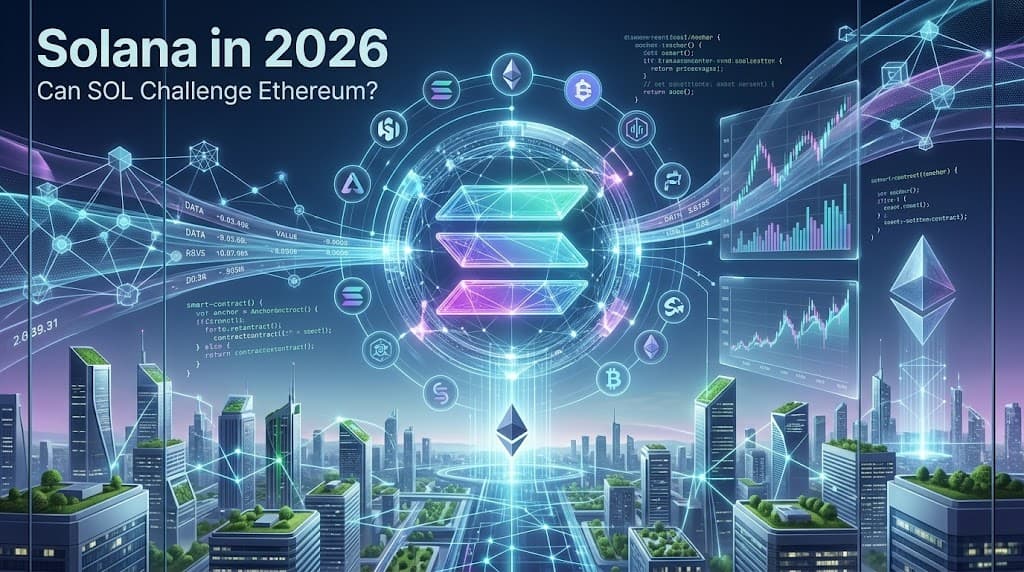

Solana has become one of the most closely watched blockchain networks in the crypto market. Known for fast transactions, relatively low fees, and a growing ecosystem of decentralized applications, Solana enters 2026 with strong competition from Ethereum and other smart-contract platforms.
The big question is whether SOL can seriously challenge Ethereum’s dominance in the next major crypto cycle.
Solana’s Growing Ecosystem
Solana has attracted developers and users across DeFi, decentralized exchanges, NFTs, gaming, payments, and consumer applications. Its high-throughput architecture is designed to handle large numbers of transactions while keeping costs comparatively low.
This combination has helped Solana become an important competitor in the smart-contract blockchain market.
SOL and the Next Crypto Cycle
Crypto market cycles can bring significant increases in network activity and investor interest. If another strong cycle develops, Solana could benefit from increased demand for decentralized applications and blockchain-based financial services.
However, SOL’s future will depend on more than market speculation. Network reliability, developer adoption, ecosystem growth, regulation, and competition will all play important roles.
Can Solana Challenge Ethereum?
Ethereum remains one of the largest and most established smart-contract ecosystems, with extensive developer infrastructure, DeFi applications, stablecoins, and institutional interest.
Solana’s strongest advantages include speed, scalability, and low transaction costs. Ethereum, meanwhile, benefits from its maturity, broad adoption, and expanding Layer-2 ecosystem.
Rather than completely replacing Ethereum, Solana may increasingly compete with it for specific applications and users.
1. Solana vs Ethereum: Key Differences in 2026
Solana and Ethereum are both major smart-contract blockchains, but they take different approaches to scalability and network performance. Solana focuses on high transaction throughput and low-cost activity, making it attractive for applications that require frequent transactions. Ethereum has a much larger and more mature ecosystem, with extensive DeFi infrastructure and a broad developer community. In 2026, the competition between the two networks is likely to focus on users, developers, liquidity, applications, and real-world adoption.
2. Institutional Interest in Solana
Institutional participation could become an important factor in Solana’s future. As blockchain technology becomes more integrated into financial services, large companies and professional investors may increasingly evaluate networks beyond Ethereum. Solana’s transaction efficiency and expanding ecosystem could make it attractive for payments, trading infrastructure, tokenized assets, and other financial applications. However, institutional adoption will also depend on regulation, security, liquidity, and long-term network reliability.
3. The Future of Solana DeFi and Web3
Solana’s DeFi and Web3 ecosystem could remain major areas of growth in 2026. Decentralized exchanges, lending platforms, stablecoins, gaming applications, and other Web3 projects can benefit from a blockchain designed for fast and relatively inexpensive transactions. If developers continue building innovative applications and users continue moving liquidity onto the network, Solana could strengthen its position as one of Ethereum’s biggest competitors in the next crypto cycle.
Solana and DeFi in 2026
Decentralized finance could remain a major growth area for Solana. Faster transactions and lower fees can be attractive for trading, lending, decentralized exchanges, and other financial applications.
If Solana continues attracting developers and liquidity, its DeFi ecosystem could become an even stronger competitor to Ethereum-based alternatives.
What Could Drive SOL Growth?
Several factors could influence Solana's performance in 2026:
Growth in DeFi activity
Increased blockchain adoption
New applications and protocols
Institutional interest
Improvements in network infrastructure
Greater developer adoption
Expansion of stablecoin usage
Broader cryptocurrency market growth
Risks to Consider
Solana also faces important risks. Cryptocurrency markets remain highly volatile, and SOL can experience significant price movements.
Competition from Ethereum, Layer-2 networks, and other high-performance blockchains could also affect Solana's market position. Regulatory developments and technical issues may create additional uncertainty.
Final Thoughts
Solana has established itself as a major smart-contract platform and could play an increasingly important role in the 2026 crypto market.
Whether SOL can challenge Ethereum will depend on adoption, technology, liquidity, developers, and the overall crypto cycle. For investors and blockchain enthusiasts, Solana vs. Ethereum is likely to remain one of the most interesting competitions in the crypto industry.
20 FAQs
1. What is Solana?
Solana is a blockchain platform designed for fast and scalable transactions and decentralized applications.
2. What is SOL?
SOL is the native cryptocurrency of the Solana blockchain.
3. Why is Solana popular?
Its speed, relatively low transaction costs, and growing application ecosystem have contributed to its popularity.
4. Can Solana compete with Ethereum in 2026?
Yes. Solana can compete for developers, users, liquidity, and decentralized applications, although Ethereum remains highly established.
5. Is Solana faster than Ethereum?
Solana is designed for high transaction throughput, while Ethereum's base layer has a different architecture and relies heavily on Layer-2 networks for scaling.
6. Is Solana good for DeFi?
Solana supports a growing range of decentralized finance applications, including trading, lending, and liquidity protocols.
7. Could SOL reach a new all-time high?
It is possible, but no price target is guaranteed. Market conditions, adoption, supply, and investor sentiment all matter.
8. Is SOL a good investment in 2026?
SOL may interest investors who believe in Solana's long-term ecosystem, but cryptocurrency investments carry substantial risk.
9. What makes Solana different from Ethereum?
They use different technical architectures and have different approaches to scalability, fees, and ecosystem development.
10. Does Solana have smart contracts?
Yes. Developers can build decentralized applications and programmable blockchain applications on Solana.
11. What could increase SOL demand?
Greater network usage, DeFi growth, applications, stablecoin activity, and broader crypto adoption could potentially increase demand.
12. What are Solana's biggest risks?
Major risks include competition, technical problems, regulatory uncertainty, market volatility, and changes in user or developer activity.
13. Is Ethereum still stronger than Solana?
Ethereum remains highly established, particularly in DeFi and developer infrastructure, while Solana has strengths in speed and transaction efficiency.
14. Could Solana replace Ethereum?
A complete replacement is uncertain. Both networks may continue serving different applications and user groups.
15. Is Solana decentralized?
Solana is a decentralized blockchain, although debates about validator distribution and network architecture continue.
16. What is Solana DeFi?
It refers to decentralized financial applications operating on the Solana blockchain.
17. Will Solana be important in the next crypto cycle?
Its existing ecosystem and developer activity make it a blockchain worth watching during future market cycles.
18. Does Solana support NFTs?
Yes. Solana supports NFT marketplaces and applications.
19. What could hurt Solana's growth?
Reduced adoption, strong competition, technical challenges, unfavorable regulations, or a prolonged crypto downturn could hurt growth.
20. What should investors watch in 2026?
Investors can monitor network activity, developer growth, DeFi liquidity, stablecoin usage, ecosystem developments, regulations, and overall crypto-market conditions.
21. Why is Solana considered an Ethereum competitor?
Solana competes with Ethereum because both support smart contracts, decentralized applications, DeFi, and digital assets.
22. What industries could benefit from Solana?
Payments, gaming, decentralized finance, digital assets, trading, and Web3 applications could potentially benefit from Solana's infrastructure.
23. Could Solana attract more developers in 2026?
Yes, continued ecosystem growth, improved development tools, and demand for high-performance applications could attract additional developers.
24. How does Solana handle high transaction activity?
Solana uses its own blockchain architecture and consensus mechanisms designed to process large amounts of activity efficiently.
25. What role could stablecoins play on Solana?
Stablecoins can support payments, trading, lending, and other financial applications, potentially increasing activity on the network.
26. Is Solana useful for decentralized exchanges?
Yes. Solana supports decentralized exchanges where users can trade digital assets without relying on traditional centralized intermediaries.
27. Could Solana benefit from increased Web3 adoption?
Greater Web3 adoption could increase demand for blockchain applications and potentially bring more users and developers to Solana.
28. What is Solana's biggest advantage over Ethereum?
Transaction efficiency and relatively low costs are among Solana's commonly cited advantages.
29. What is Ethereum's biggest advantage over Solana?
Ethereum has a highly established ecosystem, extensive developer infrastructure, significant liquidity, and broad adoption.
30. Can both Ethereum and Solana succeed?
Yes. The blockchain market does not necessarily require one network to dominate every use case. Different networks can serve different applications.
31. Does Solana have potential beyond DeFi?
Yes. Its ecosystem also includes areas such as payments, gaming, NFTs, consumer applications, and tokenized assets.
32. How important are network upgrades for Solana?
Network upgrades can improve performance, reliability, scalability, and developer capabilities, making them important for long-term growth.
33. Could regulation affect SOL in 2026?
Yes. Changes in cryptocurrency regulations could influence exchanges, institutional participation, investment products, and overall demand for SOL.
34. What should users consider before using Solana?
Users should consider network conditions, wallet security, transaction risks, application reliability, and the risks associated with cryptocurrency markets.
35. What could determine Solana's long-term success?
Long-term success could depend on developer adoption, user growth, network reliability, applications, liquidity, technological improvements, and broader blockchain adoption.