
The cryptocurrency market continues to evolve rapidly in 2026. Bitcoin remains the largest digital asset, while Ethereum and other blockchain networks are competing for a growing role in payments, decentralized finance, tokenization, and digital applications.
For investors, traders, and technology enthusiasts, one important question remains: what could drive Bitcoin and altcoins next?
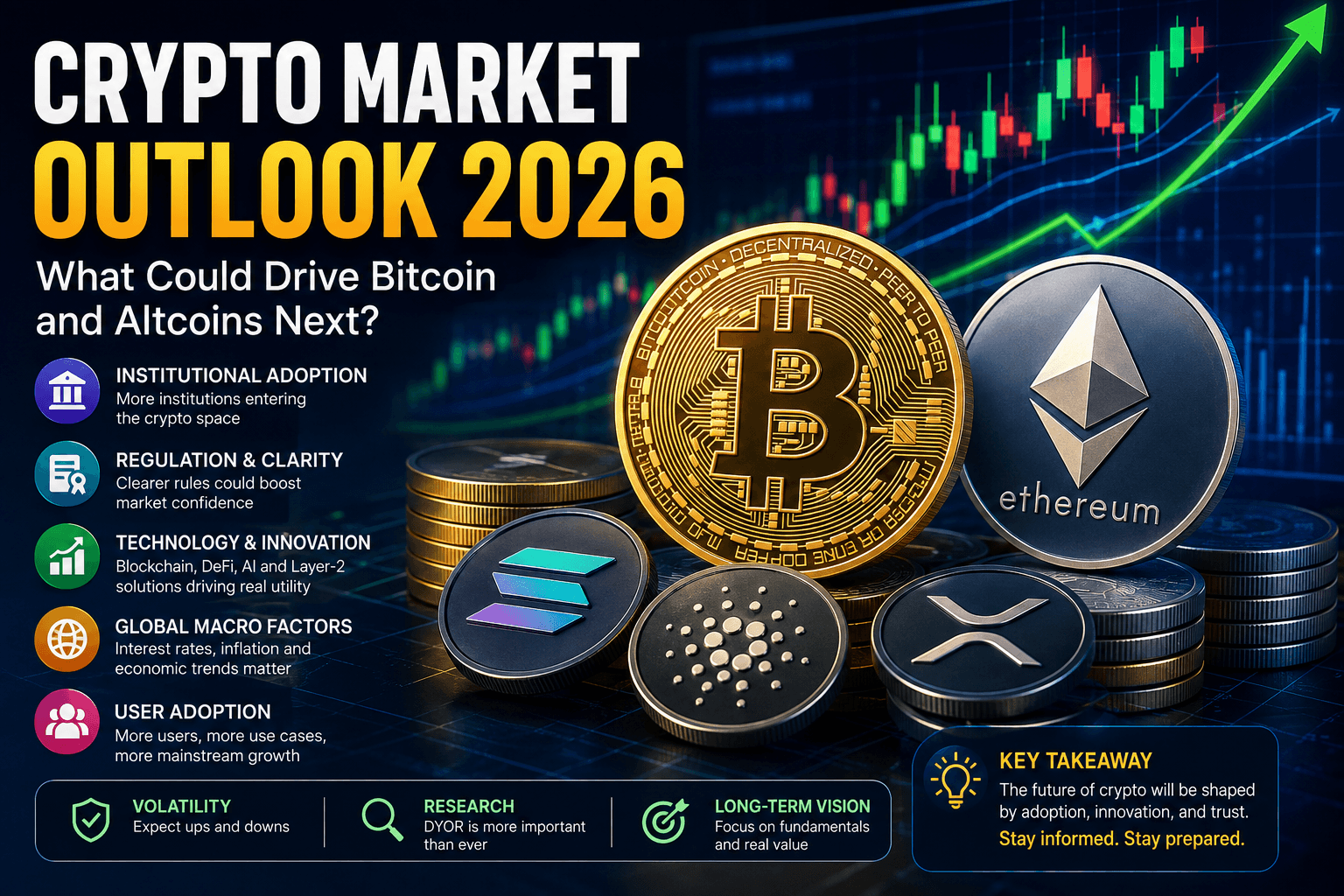
The answer depends on several factors, including institutional adoption, regulation, interest rates, blockchain development, market liquidity, and investor sentiment.
Bitcoin's Role in the 2026 Crypto Market
Bitcoin continues to dominate the crypto market because of its established network, limited supply, and strong recognition among institutional and retail investors.
One major factor to watch is institutional participation. Financial companies and investment managers have increasingly developed products and services connected to digital assets, potentially making cryptocurrency more accessible to traditional investors.
However, Bitcoin remains volatile. Its price can react quickly to economic data, monetary policy, regulations, geopolitical developments, and changes in investor sentiment.
What Could Drive Bitcoin Next?
Several factors could influence Bitcoin's performance during 2026:
1. Institutional Adoption
Institutional demand can have a significant effect on cryptocurrency liquidity and market sentiment. Greater participation from asset managers, financial institutions, and businesses could support long-term adoption.
2. Global Interest Rates
Interest rates remain important for risk assets. When borrowing costs and yields change, investors may adjust how much capital they allocate to assets such as cryptocurrencies.
3. Bitcoin Supply Dynamics
Bitcoin has a capped maximum supply of 21 million coins. Changes in the amount of Bitcoin available for trading can influence market dynamics, although scarcity alone does not guarantee price increases.
4. Regulation
Clearer cryptocurrency regulations could encourage businesses and financial institutions to enter the market. On the other hand, restrictive rules could create challenges for certain crypto businesses and tokens.
5. Investor Sentiment
Crypto markets are heavily influenced by sentiment. Positive news can attract new buyers, while fear, uncertainty, or major market events can cause rapid selling.
What About Altcoins?
Altcoins include cryptocurrencies other than Bitcoin. Ethereum remains one of the most important because of its smart-contract ecosystem and extensive decentralized application infrastructure.
Other blockchain networks are also competing in areas such as:
Decentralized finance (DeFi)
Stablecoins
Tokenized real-world assets
Blockchain gaming
Layer-2 scaling
Cross-chain applications
Decentralized physical infrastructure
Not every altcoin will perform equally. Projects with useful technology, active developers, strong ecosystems, and sustainable economics may have better long-term prospects than tokens driven primarily by speculation.
Ethereum's Influence
Ethereum could remain a major force in the crypto market because developers use its infrastructure for smart contracts, decentralized applications, DeFi protocols, and tokenization.
Ethereum's future performance may depend on network scalability, transaction costs, developer activity, competition from other blockchains, and continued adoption of its ecosystem.
Stablecoins Could Become Even More Important
Stablecoins are cryptocurrencies designed to maintain a relatively stable value, commonly by being linked to fiat currencies such as the U.S. dollar.
Their use in trading is already significant, but their potential applications extend beyond exchanges. Stablecoins could increasingly be used for cross-border payments, digital commerce, remittances, and settlement.
Regulation will be particularly important for this part of the industry.
Real-World Asset Tokenization
One of the most interesting crypto trends is the tokenization of real-world assets.
Financial assets such as bonds, funds, and other instruments can potentially be represented digitally on blockchain networks. Tokenization could improve settlement efficiency, transparency, and accessibility in some financial markets.
If adoption grows, blockchain networks supporting tokenized assets could benefit from increased activity.
AI and Crypto
Artificial intelligence and blockchain are also beginning to overlap.
AI can potentially be used for blockchain analytics, fraud detection, automation, cybersecurity, and market research. Meanwhile, blockchain technology can provide infrastructure for certain digital ownership and decentralized applications.
The combination of AI and crypto is still developing, so investors should distinguish genuine technological projects from speculative marketing.
Key Risks to Watch
Despite the potential opportunities, cryptocurrency remains a high-risk market.
Important risks include:
Extreme price volatility
Regulatory changes
Exchange failures
Cybersecurity attacks
Fraud and scams
Project failures
Liquidity problems
Leverage-related losses
Macroeconomic uncertainty
Investors should never assume that past crypto performance guarantees future returns.
What Could Happen Next?
The crypto market could develop in several different directions. Bitcoin may continue to strengthen its position as the leading digital asset, while Ethereum and other networks compete for applications involving DeFi, tokenization, payments, and decentralized technology.
The most important developments may not simply be cryptocurrency prices. Adoption, regulation, technology, and real-world utility could determine which blockchain projects remain relevant over the long term.
Final Thoughts
The 2026 crypto market is likely to remain dynamic and unpredictable. Bitcoin, Ethereum, stablecoins, tokenization, DeFi, and blockchain infrastructure are among the areas worth watching.
For anyone researching crypto, the best approach is to focus on fundamentals rather than hype. Understanding the technology, market conditions, risks, and regulatory environment can be more valuable than simply following short-term price predictions.
This article is for informational purposes only and is not financial advice. Cryptocurrency investments can involve substantial risk, including loss of capital.
FAQs
1. What is the crypto market outlook for 2026?
The outlook depends on factors such as institutional adoption, regulation, interest rates, liquidity, technology development, and investor sentiment.
2. Is Bitcoin still important in 2026?
Yes. Bitcoin remains the largest and most widely recognized cryptocurrency and continues to influence overall crypto-market sentiment.
3. What could drive Bitcoin's price?
Institutional demand, macroeconomic conditions, regulation, market liquidity, supply dynamics, and investor sentiment can all influence Bitcoin's price.
4. Are altcoins likely to grow in 2026?
Some altcoins may benefit from adoption and technological development, but performance can vary significantly between projects.
5. What is Ethereum used for?
Ethereum supports smart contracts and decentralized applications, including DeFi platforms, tokenized assets, and other blockchain-based services.
6. What are stablecoins?
Stablecoins are digital assets designed to maintain a relatively stable value, often by being linked to a fiat currency.
7. Why is crypto regulation important?
Regulation can influence how exchanges, financial institutions, businesses, and investors interact with digital assets.
8. Is cryptocurrency a safe investment?
Cryptocurrency can be highly volatile and carries significant risks. It should not be considered risk-free.
9. What is DeFi?
DeFi, or decentralized finance, refers to financial services and applications built using blockchain technology and smart contracts.
10. What is tokenization?
Tokenization involves representing an asset or financial instrument digitally on a blockchain.
11. Could institutional adoption affect Bitcoin?
Greater institutional participation could influence liquidity, demand, and market sentiment.
12. Why do interest rates matter to crypto?
Changes in interest rates can affect investor appetite for riskier assets, including cryptocurrencies.
13. What is Bitcoin's maximum supply?
Bitcoin's protocol specifies a maximum supply of 21 million BTC.
14. Could stablecoins become mainstream?
Their use could expand if regulatory frameworks, infrastructure, and real-world payment applications continue developing.
15. What crypto trends should investors watch?
Important areas include Bitcoin adoption, Ethereum development, stablecoins, DeFi, tokenization, regulation, and blockchain scalability.
16. Is Bitcoin different from altcoins?
Yes. Bitcoin is the original cryptocurrency and the largest by market capitalization, while altcoins generally refer to other cryptocurrencies.
17. What are the biggest crypto risks?
Volatility, scams, cybersecurity incidents, regulatory changes, liquidity issues, and project failures are among the major risks.
18. How does blockchain technology support crypto?
Blockchain provides the distributed ledger infrastructure used to record and verify many cryptocurrency transactions.
19. Will all cryptocurrencies succeed?
No. The crypto market contains thousands of projects with different technologies, economics, and levels of adoption.
20. Should investors follow crypto price predictions?
Price predictions are inherently uncertain. Researching fundamentals, risks, market conditions, and personal financial circumstances is generally more useful than relying on a single forecast.