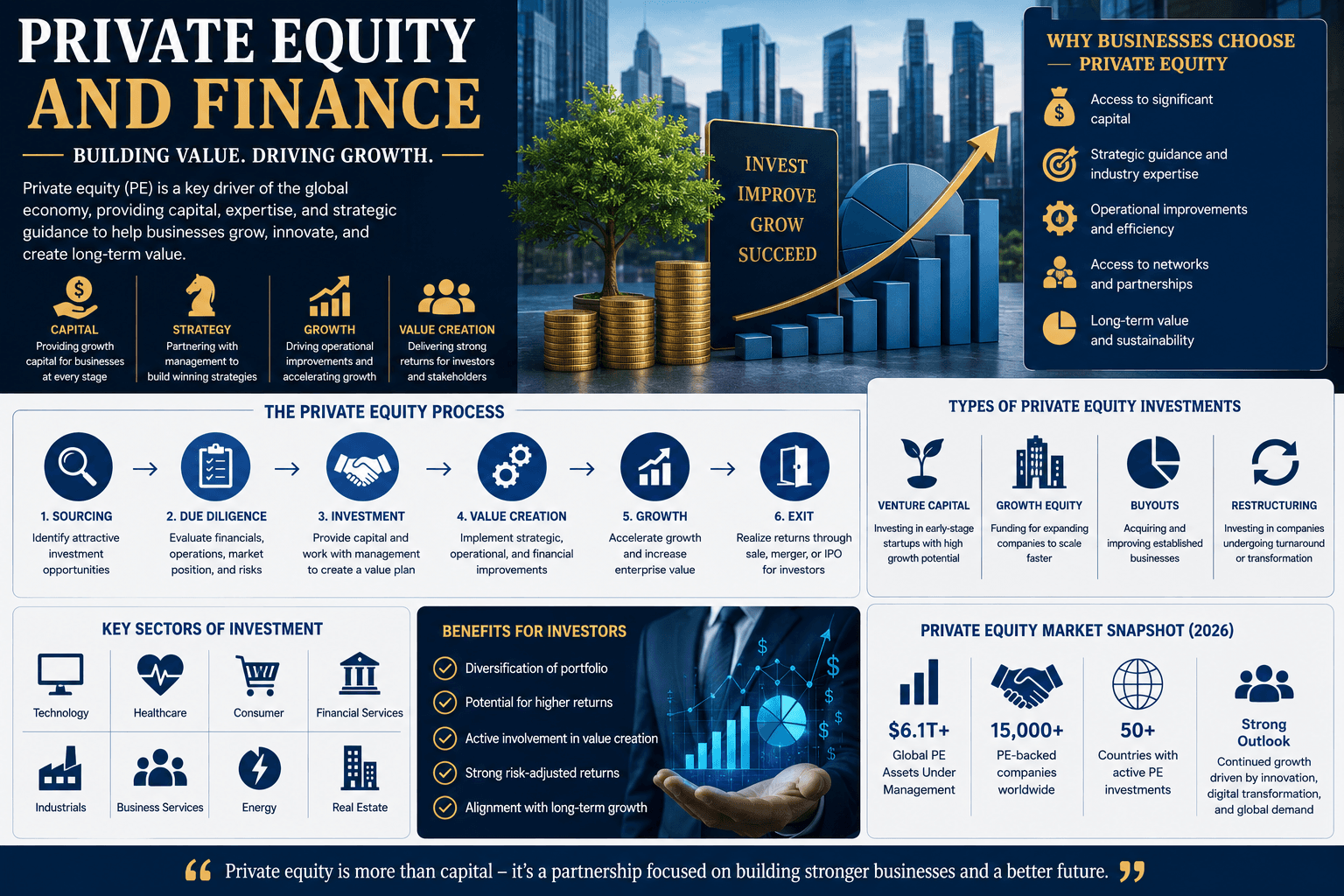

PEPrivate Equity in 2026: Key Trends Shaping the Global Investment Landscape
Private equity remains an important source of capital for companies around the world. In 2026, private-equity deal activity is being shaped by interest rates, financing conditions, company valuations, artificial intelligence, mergers and acquisitions, and the availability of investment capital.
Private-equity firms can participate in acquisitions, growth investments, recapitalizations, and other transactions. Understanding the forces behind these deals provides useful context for following the global investment landscape.
What Is a Private Equity Deal?
A private-equity deal generally involves a private-equity firm investing in or acquiring a company.
Depending on the strategy, a transaction may involve:
Full company acquisitions
Majority investments
Minority investments
Growth capital
Management buyouts
Add-on acquisitions
Recapitalizations
The structure depends on the investment strategy and the characteristics of the target company.
Why Are Private Equity Deals Important in 2026?
Private-equity transactions can provide businesses with capital for expansion, acquisitions, technology investment, restructuring, or changes in ownership.
For private-equity firms, deals provide opportunities to deploy capital and build investment portfolios.
The broader M&A market also influences private-equity activity because firms often compete with strategic corporate buyers for attractive businesses.
Interest Rates and Deal Activity
Interest rates are one of the most important factors affecting private-equity transactions.
Many acquisitions use debt financing. When borrowing costs increase, financing a transaction can become more expensive.
Higher financing costs can affect:
Purchase prices
Deal structures
Debt levels
Expected returns
Seller expectations
Investment timelines
Changes in interest-rate expectations can therefore influence both buyers and sellers.
The Role of Deal Valuations
Valuation is another critical component of private-equity transactions.
Buyers want to purchase businesses at prices that fit their investment objectives, while sellers generally seek attractive valuations.
Valuations can depend on:
Revenue growth
Profitability
Cash flow
Industry conditions
Competitive position
Growth opportunities
Interest rates
Comparable transactions
When buyers and sellers disagree about value, transactions can take longer to complete.
M&A and Private Equity
Private-equity firms are significant participants in mergers and acquisitions.
A private-equity-backed company may also acquire smaller businesses as part of a strategy known as a buy-and-build approach.
Under this strategy, an investor acquires a platform company and then adds complementary businesses through additional acquisitions.
What Is a Buyout?
A buyout occurs when an investor acquires a controlling interest in a company.
In a leveraged buyout, debt financing is used alongside equity capital to fund the acquisition.
The amount of leverage depends on financing conditions, the company's cash flow, lender requirements, and transaction structure.
Growth Equity Deals
Not every private-equity investment involves buying an entire company.
Growth-equity investments provide capital to established companies that are expanding and may need funding for new products, markets, technology, or acquisitions.
These transactions can involve minority ownership rather than complete control.
AI Is Influencing Deal-Making
Artificial intelligence has become an important theme in private-equity investing.
Investors are examining companies involved in:
AI software
Data centers
Semiconductors
Cloud computing
Automation
Cybersecurity
Enterprise AI
Data infrastructure
AI can also be used within the investment process for research, data analysis, due diligence, and portfolio monitoring.
Technology M&A
Technology remains a major area of interest for private-equity investors.
Software and technology businesses can offer recurring revenue, scalable business models, and opportunities for digital expansion.
However, technology investments can also face rapid competition, changing customer preferences, cybersecurity risks, and technological disruption.
Healthcare Deals
Healthcare remains another important private-equity sector.
Potential investment areas include:
Healthcare services
Medical devices
Healthcare technology
Pharmaceutical services
Specialty clinics
Business services supporting healthcare providers
Healthcare transactions may involve additional regulatory considerations depending on the country and industry.
Infrastructure and Energy Investments
Private capital is also relevant to infrastructure and energy.
Investment opportunities can include:
Data centers
Renewable energy
Power infrastructure
Transportation
Utilities
Industrial infrastructure
Long-term capital requirements can make these areas relevant to private-equity and other private-market investors.
Private Equity Dry Powder
Private-equity firms maintain capital that has been raised but not yet invested. This is commonly known as dry powder.
A large amount of available capital means firms have resources available for new transactions.
However, having capital available does not mean firms will invest immediately. Valuations, financing costs, due diligence, and expected returns remain important considerations.
The Importance of Due Diligence
Before completing a transaction, investors typically conduct extensive due diligence.
This can involve examining:
Financial statements
Revenue quality
Customer concentration
Debt
Legal issues
Tax matters
Technology
Management
Market conditions
Operational risks
The purpose is to understand the company's financial and operational position before committing capital.
What Happens After an Acquisition?
Private-equity ownership often involves active portfolio management.
Depending on the investment strategy, a firm may work with management to improve:
Operations
Sales
Technology
Cost efficiency
Supply chains
Corporate strategy
International expansion
The objective can be to improve the company's performance and prepare for a future exit.
Private Equity Exit Strategies
A private-equity investment eventually needs an exit.
Common options include:
Sale to a Strategic Buyer
Another company purchases the portfolio business.
Sale to Another Private Equity Firm
A secondary buyout transfers ownership to another financial sponsor.
Initial Public Offering
The company becomes publicly traded.
Recapitalization
The company changes its financing structure while the private-equity investor may retain some ownership.
Challenges in Private Equity Deals
Private-equity transactions can face several challenges.
These include:
Financing costs
Valuation disagreements
Regulatory reviews
Competition among buyers
Economic uncertainty
Weak exit markets
Integration problems
Unexpected operational issues
A transaction may also fail to close if buyers and sellers cannot reach an agreement.
What Investors Are Watching in 2026
Important areas to monitor include:
Interest-rate expectations
M&A activity
Deal valuations
Private-equity fundraising
Credit-market conditions
Exit activity
AI-related investment
Healthcare transactions
Infrastructure investment
Economic growth
These indicators can help explain changes in private-equity deal activity.
Private Equity and the Global Economy
Private-equity deals can have broader economic effects.
When investors provide capital to businesses, companies may use that capital to expand operations, hire employees, develop technology, or acquire competitors.
At the same time, private-equity transactions can involve restructuring and changes in ownership, making their economic effects dependent on the individual transaction.
Conclusion
Private-equity deals in 2026 are being influenced by financing costs, valuations, M&A activity, AI, technology, healthcare, infrastructure, and investor demand.
Deal activity depends on both the availability of capital and the willingness of buyers and sellers to agree on valuations and transaction structures.
For anyone following private markets, understanding interest rates, financing conditions, deal valuations, due diligence, and exit strategies provides useful context for interpreting private-equity activity.
Frequently Asked Questions
1. What is a private-equity deal?
It is a transaction in which a private-equity firm invests in or acquires a private company.
2. What is a private-equity buyout?
A buyout involves acquiring a controlling or significant ownership interest in a company.
3. What is an M&A deal?
M&A stands for mergers and acquisitions and involves companies combining or one company acquiring another.
4. How do interest rates affect private-equity deals?
Interest rates influence the cost of debt financing and can affect valuations, transaction structures, and expected returns.
5. What is a leveraged buyout?
A leveraged buyout, or LBO, is an acquisition financed using a combination of equity and borrowed money.
6. What is private-equity dry powder?
Dry powder is capital that private-equity funds have raised but have not yet invested.
7. Why are valuations important?
Valuations determine how much buyers may pay for a company and influence potential investment returns.
8. What industries attract private-equity deals?
Technology, healthcare, business services, infrastructure, energy, and consumer industries can attract private-equity investment.
9. Why is AI important to private equity?
AI is both an investment theme and a technology that can assist with research, due diligence, portfolio monitoring, and business operations.
10. What is a buy-and-build strategy?
It involves acquiring a platform company and then purchasing additional businesses to build a larger combined organization.
11. What is growth equity?
Growth equity provides capital to established companies that are expanding but may not require a complete ownership change.
12. What happens during due diligence?
Investors examine financial, legal, operational, commercial, tax, technological, and other information before completing a transaction.
13. Can a private-equity deal fail?
Yes. Transactions can fail because of valuation disagreements, financing problems, regulatory issues, due-diligence findings, or other factors.
14. What is a private-equity exit?
An exit is the process of selling or otherwise realizing an investment in a portfolio company.
15. What is a secondary buyout?
It occurs when one private-equity firm sells a portfolio company to another private-equity firm.
16. What is an IPO exit?
An IPO exit occurs when a privately held company becomes publicly traded, allowing shares to be sold through public markets.
17. Why is healthcare attractive to private equity?
Healthcare can offer opportunities linked to demographic trends, technology, specialized services, and changing healthcare demand, although regulatory considerations can be significant.
18. Why does infrastructure attract private capital?
Infrastructure projects can require substantial long-term capital and may provide opportunities across areas such as energy, transportation, utilities, and data centers.
19. What should investors monitor in the private-equity market?
Interest rates, deal volumes, valuations, fundraising, credit conditions, M&A activity, and exit markets are important indicators.
20. What are the main risks in private-equity deals?
Risks can include excessive valuation, financing costs, operational problems, regulatory changes, economic downturns, integration challenges, and limited exit opportunities.