

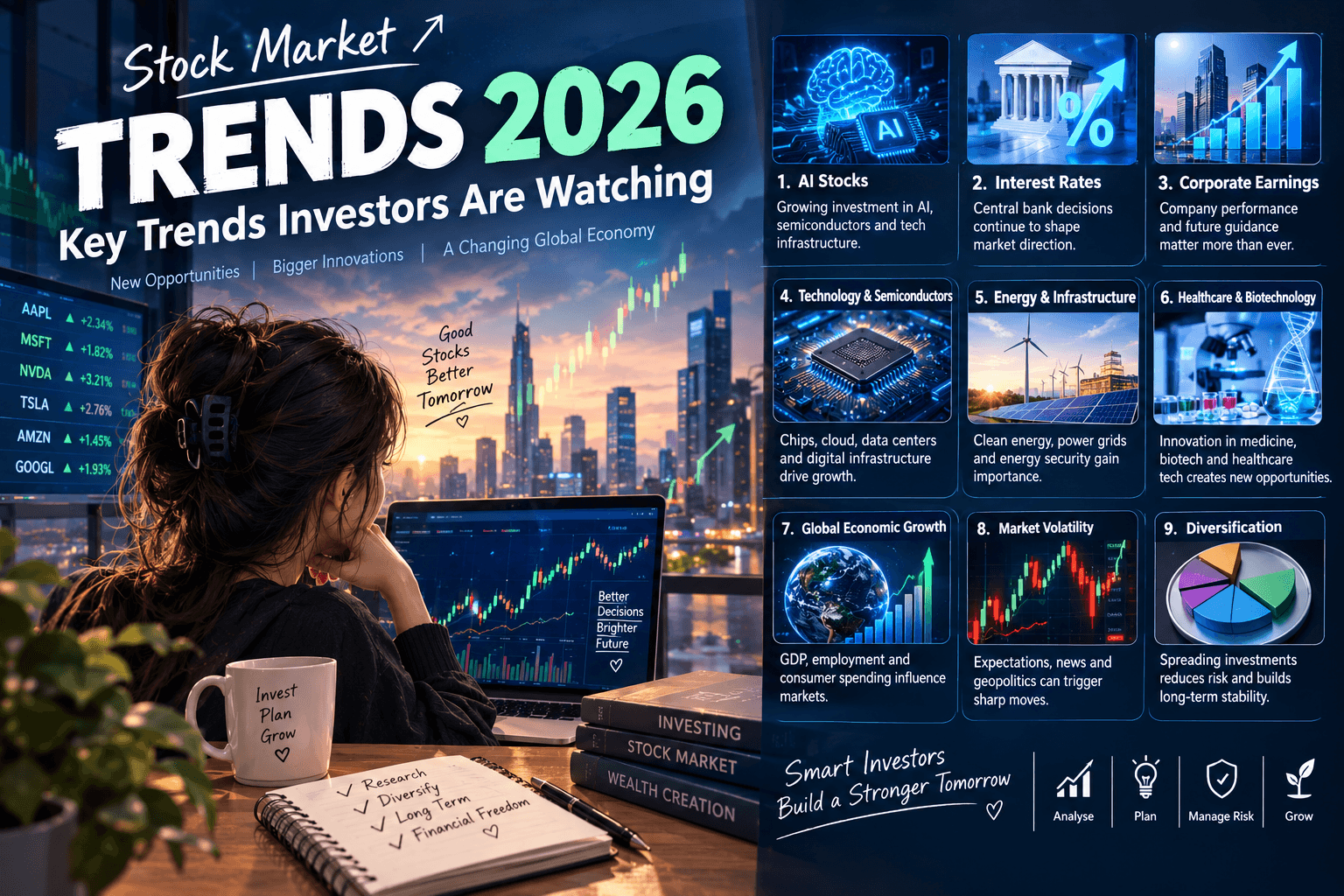
The stock market continues to attract attention in 2026 as investors monitor economic growth, interest rates, corporate earnings, artificial intelligence, energy markets, and changing consumer behavior.
Stock prices can move quickly in response to new economic data and company developments. Rather than focusing on a single market trend, investors often examine multiple factors to understand the broader investment environment.
What Is Driving Stock Markets in 2026?
Several themes are receiving attention across global equity markets:
Interest-rate expectations
Corporate earnings
Artificial intelligence
Technology investment
Economic growth
Inflation
Energy demand
Consumer spending
Geopolitical developments
These factors can affect different industries in different ways.
Interest Rates and Stock Valuations
Interest rates remain an important factor for investors.
When borrowing costs rise, companies may face higher financing expenses. Higher rates can also influence how investors value future corporate earnings.
When rates decline, financing conditions may become easier, although the market response depends on why rates are falling and what investors expect for economic growth.
Artificial Intelligence and Technology Stocks
Artificial intelligence remains one of the major investment themes of the decade.
Companies involved in AI infrastructure, semiconductors, cloud computing, data centers, software, and cybersecurity are receiving significant attention.
However, investors should distinguish between companies benefiting from genuine revenue growth and businesses whose valuations depend heavily on future expectations.
Semiconductor Industry
Semiconductors are essential for smartphones, computers, vehicles, data centers, and artificial-intelligence systems.
Growing demand for computing power has increased attention on chip manufacturers, semiconductor equipment companies, and related infrastructure providers.
The sector can nevertheless be cyclical, with demand and pricing changing significantly over time.
Financial Sector
Banks, insurance companies, asset managers, and other financial businesses are closely connected to interest rates and economic activity.
Bank profitability can be affected by lending demand, funding costs, credit quality, and the difference between interest earned on assets and interest paid on liabilities.
Energy Stocks
Energy markets remain important because oil, natural gas, electricity, and renewable-energy investment affect both businesses and consumers.
Traditional energy companies can be influenced by commodity prices, while renewable-energy businesses depend on technology costs, government policies, financing conditions, and energy demand.
Healthcare and Biotechnology
Healthcare is another major stock-market sector.
Pharmaceutical companies, medical-device manufacturers, healthcare providers, and biotechnology firms can be influenced by demographic trends, medical innovation, regulatory decisions, and research outcomes.
Biotechnology stocks can be particularly volatile because individual companies may depend heavily on clinical-trial results or regulatory approvals.
Consumer Spending and Retail Stocks
Consumer behavior provides important information about economic conditions.
Retailers and consumer companies may benefit when household spending remains strong. However, inflation, employment conditions, interest rates, and consumer confidence can influence purchasing patterns.
Investors often examine company earnings and sales figures to understand how consumers are behaving.
Small-Cap vs. Large-Cap Stocks
Large companies and smaller companies can respond differently to economic conditions.
Large-cap companies may have greater access to financing and more diversified operations.
Small-cap companies can sometimes be more sensitive to domestic economic conditions and borrowing costs.
Neither category is guaranteed to outperform the other.
Dividend Stocks
Dividend-paying companies remain relevant to investors seeking income from their portfolios.
Companies with established dividend policies may attract attention during periods of market uncertainty.
However, investors should examine whether a company's dividend is supported by sustainable cash flow rather than focusing only on the dividend yield.
Global Stock Markets
Investors in 2026 are not limited to one country's stock market.
International markets provide exposure to different economies, industries, currencies, and economic cycles.
However, international investing also introduces risks such as currency fluctuations, political developments, regulatory differences, and market-access considerations.
What Could Make Stock Markets Volatile?
Stock markets can experience volatility when investors rapidly change their expectations.
Potential sources include:
Unexpected inflation data
Interest-rate decisions
Weak corporate earnings
Geopolitical events
Currency movements
Commodity-price changes
Recession concerns
Major technological developments
Volatility is a normal feature of equity markets.
How Corporate Earnings Matter
Ultimately, company earnings are a major component of stock valuation.
Investors often examine revenue growth, profit margins, earnings forecasts, cash flow, debt levels, and management guidance.
A company can have a popular product or industry position while still facing financial challenges.
What Investors Should Watch in 2026
Important indicators include:
Inflation reports
Central-bank decisions
Employment data
Economic-growth figures
Corporate earnings
Bond yields
Consumer spending
Commodity prices
Technology investment
Global market conditions
Following several indicators together can provide more context than concentrating on one headline.
Risk Management in the Stock Market
Investing in stocks involves the possibility of losing money.
Investors can consider factors such as diversification, investment time horizon, liquidity requirements, and risk tolerance when constructing a portfolio.
Diversification cannot eliminate losses, but it can reduce reliance on the performance of a single company or sector.
Long-Term vs. Short-Term Investing
Short-term trading focuses heavily on price movements and market timing.
Long-term investing generally focuses more on company fundamentals, earnings growth, valuation, and broader financial objectives.
The appropriate approach depends on an individual's circumstances and goals.
Conclusion
Stock-market trends in 2026 are being shaped by a combination of monetary policy, economic conditions, corporate earnings, technology investment, AI development, energy demand, and consumer behavior.
Different sectors can respond differently to the same economic environment. For investors, understanding these relationships can provide useful context when researching companies and markets.
Rather than relying on a single trend, investors can examine fundamentals, valuation, diversification, and their own financial objectives when evaluating the stock market.
Frequently Asked Questions
1. What are the major stock-market themes in 2026?
Major themes include AI, technology infrastructure, interest rates, corporate earnings, energy, healthcare, and consumer spending.
2. How do interest rates affect stocks?
Interest rates can influence corporate borrowing costs, consumer demand, bond yields, and the valuation investors place on future earnings.
3. Why are AI stocks attracting attention?
AI is driving investment in areas such as semiconductors, cloud computing, data centers, software, and cybersecurity.
4. Are technology stocks always the best performers?
No. Sector performance changes over time and depends on valuations, earnings, economic conditions, and investor expectations.
5. What are small-cap stocks?
Small-cap stocks represent companies with relatively smaller market capitalizations compared with large-cap companies.
6. What are large-cap stocks?
Large-cap stocks represent companies with relatively large market capitalizations and often include established businesses.
7. Why are corporate earnings important?
Earnings provide information about a company's financial performance and can influence how investors value its shares.
8. What sectors are investors watching in 2026?
Technology, semiconductors, financials, healthcare, energy, consumer businesses, and AI-related industries are among the areas receiving attention.
9. Can stock prices fall even when a company reports profits?
Yes. Investors may have expected stronger results, or other factors such as valuation, economic conditions, or future guidance may affect the share price.
10. What causes stock-market volatility?
Economic data, interest-rate decisions, corporate earnings, geopolitical developments, commodity prices, and changing investor expectations can all contribute to volatility.
11. Are dividend stocks safer than other stocks?
Not necessarily. Dividend-paying companies can still experience substantial share-price declines and business risks.
12. What is diversification?
Diversification means spreading investments across different assets, companies, sectors, or markets to reduce dependence on any single investment.
13. Does diversification eliminate investment risk?
No. Diversification can reduce certain concentration risks but cannot guarantee profits or prevent losses.
14. Why are semiconductor stocks important?
Semiconductors power many modern technologies, including smartphones, computers, vehicles, cloud infrastructure, and AI systems.
15. How does inflation affect stocks?
Inflation can increase business costs and influence interest-rate policy, consumer spending, and investor expectations.
16. How does consumer spending affect stocks?
Consumer spending directly affects many retailers, restaurants, manufacturers, travel companies, and other consumer-focused businesses.
17. What should investors monitor in 2026?
Investors may monitor inflation, interest rates, employment, economic growth, earnings, bond yields, commodity prices, and industry-specific developments.
18. Are international stocks worth considering?
International stocks can provide exposure to different economies and industries, but they also involve currency, regulatory, political, and market-specific risks.
19. Is short-term stock trading risky?
Yes. Short-term prices can be highly volatile, and timing markets consistently is difficult.
20. What is the most important thing to understand about stock-market trends?
Market trends can change quickly. Investors should consider company fundamentals, valuations, diversification, risk tolerance, and investment time horizon rather than relying on a single market theme.