
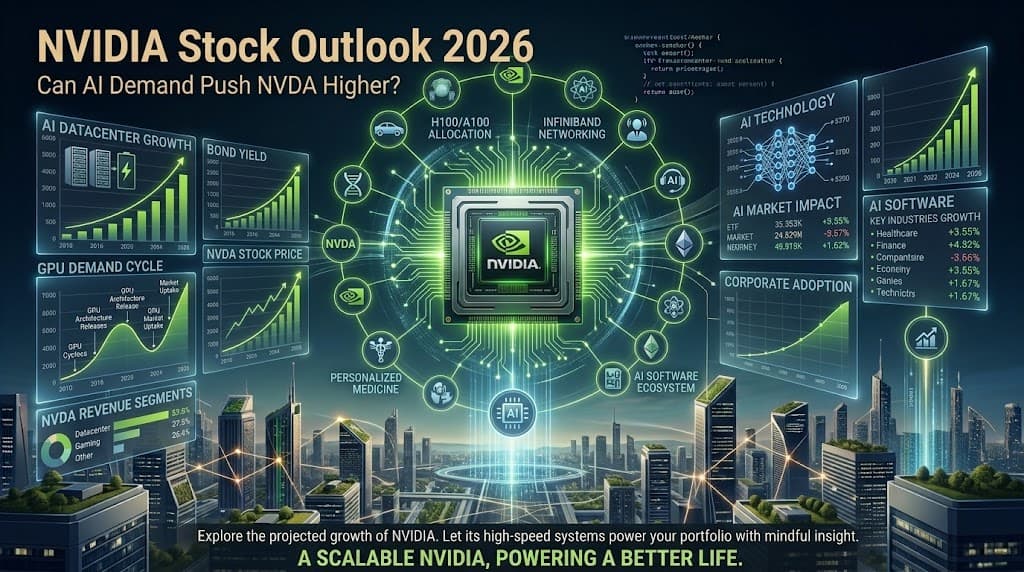

NVIDIA has become one of the most important companies in the artificial intelligence boom. Its graphics processing units (GPUs), networking technology, and data-center platforms are widely used to build and operate advanced AI systems.
As AI investment continues to attract attention in 2026, investors are asking an important question: Can NVIDIA stock continue its growth, or are expectations already too high?
NVIDIA’s Role in the AI Revolution
NVIDIA is a major supplier of computing technology used for AI training and inference. Its GPUs provide the processing power required by many large-scale AI models and data centers.
The continued expansion of generative AI, autonomous systems, robotics, and enterprise AI could support long-term demand for accelerated computing.
Why NVIDIA Stock Remains in Focus
NVIDIA's strong position in AI infrastructure has made NVDA one of the most closely followed technology stocks. Investors are watching its revenue growth, profitability, product launches, data-center demand, and relationships with major technology companies.
The stock's future, however, will depend on whether business growth can continue to justify investor expectations.
AI Data Centers and NVIDIA
Modern AI systems require enormous amounts of computing power. Cloud providers and technology companies are investing heavily in data centers capable of supporting AI workloads.
NVIDIA benefits from this spending through its GPUs, networking products, and broader data-center ecosystem.
NVIDIA’s Next-Generation Chips
The company's future performance is closely connected to its ability to deliver increasingly powerful and efficient computing platforms.
New generations of chips can encourage customers to upgrade their infrastructure, potentially creating additional demand. Investors will therefore pay close attention to product launches, production capacity, and customer adoption.
NVIDIA and Hyperscale Cloud Companies
Large cloud providers are among the biggest buyers of AI computing infrastructure. Their continued investment in AI data centers can have a major impact on NVIDIA's business.
If hyperscalers maintain strong capital spending on AI infrastructure, NVIDIA could continue benefiting from this trend.
Competition in the AI Chip Market
NVIDIA does not operate without competition. Companies such as AMD and Intel are developing competing solutions, while major cloud providers are also designing custom AI accelerators.
Competition could eventually put pressure on prices, margins, or NVIDIA's market share.
NVIDIA’s Software Advantage
NVIDIA's competitive position is not based only on hardware. Its software ecosystem and development tools can make it easier for developers and organizations to build AI applications using NVIDIA hardware.
A strong software ecosystem can create additional customer loyalty and make switching to competing platforms more difficult.
NVIDIA’s Financial Performance
Revenue growth and profitability are critical factors for NVDA investors. Strong demand for AI infrastructure can translate into higher sales, but investors also need to consider operating expenses, margins, supply constraints, and future growth expectations.
Quarterly earnings reports can therefore create significant movements in the stock.
Could AI Spending Slow Down?
One major risk is that companies could eventually reduce their AI infrastructure spending.
After making large investments, some businesses may begin demanding clearer returns on those investments. A slowdown in data-center spending could affect companies throughout the AI hardware supply chain, including NVIDIA.
NVIDIA and Robotics
AI-powered robotics is another potential growth area. Robots used in manufacturing, logistics, healthcare, and other industries require advanced computing and AI capabilities.
If robotics adoption accelerates, it could create another source of demand for NVIDIA's technology.
NVIDIA in Autonomous Vehicles
NVIDIA also develops computing platforms for autonomous and software-defined vehicles. As automotive companies invest in advanced driver-assistance systems and autonomous technology, automotive computing could become another important opportunity.
NVIDIA and Generative AI
The growth of generative AI has been a major catalyst for demand for accelerated computing. Businesses are using AI for search, customer service, coding, content creation, analytics, and automation.
As organizations move from experimenting with AI to deploying it at scale, demand for computing infrastructure could remain strong.
NVIDIA’s Global Supply Chain
Semiconductor manufacturing depends on a complex global supply chain. Manufacturing capacity, advanced packaging, memory availability, geopolitical developments, and logistics can all affect NVIDIA's ability to meet customer demand.
Supply-chain conditions remain an important consideration for investors.
What Could Drive NVDA Higher in 2026?
Potential growth drivers include:
Continued AI infrastructure spending
Strong data-center demand
New GPU platforms
Generative AI adoption
Growth in cloud computing
Robotics expansion
Autonomous vehicle technology
Enterprise AI adoption
Software ecosystem growth
Strong corporate earnings
Risks Facing NVIDIA Stock
Despite its strong AI position, NVIDIA faces several risks. These include high investor expectations, competition, semiconductor supply constraints, regulatory developments, geopolitical tensions, and a possible slowdown in AI spending.
A strong company can still experience stock-price declines if its results fail to meet market expectations.
NVIDIA Valuation and Investor Expectations
Valuation is an important consideration for any investor. When expectations for future growth are extremely high, even strong earnings may not be enough to push a stock higher if investors were expecting even better results.
NVDA investors should therefore consider both business performance and the expectations already reflected in the stock price.
What Investors Should Watch in 2026
Important indicators include:
NVIDIA quarterly earnings
Data-center revenue
Gross margins
AI infrastructure spending
New chip launches
Cloud-provider capital expenditure
Competitor product announcements
Supply-chain conditions
Regulatory developments
Management's future guidance
NVIDIA’s Long-Term AI Opportunity
The long-term opportunity for NVIDIA extends beyond today's AI boom. AI computing could become an increasingly important part of cloud services, enterprise software, robotics, healthcare, scientific research, and autonomous systems.
The challenge for investors is determining how much future growth is already reflected in NVIDIA's market valuation.
Final Thoughts
NVIDIA remains a central player in the global AI infrastructure market. Continued AI adoption, data-center investment, and new computing technologies could provide significant opportunities for the company.
At the same time, NVDA is not without risk. Competition, valuation, supply constraints, regulation, and changes in AI spending could influence its future performance.
Investors should evaluate NVIDIA's fundamentals and their own risk tolerance rather than relying solely on short-term stock-price predictions.
This article is for informational purposes only and is not personalized investment advice.
30 FAQs
1. What does NVIDIA do?
NVIDIA develops GPUs, networking products, software, and computing platforms used for AI, gaming, data centers, professional visualization, and other applications.
2. Why is NVIDIA important to AI?
Its GPUs and related software provide computing infrastructure used to train and run many advanced AI systems.
3. What is NVDA?
NVDA is NVIDIA Corporation's stock ticker symbol.
4. Why is NVIDIA stock popular?
Investors are interested in NVIDIA because of its significant role in AI computing and its strong exposure to data-center and semiconductor growth.
5. Can NVIDIA stock continue rising in 2026?
It could, but future performance depends on earnings growth, valuation, AI demand, market conditions, and other factors.
6. What is driving NVIDIA's growth?
AI infrastructure investment and data-center demand are among the major factors supporting NVIDIA's business.
7. Who competes with NVIDIA?
AMD and Intel are among its major semiconductor competitors, while several technology companies are also developing custom AI chips.
8. Does NVIDIA make AI chips?
Yes. NVIDIA develops GPUs and accelerated-computing platforms designed for AI workloads.
9. Why are data centers important to NVIDIA?
Large AI models require substantial computing resources, creating demand for data-center GPUs, networking, and related infrastructure.
10. Could AI demand decline?
AI spending could slow if companies reduce infrastructure investment or demand clearer returns from their AI projects.
11. Is NVIDIA dependent on AI?
AI is a major growth driver, although NVIDIA also has businesses and opportunities in gaming, professional visualization, automotive, and other markets.
12. What is NVIDIA's software advantage?
Its software ecosystem and development tools can help developers optimize applications for NVIDIA hardware.
13. Does NVIDIA compete with AMD?
Yes. AMD develops competing GPUs and AI accelerators and is one of NVIDIA's major competitors.
14. Why do NVIDIA earnings matter?
Earnings provide information about revenue growth, profitability, demand, margins, and management's expectations for the future.
15. What could hurt NVIDIA stock?
A slowdown in AI spending, increased competition, supply problems, regulation, geopolitical risks, or disappointing earnings could pressure the stock.
16. Is NVIDIA involved in robotics?
Yes. NVIDIA provides computing and software technologies designed to support robotics and physical AI applications.
17. Is NVIDIA involved in autonomous vehicles?
Yes. The company develops automotive computing platforms and technologies for advanced driver-assistance and autonomous-driving applications.
18. What are hyperscalers?
Hyperscalers are large cloud and technology companies operating massive computing infrastructures. They are major customers and investors in AI data centers.
19. Why is NVIDIA's valuation important?
A high valuation can mean investors already expect substantial future growth, increasing the importance of meeting or exceeding those expectations.
20. What should investors watch in NVIDIA earnings?
Investors commonly examine revenue growth, data-center sales, margins, guidance, new products, and management commentary.
21. Could custom AI chips hurt NVIDIA?
Potentially. If major technology companies increasingly use internally developed accelerators, demand for third-party AI hardware could be affected.
22. How important is NVIDIA's supply chain?
Very important. Advanced semiconductor manufacturing and packaging are necessary to produce its high-performance computing products.
23. Could NVIDIA benefit from enterprise AI?
Yes. Businesses adopting AI for automation, analytics, software development, and customer services may increase demand for AI infrastructure.
24. Could cloud computing support NVIDIA?
Continued investment in cloud AI infrastructure could support demand for NVIDIA's data-center technologies.
25. What role does generative AI play in NVIDIA's growth?
Generative AI requires significant computing power, helping drive demand for GPUs and accelerated computing platforms.
26. Could robotics become a major market for NVIDIA?
Robotics could become an important long-term opportunity if AI-powered robots see wider adoption across industries.
27. How does competition affect NVDA?
Competition can encourage innovation while potentially putting pressure on market share, pricing, and profit margins.
28. Is NVIDIA a technology stock?
Yes. NVIDIA is generally classified as a technology company and is also a major semiconductor and AI infrastructure company.
29. Should investors buy NVIDIA stock in 2026?
Whether to buy depends on an individual's financial goals, risk tolerance, valuation expectations, and investment strategy. No stock is guaranteed to rise.
30. What is NVIDIA's long-term outlook?
NVIDIA's long-term outlook is closely tied to AI adoption, accelerated computing, data centers, software, robotics, and other emerging technology markets.