TFThe Future of Smart Homes in 2026: AI, Automation & Connected Living
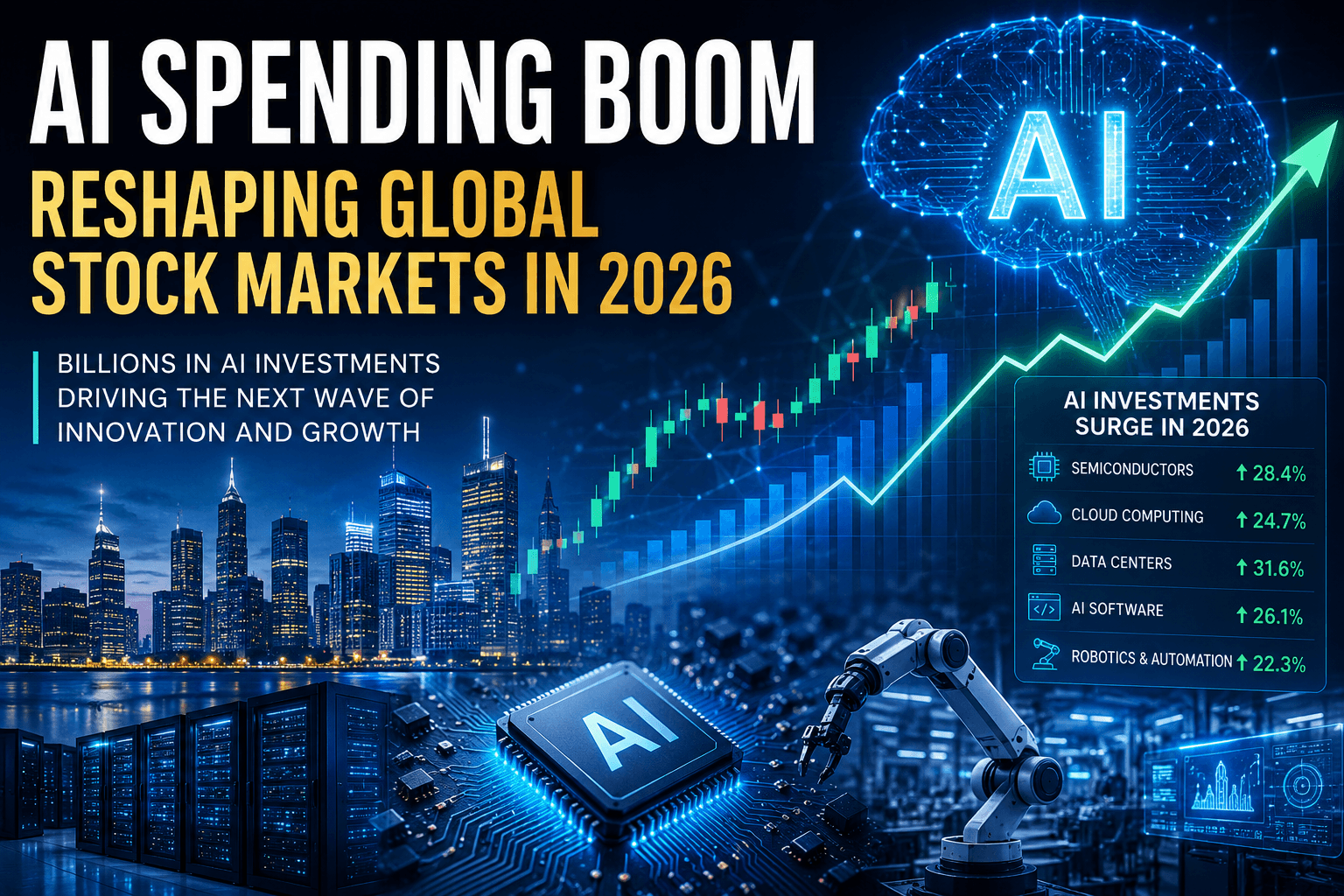
Artificial intelligence has moved far beyond being a promising technology—it has become one of the most powerful forces driving global financial markets. In 2026, AI spending by governments, technology companies, financial institutions, healthcare providers, and manufacturers is accelerating at an unprecedented pace. Billions of dollars are flowing into AI infrastructure, cloud computing, advanced semiconductors, enterprise software, and automation platforms, fundamentally changing how investors evaluate companies.
The latest market cycles demonstrate that artificial intelligence is no longer viewed as a niche technology sector. Instead, it has become a central investment theme influencing valuations across industries. Companies capable of integrating AI into their products or operations are attracting stronger investor confidence, while businesses failing to adopt AI risk falling behind competitors.
This transformation has created one of the biggest investment stories of the decade: the AI spending boom. Investors are increasingly recognizing that the businesses building AI infrastructure today may shape the global economy for years to come.
AI Investment Is Reaching Historic Levels
Global investment in artificial intelligence continues to expand as organizations seek competitive advantages through automation, predictive analytics, and intelligent decision-making. Large technology companies are allocating record budgets toward AI research, data centers, custom chips, cloud platforms, and machine learning models.
Rather than treating AI as a side project, corporations now consider it an essential part of long-term business strategy. This shift has encouraged institutional investors to focus on businesses with strong AI roadmaps instead of relying solely on traditional growth metrics.
The result is a significant increase in capital flowing toward AI-related industries, including:
Semiconductor manufacturing
Cloud infrastructure
Data center operators
Cybersecurity
Enterprise software
Robotics
Industrial automation
Healthcare technology
Financial technology
Autonomous systems
As these industries expand, stock markets increasingly respond to announcements related to AI investments rather than conventional quarterly earnings alone.
Why Investors Are Paying Close Attention
The rapid growth of AI spending reflects more than excitement around new technology. Investors believe AI has the potential to increase productivity across nearly every sector of the economy.
Businesses implementing AI successfully can often:
Reduce operating expenses
Improve customer experiences
Increase employee productivity
Enhance supply chain efficiency
Accelerate research and development
Improve financial forecasting
Reduce human error
Generate new revenue streams
Companies demonstrating measurable improvements from AI adoption frequently receive stronger valuations because investors expect higher future profitability.
AI Infrastructure Has Become the Foundation of Growth
One of the largest beneficiaries of the AI boom is infrastructure.
Training advanced AI systems requires enormous computing power. This demand has fueled significant investments in:
Graphics processing units (GPUs)
High-performance servers
AI accelerators
Cloud computing
Networking equipment
Data storage
Energy-efficient computing
Technology firms are expanding global data center capacity to support growing AI workloads. Cloud providers are racing to build larger, more efficient facilities capable of processing trillions of AI calculations every day.
Infrastructure companies that supply these technologies are becoming increasingly important players in financial markets.
Semiconductor Companies Remain at the Center
Artificial intelligence cannot function without advanced semiconductor technology.
Modern AI models require specialized processors capable of handling complex mathematical operations efficiently. This demand has significantly increased investment in semiconductor design, manufacturing, and packaging.
Investors continue monitoring companies involved in:
AI chips
Memory technology
High-speed networking
Advanced manufacturing equipment
Chip fabrication
Semiconductor materials
As AI adoption spreads globally, semiconductor demand extends beyond technology firms into healthcare, automotive manufacturing, industrial automation, finance, defense, and telecommunications.
This diversification helps reduce dependence on any single industry while creating multiple long-term revenue opportunities.
Cloud Computing Continues Expanding
Cloud providers remain among the biggest winners of increasing AI spending.
Instead of building expensive AI infrastructure internally, many organizations choose cloud-based AI services that provide scalable computing resources on demand.
This model offers several advantages:
Lower upfront investment
Faster deployment
Flexible computing capacity
Enhanced security
Easier AI integration
Global accessibility
As enterprises continue migrating AI workloads to the cloud, cloud service providers benefit from recurring subscription revenue, making them attractive to long-term investors.
Enterprise AI Is Driving Corporate Transformation
Businesses across nearly every industry are integrating artificial intelligence into daily operations.
Instead of replacing employees entirely, AI increasingly assists professionals by automating repetitive tasks while enabling workers to focus on higher-value activities.
Examples include:
Banking
AI detects fraudulent transactions, automates customer support, and improves credit risk analysis.
Healthcare
Hospitals use AI to analyze medical images, assist diagnosis, and optimize patient scheduling.
Manufacturing
Factories deploy AI for predictive maintenance, quality control, and robotics.
Retail
Retailers personalize shopping experiences using recommendation engines and inventory forecasting.
Logistics
Transportation companies optimize delivery routes using AI-driven analytics.
These improvements increase operational efficiency while strengthening long-term profitability.
Global Markets Are Responding
Artificial intelligence is influencing stock markets beyond the United States.
Investors are increasingly evaluating opportunities in:
Europe
Asia-Pacific
Middle East
India
Japan
South Korea
Governments worldwide are introducing policies encouraging AI research, semiconductor manufacturing, and digital infrastructure investment.
Countries competing to become AI leaders continue attracting domestic and international investment, creating additional growth opportunities for public companies.
AI Is Changing How Investors Evaluate Businesses
Traditional investment analysis focused heavily on earnings growth, revenue, debt levels, and cash flow.
Today, investors increasingly ask additional questions:
Does the company have a clear AI strategy?
Is management investing in automation?
Can AI improve long-term profitability?
Does the company own valuable AI intellectual property?
Can AI create new revenue opportunities?
Is management capable of executing AI initiatives?
Businesses providing convincing answers often receive stronger investor support.
The Risks Investors Should Not Ignore
Despite enormous enthusiasm, AI investing also carries meaningful risks.
These include:
High infrastructure costs
Intense competition
Regulatory uncertainty
Data privacy concerns
Cybersecurity threats
Rapid technological change
Valuation risk
Geopolitical tensions affecting semiconductor supply chains
Investors should balance growth expectations with careful analysis of financial fundamentals rather than relying solely on market excitement.
FAQs:
1. What is the AI spending boom?
The AI spending boom refers to the rapid increase in investments by businesses, governments, and technology companies in artificial intelligence technologies, including AI software, cloud computing, data centers, semiconductors, and automation tools.
2. Why is AI influencing global stock markets?
AI is driving stock markets because investors expect companies adopting AI to improve productivity, reduce costs, and generate stronger long-term earnings, making them more attractive investments.
3. Which industries benefit the most from AI spending?
Key beneficiaries include semiconductor manufacturers, cloud computing providers, software companies, cybersecurity firms, healthcare technology companies, robotics manufacturers, and industrial automation businesses.
4. How do semiconductor companies benefit from AI?
AI models require powerful chips for training and inference. This has significantly increased demand for GPUs, AI accelerators, memory chips, and advanced semiconductor manufacturing technologies.
5. Why are cloud providers gaining from AI growth?
Cloud providers offer scalable computing power that businesses use to build and deploy AI applications without investing heavily in their own infrastructure, creating recurring revenue opportunities.
6. Can AI improve company profitability?
Yes. AI can automate repetitive tasks, improve operational efficiency, optimize supply chains, reduce errors, and enhance customer experiences, all of which can contribute to higher profitability.
7. Is AI only benefiting technology companies?
No. Industries such as healthcare, finance, retail, manufacturing, logistics, energy, education, and agriculture are increasingly using AI to improve operations and decision-making.
8. What risks should investors consider when investing in AI-related stocks?
Investors should consider high valuations, regulatory changes, cybersecurity risks, technological competition, infrastructure costs, and geopolitical issues affecting semiconductor supply chains.
9. How does AI impact long-term investment strategies?
AI has become a long-term growth theme, encouraging investors to focus on companies with sustainable AI strategies, innovation capabilities, and strong financial fundamentals rather than short-term market trends.
10. Will AI continue to shape stock markets beyond 2026?
Most analysts expect AI to remain a major driver of global markets as businesses continue increasing investments in automation, enterprise AI, cloud infrastructure, advanced chips, and digital transformation over the coming years.