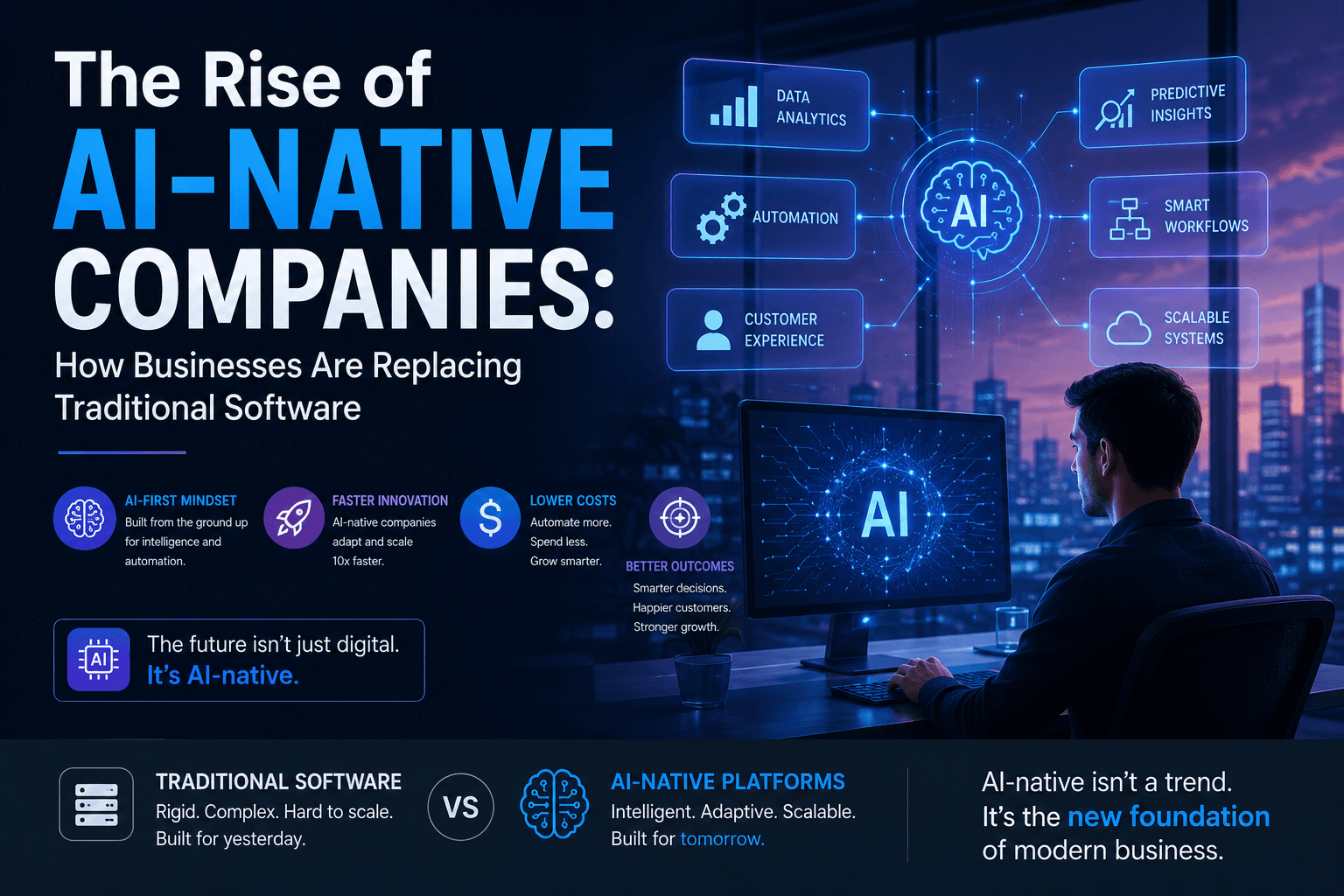

Artificial intelligence is no longer just another feature added to business software—it is becoming the foundation upon which modern companies are built. Across industries, organizations are shifting from traditional software platforms to AI-native systems that automate workflows, improve decision-making, and create entirely new ways of operating. This transformation is changing how businesses develop products, serve customers, manage employees, and compete in the global economy.
In 2026, AI-native companies are emerging as the fastest-growing organizations because they are designed around artificial intelligence from day one. Instead of treating AI as an optional enhancement, these companies rely on machine learning, generative AI, and intelligent automation to power nearly every aspect of their operations.
What Is an AI-Native Company?
An AI-native company is a business that builds its products, services, and internal operations around artificial intelligence. Unlike traditional organizations that integrate AI into existing software, AI-native businesses design their systems with AI at the core.
Their platforms continuously learn from data, improve performance over time, and automate processes that once required significant human effort. This allows them to respond faster to customer needs, reduce costs, and innovate more rapidly than companies relying on conventional software.
Why Traditional Software Is Being Replaced
For decades, businesses depended on software that followed predefined rules. These systems required users to manually enter data, configure workflows, and update processes whenever business requirements changed.
AI-native platforms work differently.
Instead of waiting for instructions, they can:
Understand natural language
Analyze massive datasets
Generate reports automatically
Predict customer behavior
Recommend business strategies
Automate repetitive tasks
Learn from user interactions
As a result, companies spend less time managing software and more time focusing on innovation and growth.
The Technologies Behind AI-Native Businesses
Several advanced technologies make AI-native companies possible.
Large Language Models (LLMs)
Modern AI assistants can understand context, answer questions, summarize documents, generate content, and assist employees across multiple departments.
Machine Learning
Machine learning enables systems to improve automatically as more data becomes available, making business processes increasingly accurate over time.
Natural Language Processing (NLP)
NLP allows software to understand conversations, emails, customer requests, and documents in human language rather than requiring structured commands.
Cloud Computing
Cloud infrastructure provides the computing power needed to train and deploy AI applications at scale while reducing infrastructure costs.
Intelligent Automation
AI-powered automation eliminates repetitive manual work across finance, HR, sales, customer service, and operations.
Industries Leading the AI-Native Revolution
AI-native companies are expanding across nearly every major industry.
Healthcare
Hospitals use AI to analyze medical images, automate documentation, predict patient risks, and improve treatment planning.
Financial Services
Banks use AI to detect fraud, automate compliance, assess lending risks, and provide personalized financial recommendations.
Manufacturing
Manufacturers rely on AI for predictive maintenance, quality control, production scheduling, and supply chain optimization.
Retail and E-commerce
Retailers personalize shopping experiences, forecast inventory demand, optimize pricing, and automate customer support using AI.
Marketing
Marketing teams generate content, analyze campaign performance, personalize advertisements, and predict consumer behavior with AI-powered platforms.
How AI-Native Companies Improve Productivity
One of the biggest advantages of AI-native organizations is their ability to automate repetitive work.
Instead of spending hours creating reports, organizing data, responding to customer inquiries, or scheduling meetings, employees can rely on AI assistants to complete these tasks within minutes.
This allows teams to focus on:
Strategic planning
Product innovation
Customer relationships
Creative problem-solving
Business development
Higher productivity translates directly into faster business growth.
AI Is Transforming Customer Experience
Modern consumers expect immediate responses and personalized interactions.
AI-native businesses meet these expectations through:
Intelligent chatbots
Virtual assistants
Personalized product recommendations
Real-time customer support
Automated follow-up communications
Predictive customer service
Rather than waiting hours for support, customers receive accurate answers within seconds.
Lower Costs and Greater Efficiency
Traditional software often requires multiple tools for accounting, customer management, marketing, analytics, and project management.
AI-native platforms combine many of these capabilities into unified systems that reduce software subscriptions and administrative overhead.
Organizations also benefit from:
Reduced operational costs
Faster decision-making
Lower error rates
Improved resource allocation
Better scalability
These efficiencies create significant long-term savings.
The Future of Software Development
Software development itself is changing.
Developers increasingly use AI for:
Writing code
Finding bugs
Creating documentation
Testing applications
Reviewing security vulnerabilities
Optimizing performance
Rather than replacing developers, AI acts as a productivity partner that accelerates software delivery while improving quality.
Challenges Facing AI-Native Companies
Despite their advantages, AI-native businesses still face several obstacles.
Data Privacy
AI systems require large volumes of data, making privacy protection a top priority.
Cybersecurity
As AI becomes more powerful, cybercriminals are also using AI to launch more sophisticated attacks.
Regulation
Governments worldwide continue developing rules governing responsible AI development and deployment.
Workforce Training
Employees must learn how to work effectively alongside AI systems rather than viewing them as replacements.
What This Means for Businesses
Organizations that embrace AI-native strategies are likely to gain competitive advantages through greater efficiency, improved customer experiences, and faster innovation.
Businesses that continue relying solely on traditional software may struggle to keep pace with competitors using intelligent automation and AI-driven decision-making.
The transition does not necessarily require replacing every existing system overnight. Many organizations begin by introducing AI into customer support, analytics, marketing, or internal operations before expanding AI across the business.
The Future of AI-Native Companies
Over the next decade, AI-native businesses are expected to become the standard rather than the exception. Intelligent systems will increasingly manage workflows, support employees, optimize operations, and help leaders make faster, data-driven decisions.
Instead of simply providing software tools, future business platforms will act as intelligent partners capable of understanding goals, executing tasks, and continuously improving outcomes. Companies that invest in AI-first strategies today will be better positioned to lead tomorrow's digital economy.
Conclusion
The rise of AI-native companies marks one of the most significant shifts in business technology since the emergence of cloud computing. By replacing traditional software with intelligent, adaptive systems, organizations are unlocking new levels of productivity, innovation, and customer satisfaction.
As artificial intelligence continues to evolve, businesses that embrace AI-native operations will be better equipped to compete in an increasingly digital and automated world. The future of enterprise software is no longer about adding AI features—it is about building businesses where AI is the foundation of every process, decision, and customer interaction.
Frequently Asked Questions (FAQs)
FAQ 1: What is an AI-native company, and why is it becoming important?
An AI-native company is a business that builds its products, services, and internal operations around artificial intelligence from the very beginning rather than adding AI features to existing software later. AI serves as the foundation of the company's technology, enabling intelligent automation, predictive analytics, personalized customer experiences, and data-driven decision-making. These companies continuously improve their systems using machine learning and large language models, making them more adaptive and efficient than traditional software-based businesses. As organizations seek to reduce costs, increase productivity, and stay competitive, AI-native companies are becoming a major force in the digital economy.
FAQ 2: How are AI-native companies replacing traditional software?
AI-native companies are replacing traditional software by offering intelligent platforms that can understand user intent, automate repetitive tasks, generate content, analyze data, and make recommendations without requiring extensive manual configuration. Unlike conventional software that relies on predefined rules and workflows, AI-native applications learn from data and continuously improve their performance over time. Businesses are increasingly adopting these solutions for customer support, marketing, finance, software development, and operations because they improve efficiency, reduce operational costs, accelerate decision-making, and allow employees to focus on higher-value work instead of routine administrative tasks.