
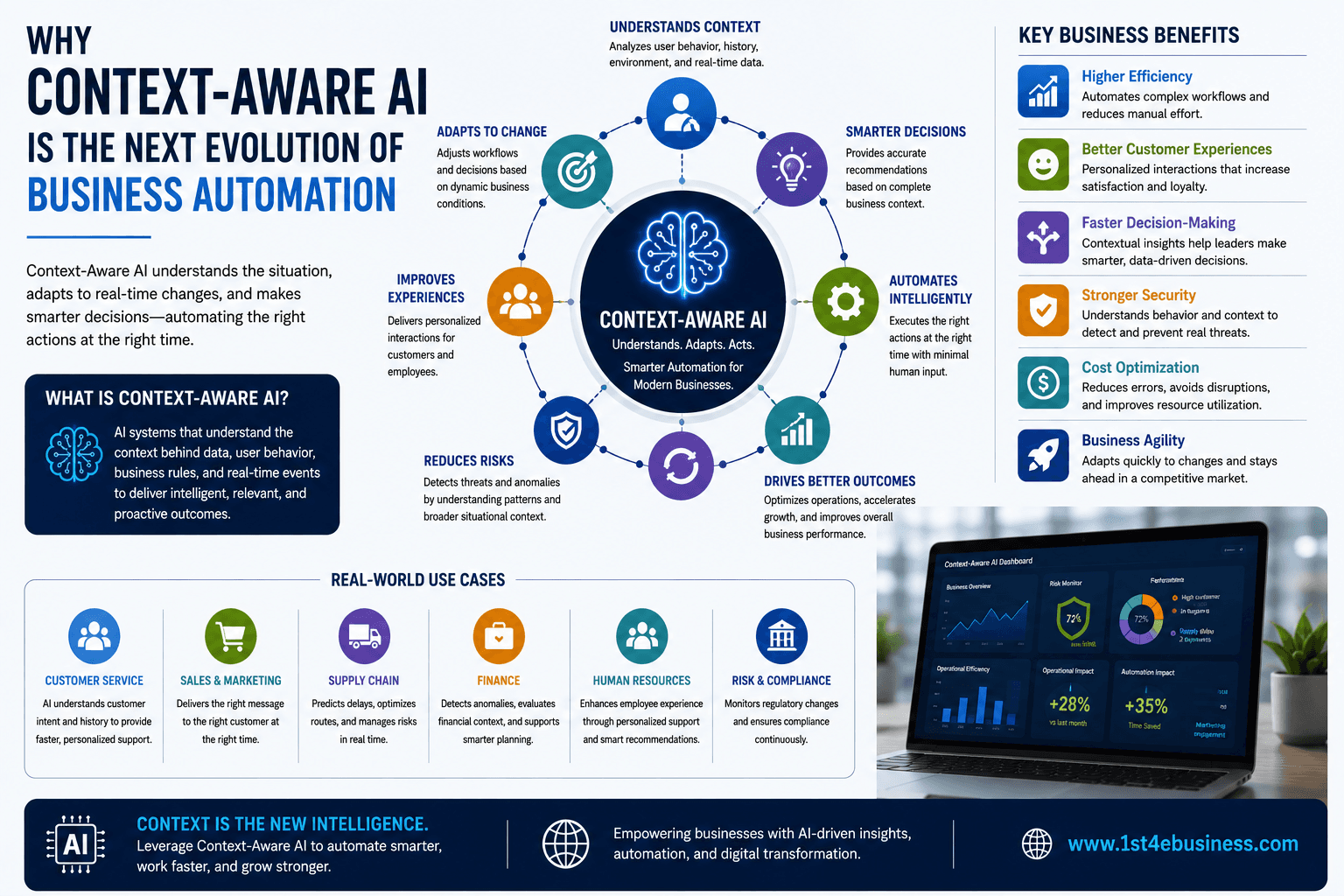

Business automation has evolved rapidly over the past decade. Early automation systems followed rigid rules: if something happened, the software performed a predefined action. Robotic process automation expanded those capabilities by automating repetitive digital tasks.
Now, artificial intelligence is pushing automation into a new phase.
Context-aware AI can understand the circumstances surrounding a task before deciding what to do. Instead of simply following instructions, it can consider information such as customer history, business rules, previous interactions, current conditions, organizational goals, and the desired outcome.
This shift could make business automation more flexible, intelligent, and capable of handling complex workflows.
What Is Context-Aware AI?
Context-aware AI refers to artificial intelligence systems that use surrounding information to interpret situations and make more relevant decisions.
A traditional automation workflow might follow:
Trigger → Rule → Action
A context-aware system can operate more like:
Situation → Context → Reasoning → Decision → Action → Feedback
For example, a traditional customer-service automation might send the same response whenever a customer submits a refund request.
A context-aware AI system could consider the customer's purchase history, previous complaints, subscription status, refund policy, product type, and urgency before recommending an appropriate response.
The difference is not simply automation.
It is contextual decision-making.
Why Traditional Automation Has Limitations
Rule-based automation works extremely well when processes are predictable.
For example:
Send an invoice after an order is completed.
Notify a manager when a payment exceeds a threshold.
Create a ticket when a monitoring system detects an error.
Send a reminder seven days before a deadline.
But real businesses rarely operate entirely according to fixed rules.
Employees encounter exceptions, customers behave differently, market conditions change, and business priorities evolve.
Rigid automation can struggle when a situation doesn't fit its predefined logic.
Context-aware AI is designed to handle more of these variations.
Context Makes AI More Useful
AI models can generate text, analyze data, classify information, and make recommendations. But without sufficient context, their outputs may be generic or inaccurate.
Context provides the information needed to make an output more relevant.
For businesses, useful context can include:
Customer information
Transaction history
Company policies
Industry regulations
Previous conversations
Current business objectives
Employee roles
Operational data
Product information
Real-time events
The more effectively an AI system can retrieve and interpret relevant context, the more useful its decisions can become.
Context-Aware Customer Service
Customer service is one of the clearest applications.
Imagine a customer contacting an online retailer about a delayed order.
A basic chatbot might ask for an order number and provide a generic shipping message.
A context-aware AI system could potentially identify:
The customer's order
Shipping status
Previous interactions
Customer preferences
Delivery history
Available compensation policies
Product value
Service-level commitments
It could then provide a response tailored to the situation.
The goal is not simply to automate conversations. It is to make automated interactions feel more informed and useful.
Smarter Sales Automation
Sales teams generate enormous amounts of customer data.
Context-aware AI can combine information from CRM systems, emails, meetings, website activity, purchase history, and support interactions to create a more complete picture of a prospect.
Instead of simply telling a salesperson that a lead is active, an AI system could identify why the lead appears ready for engagement.
For example:
"The prospect has viewed the enterprise pricing page three times, attended a product webinar, and recently opened two implementation-related emails."
This context can help sales representatives prioritize their time and personalize their outreach.
More Intelligent Marketing
Marketing automation has traditionally relied heavily on predefined customer segments.
Context-aware AI can potentially move beyond static segmentation.
A customer's behavior, preferences, previous purchases, browsing activity, and current engagement can all contribute to deciding what content or offer is most relevant.
Instead of sending the same campaign to everyone, businesses can create dynamic experiences based on changing customer context.
This can improve personalization while reducing irrelevant messaging.
Context-Aware Employee Workflows
Context-aware automation isn't limited to customers.
Employees can also benefit.
Consider an employee requesting access to a business application.
A basic system may simply route the request to an administrator.
A context-aware system could consider the employee's department, role, manager, existing permissions, project assignment, security policies, and access history.
The system could then determine whether the request should be automatically approved, rejected, or escalated for human review.
This can make internal processes faster while maintaining appropriate controls.
AI Agents and Context
Context-aware AI is closely connected to the rise of AI agents.
AI agents are designed to perform tasks across multiple steps rather than simply generating individual responses.
For agents to operate effectively, they need context.
An AI sales agent, for example, may need to understand:
The customer's previous conversations
Available products
Pricing policies
Inventory
Sales targets
Approval requirements
Customer preferences
Without this information, an agent may perform actions that technically follow its instructions but don't make sense for the business.
Context allows AI agents to operate more intelligently within real-world environments.
Context Improves Decision-Making
One of the biggest opportunities is using AI to support business decisions.
A company could ask:
"Should we increase inventory for this product?"
A simple AI system might look at historical sales.
A context-aware system could consider sales trends, current inventory, supplier lead times, seasonal demand, promotions, customer behavior, and market conditions.
That doesn't guarantee the correct decision, but it provides a richer foundation for analysis.
The Importance of Data Integration
Context-aware AI depends heavily on access to relevant information.
If customer information exists in one system, sales history in another, support conversations in a third, and inventory data somewhere else, the AI may struggle to understand the full situation.
This makes integration increasingly important.
Businesses may need to connect:
CRM platforms
ERP systems
Customer-service tools
Data warehouses
Communication platforms
Knowledge bases
Document repositories
Business intelligence systems
Better-connected data creates better context.
Context Windows Aren't Enough
A common misconception is that giving an AI model a large amount of information automatically creates context awareness.
It doesn't.
Effective context management requires selecting the right information at the right time.
Too little context can produce incomplete answers.
Too much irrelevant context can overwhelm the system and reduce efficiency.
Businesses therefore need intelligent retrieval, data prioritization, permissions, and context management.
Security and Privacy Challenges
Context-aware AI also introduces significant governance challenges.
The more information an AI system can access, the greater the potential impact of inappropriate access.
Organizations need clear rules regarding:
Data permissions
Sensitive information
Customer privacy
Employee data
Access controls
Audit logs
Model behavior
Human approval
Data retention
An AI system should only access the information it is authorized to use.
Human Oversight Remains Important
Context-aware AI can improve automation, but businesses shouldn't assume that every decision should be fully automated.
High-impact decisions may require human review.
A useful model is:
AI recommends → Human validates → System executes
For lower-risk repetitive tasks, more automation may be appropriate.
For high-risk financial, legal, employment, or customer decisions, human oversight can remain essential.
How Businesses Can Prepare
Organizations interested in context-aware AI should begin with practical use cases.
Start by identifying processes where employees spend significant time collecting information before making a decision.
These may include:
Customer support
Sales qualification
Contract review
Procurement
Fraud detection
IT support
Financial operations
Compliance monitoring
Then determine what context is required to make those processes work effectively.
Businesses should also improve their data quality and integration before deploying complex AI systems.
The Future of Business Automation
The next generation of automation will likely be less about executing fixed instructions and more about understanding situations.
Context-aware AI can help systems interpret changing circumstances, retrieve relevant information, make recommendations, and take appropriate actions.
This could create a new model of enterprise automation where software doesn't simply ask:
"What rule should I follow?"
Instead, it can ask:
"What is happening, what information matters, and what should happen next?"
That represents a major evolution in business automation.
Conclusion
Context-aware AI has the potential to make business automation more adaptive, personalized, and intelligent.
Its value comes from combining AI capabilities with the information surrounding a business process. When systems can understand customers, employees, policies, history, and real-time conditions, automation becomes capable of handling more complex situations.
The organizations that benefit most will not necessarily be those that automate the largest number of tasks. They will be the ones that use AI to understand context, make better decisions, and augment human expertise.
As AI agents, enterprise data platforms, and intelligent automation continue to mature, context may become one of the most important ingredients separating basic automation from truly intelligent business operations.