
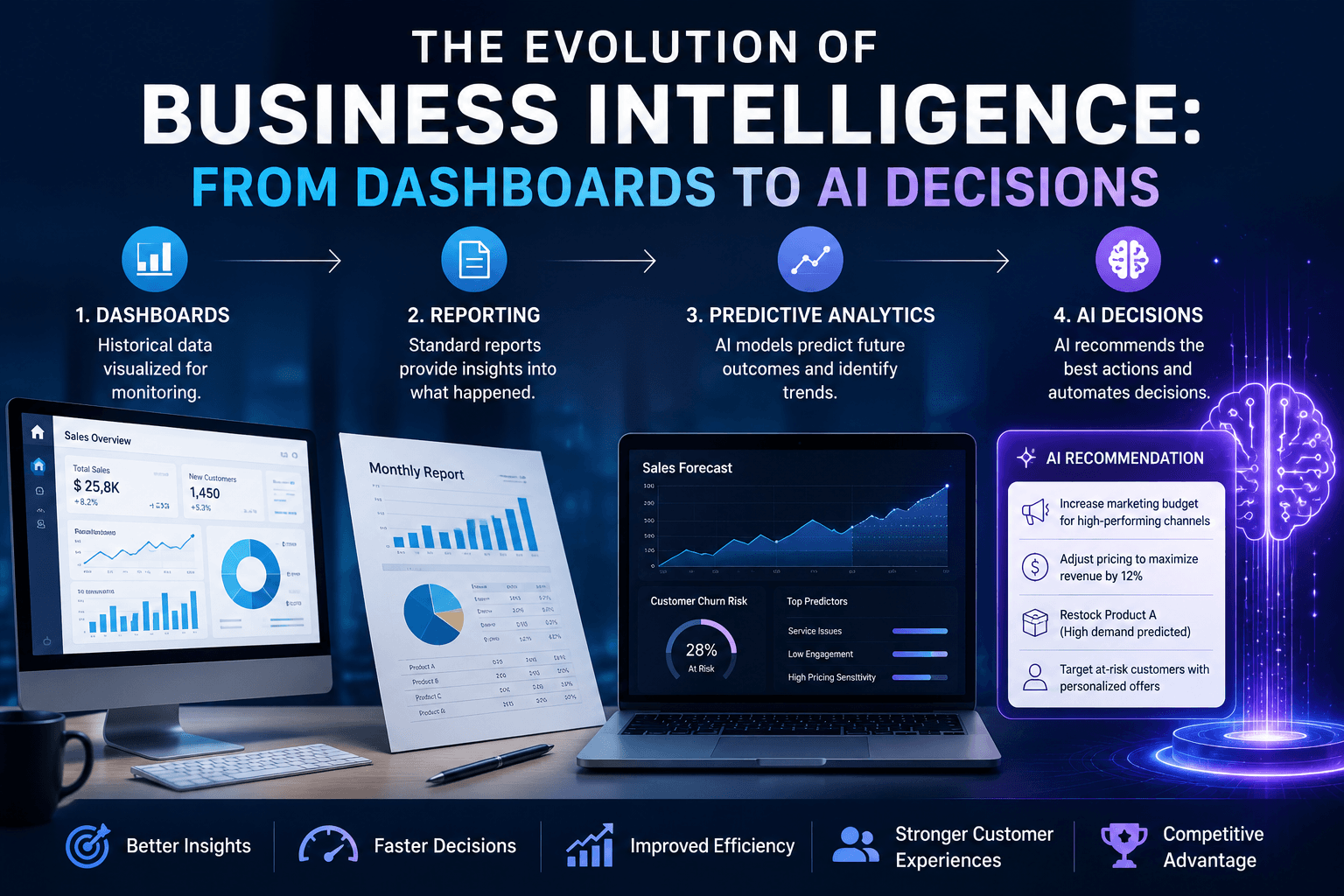

business intelligence has undergone a dramatic transformation. What began as a way to turn historical business data into reports and dashboards is evolving into intelligent systems capable of analyzing information, predicting outcomes, recommending actions, and increasingly supporting automated decisions.
This shift is changing how organizations understand data and how leaders make business decisions.
What Is Business Intelligence?
Business intelligence (BI) refers to the technologies, processes, and practices businesses use to collect, analyze, and transform data into useful insights.
Traditional BI typically focused on questions such as:
What happened?
How did the business perform?
Which products generated the most revenue?
Where are costs increasing?
Which regions are underperforming?
Modern AI-powered BI is expanding these questions:
What is likely to happen?
Why is it happening?
What should we do next?
Can the system take the appropriate action?
This represents a shift from descriptive reporting to intelligent decision support.
The Early Era of Business Intelligence
Early business intelligence systems were primarily designed to organize and report historical information.
Companies collected data from sales, finance, inventory, and operational systems and turned it into reports.
These reports helped managers understand business performance, but producing them could be slow and heavily dependent on analysts.
Data was often fragmented across different systems, making it difficult to create a unified view of the business.
The Rise of Dashboards
The next major development was the widespread adoption of interactive dashboards.
Instead of waiting for static reports, managers could view charts, graphs, key performance indicators, and trends in a centralized interface.
Dashboards made business information more accessible.
Executives could quickly monitor metrics such as:
Revenue
Profit margins
Sales performance
Customer acquisition
Inventory
Operational efficiency
However, dashboards still largely required humans to interpret the information and decide what action to take.
Self-Service BI
Business intelligence eventually became more accessible to non-technical employees.
Self-service BI tools allowed managers and business users to explore data without depending entirely on IT or specialized analysts.
Users could create reports, filter datasets, build visualizations, and investigate business questions themselves.
This democratized data analysis and helped organizations develop stronger data-driven cultures.
The Shift Toward Predictive Analytics
The next stage of BI introduced predictive analytics.
Instead of simply explaining what had happened, organizations began using historical and current data to estimate what might happen next.
Predictive analytics can help businesses forecast:
Customer demand
Sales
Churn
Fraud
Equipment failures
Cash flow
Market trends
This changed the role of BI from historical reporting toward future-oriented planning.
AI Enters Business Intelligence
Artificial intelligence is now transforming business intelligence even further.
AI can analyze large and complex datasets, identify patterns, generate summaries, detect anomalies, and answer questions using natural language.
Instead of navigating multiple dashboards, a business user might ask:
“Why did sales decline last quarter?”
An AI-powered BI system can potentially analyze the relevant data and provide a summary of the major factors contributing to the change.
This makes business intelligence more conversational and accessible.
Natural-Language Business Intelligence
One of the most significant changes is the ability to interact with business data using everyday language.
Users can ask questions such as:
“Which products have the highest growth potential?”
“Why are customer cancellations increasing?”
“Which region is exceeding its targets?”
“What could happen if we increase prices by 5%?”
Natural-language interfaces reduce the technical barriers associated with data analysis.
Business users no longer need to understand complex query languages to explore information.
From Insights to Recommendations
AI-powered BI is moving beyond simply presenting information.
Modern systems can increasingly connect insights with recommendations.
For example:
Insight: Customer churn has increased among a specific customer segment.
Prediction: Churn is likely to increase further over the next quarter.
Recommendation: Offer targeted retention incentives to high-value customers in that segment.
This progression moves BI toward decision intelligence.
The Emergence of AI Decision Systems
The newest stage of business intelligence involves AI systems that can support or perform parts of the decision-making process.
An AI decision system may:
Collect relevant data
Analyze current conditions
Identify patterns
Generate predictions
Compare potential actions
Recommend a decision
Execute approved actions
Monitor the outcome
This creates a continuous feedback loop between data, intelligence, decisions, and business results.
Agentic AI and Business Intelligence
Agentic AI is accelerating this transformation.
AI agents can potentially perform multi-step analytical tasks independently.
For example, an AI agent could monitor sales performance, investigate unusual changes, analyze customer behavior, prepare a report, and notify the appropriate manager.
With proper permissions, an agent could even initiate predefined actions.
This represents a major shift from passive dashboards to active intelligence.
The Role of Human Decision-Makers
AI-powered BI does not eliminate the need for human judgment.
Instead, the role of business leaders is evolving.
Humans remain responsible for:
Setting strategic objectives
Establishing business priorities
Evaluating major risks
Making high-impact decisions
Providing context
Ensuring accountability
AI can process information at enormous scale, but humans provide organizational context, values, experience, and judgment.
The future is therefore likely to involve closer collaboration between people and intelligent systems.
Real-Time Business Intelligence
Traditional BI often relied on scheduled reports.
Modern systems can process information much closer to real time.
This is valuable for industries where conditions change quickly.
Retailers can monitor demand, financial organizations can detect unusual transactions, manufacturers can track equipment performance, and logistics companies can monitor supply-chain disruptions.
Real-time intelligence allows businesses to respond to changes before they become larger problems.
Data Quality Becomes More Important
As BI becomes more intelligent, the importance of data quality increases.
AI systems depend on the information available to them.
Poor-quality, incomplete, outdated, or inconsistent data can produce misleading insights and recommendations.
Organizations therefore need strong:
Data governance
Data integration
Data quality management
Security
Metadata management
Access controls
The future of AI-powered BI depends as much on reliable data foundations as on advanced AI models.
Challenges of AI-Powered Business Intelligence
The transition to AI-driven decision-making introduces several challenges.
Accuracy
AI-generated insights can sometimes be incorrect or based on incomplete information.
Explainability
Decision-makers may need to understand how an AI system reached a recommendation.
Security
Sensitive business data must be protected from unauthorized access.
Governance
Organizations need clear rules around how AI can use data and influence decisions.
Over-Automation
Not every business decision should be automated. High-impact decisions may require human approval.
Building the Next Generation of BI
Businesses looking to modernize their intelligence capabilities should focus on several areas.
1. Strengthen Data Foundations
Ensure that critical business data is accurate, accessible, and governed.
2. Introduce AI Gradually
Start with high-value applications such as forecasting, anomaly detection, and natural-language analytics.
3. Connect BI to Business Workflows
Insights become more valuable when they can directly influence operational processes.
4. Establish AI Governance
Define permissions, accountability, security requirements, and human-approval processes.
5. Measure Business Outcomes
Evaluate AI-powered BI based on measurable improvements in revenue, productivity, costs, customer experience, or risk management.
The Future of Business Intelligence
Business intelligence is moving through several distinct stages:
Reports → Dashboards → Self-Service BI → Predictive Analytics → AI Insights → AI Recommendations → AI Decisions
The future will likely combine these capabilities rather than completely replace them.
Dashboards will remain useful for monitoring performance, while AI systems will provide deeper analysis and recommendations.
Eventually, AI agents may continuously monitor business conditions and help organizations respond automatically to predefined situations.
Conclusion
The evolution of business intelligence reflects a fundamental change in how organizations use information.
Traditional BI helped businesses understand the past.
Modern analytics helps them anticipate the future.
AI-powered intelligence is increasingly helping organizations determine what to do next.
The most important shift is therefore not simply from dashboards to AI. It is the transition from data visualization to intelligent decision-making.
Organizations that successfully combine high-quality data, AI capabilities, human judgment, and strong governance will be better positioned to make faster, smarter, and more adaptive business decisions.