
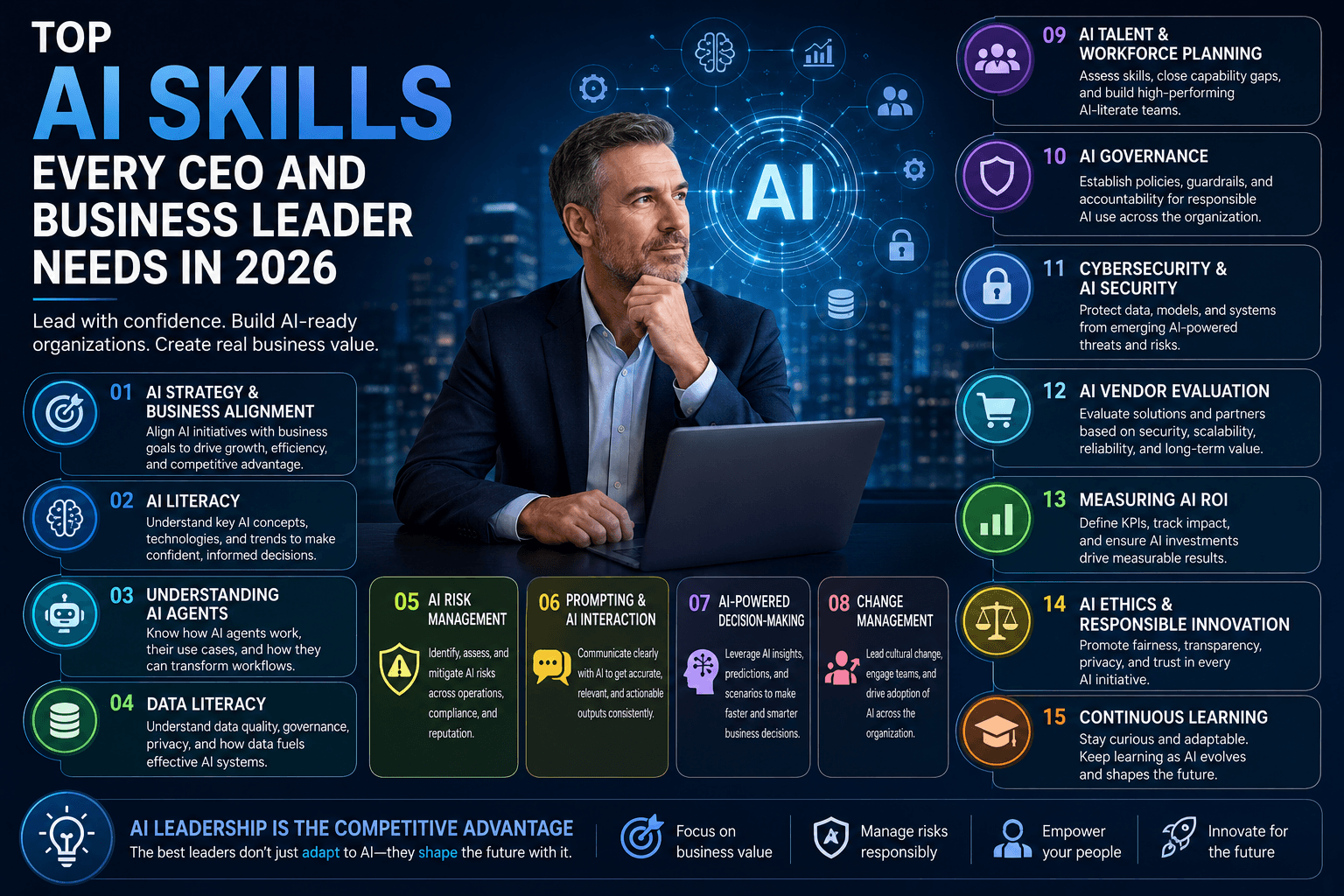

Artificial intelligence is no longer simply an IT initiative. In 2026, AI is influencing strategy, operations, customer experience, workforce planning, cybersecurity, and competitive positioning.
For CEOs and business leaders, the goal is not necessarily to become AI engineers. Instead, leaders need enough AI knowledge to identify opportunities, evaluate risks, make informed investments, and guide organizations through AI-driven transformation.
Here are the most important AI skills business leaders should develop in 2026.
1. AI Strategy and Business Alignment
The first skill is understanding how AI can support business objectives.
Leaders should be able to identify where AI can:
Increase revenue
Reduce operating costs
Improve customer experiences
Automate repetitive work
Strengthen decision-making
Create new products and services
Reduce business risks
The key question is not “Where can we use AI?”
It is:
“Where can AI create measurable business value?”
AI initiatives should therefore be connected to clear business outcomes rather than implemented simply because competitors are using AI.
2. AI Literacy
CEOs do not need to become machine-learning specialists, but they should understand fundamental AI concepts.
Important areas include:
Generative AI
Large language models
Machine learning
AI agents
Retrieval-augmented generation
Predictive analytics
AI automation
Model training and inference
Basic AI literacy allows leaders to communicate effectively with technical teams and make better technology decisions.
3. Understanding AI Agents
AI agents are becoming particularly important in 2026.
Unlike traditional software, agents can potentially interpret objectives, use tools, perform multi-step tasks, and operate with a degree of autonomy.
Business leaders should understand where agents can improve workflows and where human approval remains necessary.
For example, an AI agent might monitor sales opportunities, analyze customer interactions, update a CRM, and prepare follow-up actions.
Understanding these capabilities allows leaders to rethink workflows instead of simply adding AI to existing processes.
4. Data Literacy
AI depends heavily on data.
Executives need to understand how data is collected, managed, secured, and used.
Important concepts include:
Data quality
Data governance
Data privacy
Data security
Data ownership
Data accessibility
Data silos
Poor data can produce unreliable AI results, regardless of how sophisticated the underlying model is.
Leaders should therefore treat data as a strategic asset.
5. AI Risk Management
AI creates new business opportunities, but it also introduces new risks.
Executives should understand risks related to:
Incorrect AI outputs
Bias
Privacy
Cybersecurity
Intellectual property
Regulatory compliance
Model misuse
Automated decision-making
Leaders need frameworks that determine which AI applications are low-risk and which require stronger human oversight.
6. Prompting and AI Interaction
Prompt engineering is becoming less about writing clever prompts and more about knowing how to communicate effectively with AI systems.
Business leaders can benefit from learning how to:
Define clear objectives
Provide relevant context
Specify constraints
Request structured outputs
Ask AI to compare alternatives
Verify results
Iterate based on feedback
These skills can improve everyday productivity and help leaders understand what modern AI systems can realistically accomplish.
7. AI-Powered Decision-Making
Executives increasingly need to understand how AI can support business decisions.
AI can analyze large datasets, identify patterns, generate forecasts, evaluate scenarios, and recommend actions.
Leaders should know when AI recommendations are useful and when human judgment should take priority.
The strongest model is often:
AI analyzes → AI recommends → Human evaluates → Organization acts.
8. Change Management
AI transformation is as much a people challenge as a technology challenge.
Employees may worry about job security, changing responsibilities, or unfamiliar tools.
Business leaders need strong change-management skills to explain:
Why AI is being introduced
Which tasks will change
How employees will benefit
What new skills are required
How human oversight will work
Organizations that communicate clearly are more likely to achieve successful AI adoption.
9. AI Talent and Workforce Planning
Leaders need to understand which AI skills their organizations already possess and where gaps exist.
This includes evaluating the need for:
AI engineers
Data scientists
AI product managers
Automation specialists
AI governance professionals
Cybersecurity experts
AI-literate business teams
Not every company needs a large internal AI research team. Some capabilities can come from technology partners, consultants, or cloud platforms.
The leadership challenge is determining which capabilities should remain strategic and internal.
10. AI Governance
As AI becomes embedded in business operations, governance becomes essential.
Executives should understand how to establish rules for:
AI usage
Data access
Model evaluation
Human approval
Security
Monitoring
Documentation
Accountability
Good AI governance enables organizations to innovate without losing control.
11. Cybersecurity and AI Security
AI changes the cybersecurity landscape in two directions.
Businesses can use AI to detect threats and automate security operations, while attackers can also use AI to create more sophisticated attacks.
Business leaders therefore need a basic understanding of:
AI-powered cyberattacks
Automated threat detection
Identity and access management
Data protection
AI system security
Third-party AI risks
Cybersecurity should be treated as part of AI strategy rather than a separate technical concern.
12. AI Vendor Evaluation
The AI market is expanding rapidly, with new models, platforms, agents, and applications appearing frequently.
Leaders need the ability to evaluate vendors based on more than product demonstrations.
Important considerations include:
Security
Data handling
Integration capabilities
Reliability
Scalability
Pricing
Model performance
Compliance
Vendor dependency
A strong AI strategy requires understanding not only what a technology can do, but also whether it fits the organization's long-term needs.
13. Measuring AI ROI
AI investments should be connected to measurable outcomes.
Leaders should establish metrics such as:
Revenue growth
Cost reduction
Time saved
Productivity gains
Customer satisfaction
Conversion rates
Error reduction
Faster decision-making
Not every AI project will generate immediate financial returns, but organizations should still have a clear method for evaluating whether an initiative is creating value.
14. AI Ethics and Responsible Innovation
Leadership responsibility extends beyond financial performance.
AI systems can influence employees, customers, and communities. Leaders should consider fairness, transparency, privacy, accountability, and potential unintended consequences.
Responsible AI can also strengthen customer trust and protect the organization's reputation.
15. Continuous Learning
Perhaps the most important AI skill for a CEO is the ability to keep learning.
AI technology is evolving quickly. New models, agents, applications, regulations, and business strategies are constantly emerging.
Leaders do not need to master every new technology.
They do need to maintain enough curiosity and AI literacy to recognize important developments and understand their potential business impact.
Building an AI-Ready Leadership Mindset
The strongest AI leaders are not necessarily those who know the most technical terminology.
They are the leaders who can ask better questions:
What problem are we solving?
Can AI solve it better?
What data does the system need?
What could go wrong?
Where should humans remain involved?
How will we measure success?
Can this solution scale?
Does it create a sustainable competitive advantage?
These questions help organizations move from experimentation toward strategic AI adoption.
Conclusion
In 2026, CEOs and business leaders need a combination of AI literacy, strategic thinking, data understanding, risk management, change leadership, and decision-making skills.
The most important leadership capability is not knowing how to build an AI model. It is knowing how to use AI responsibly to transform the business.
Companies that develop AI-literate leadership teams will be better positioned to identify opportunities, manage risks, empower employees, and compete in an increasingly AI-driven economy.
AI leadership is becoming a core business competency—and the organizations that develop it early can gain a significant advantage.