
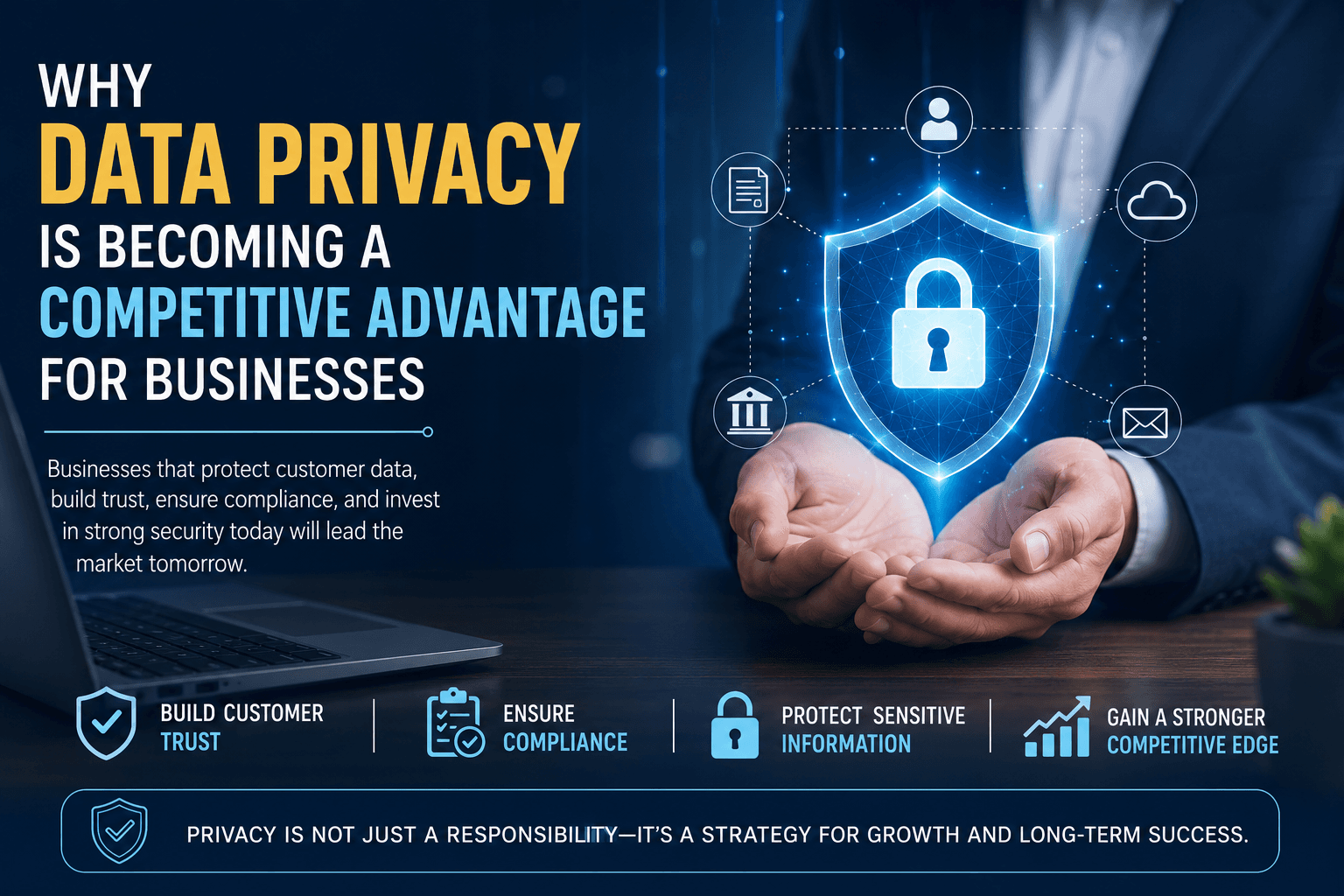

Data privacy has traditionally been viewed as a compliance requirement. Businesses collected customer information, followed applicable regulations, and invested in security controls primarily to avoid penalties and reputational damage.
That perspective is changing.
In 2026, data privacy is increasingly becoming a competitive advantage. Customers are more aware of how companies collect and use their information, regulators are increasing scrutiny, and organizations are adopting artificial intelligence that depends heavily on data.
Businesses that demonstrate responsible data practices can differentiate themselves through trust, transparency, and stronger customer relationships.
The Growing Importance of Data Privacy
Modern businesses collect enormous amounts of information. Customer profiles, purchasing behavior, payment details, location information, employee records, and online activity can all contribute to business intelligence.
At the same time, consumers have become more conscious of what happens to their information after it is collected.
A company that clearly explains why it needs customer data and gives people meaningful control over that information can build greater trust than a company that uses opaque or excessive data-collection practices.
Privacy is therefore moving from a back-office responsibility to a strategic business consideration.
Trust Is Becoming a Business Differentiator
Customers increasingly expect companies to protect their personal information.
A privacy breach can damage more than a company's technology infrastructure. It can undermine customer confidence and influence future purchasing decisions.
Businesses that consistently demonstrate responsible data handling can use privacy as part of their value proposition.
This is particularly important in industries such as:
Financial services
Healthcare
E-commerce
Technology
Telecommunications
Professional services
When customers believe that a company respects their information, they may be more willing to share data and maintain long-term relationships.
Privacy Can Strengthen Customer Loyalty
Customer loyalty depends heavily on trust.
Businesses often request personal information to personalize services, recommend products, improve experiences, and provide targeted offers. However, personalization can become uncomfortable when customers do not understand how their information is being used.
A privacy-focused strategy creates a healthier relationship between personalization and customer control.
Companies can explain what data they collect, why they collect it, how long they retain it, and how customers can manage their preferences.
This transparency can turn privacy into an element of customer experience rather than simply a legal requirement.
Privacy and Artificial Intelligence
The growth of AI is making data privacy even more important.
AI systems can process large amounts of information to generate predictions, recommendations, and automated decisions. Businesses therefore need to carefully consider what data is being used to train, operate, and evaluate AI systems.
Privacy-aware AI strategies can help organizations reduce unnecessary data exposure while maintaining useful AI capabilities.
Companies may adopt approaches such as:
Data minimization
Access controls
Encryption
Anonymization and pseudonymization
Privacy-preserving analytics
Secure AI development practices
Clear data-retention policies
These practices can reduce privacy risks while supporting responsible AI adoption.
Data Minimization Can Reduce Business Risk
Collecting more data does not automatically create more business value.
In many situations, unnecessary data increases security, compliance, and operational risks. If information is not required for a specific business purpose, storing it indefinitely may create additional exposure.
Data minimization encourages organizations to collect only what they genuinely need.
This approach can also reduce storage costs, simplify data management, and make compliance processes easier.
As a result, privacy can contribute to operational efficiency as well as risk reduction.
Privacy-First Businesses Can Build Stronger Brands
Brand reputation is increasingly connected to how companies handle customer information.
Organizations that publicly demonstrate strong privacy practices can position themselves as trustworthy and responsible.
Privacy can become part of a broader brand message:
“We don't just use your data—we respect it.”
This positioning can be particularly powerful when customers have alternatives that offer similar products or prices.
When product differentiation becomes difficult, trust can become a deciding factor.
Regulatory Compliance Is No Longer Enough
Businesses need to comply with privacy regulations, but compliance alone may not provide a competitive advantage.
A company that treats privacy as the minimum legal requirement may focus primarily on avoiding penalties.
A privacy-driven organization takes a broader approach by integrating privacy into product design, customer communication, technology architecture, and corporate culture.
This is often referred to as privacy by design.
Instead of adding privacy controls after a product has been developed, organizations consider privacy requirements from the beginning.
Privacy Can Improve Data Quality
Privacy and data quality may seem unrelated, but responsible data practices can encourage businesses to become more disciplined about the information they collect.
When organizations understand why each dataset is needed, they are more likely to establish clear ownership, retention policies, validation processes, and access controls.
Better-managed data can ultimately produce better analytics and AI outcomes.
In other words, privacy can help businesses move from data accumulation toward strategic data management.
Competitive Advantage Through Transparency
Transparency is becoming a major component of privacy strategy.
Businesses can provide customers with clear information about:
What information is collected
Why it is collected
How it is used
Who can access it
How long it is retained
Whether it is shared with third parties
How customers can request changes or deletion
Simple and understandable communication can be more effective than complicated privacy policies that customers rarely read.
Transparency helps customers make informed choices and can strengthen perceptions of trustworthiness.
Privacy as a B2B Advantage
Privacy is not only important for consumer-facing businesses.
Enterprise customers increasingly evaluate the security and privacy practices of their vendors before signing contracts.
A strong privacy program can therefore help businesses:
Pass vendor assessments more efficiently
Reduce procurement friction
Meet enterprise security requirements
Strengthen partnerships
Win contracts with privacy-conscious organizations
For technology providers, privacy capabilities can become a selling point rather than merely a compliance checkbox.
The Role of Privacy in Digital Transformation
Digital transformation requires organizations to connect more systems and use more data.
Without appropriate privacy controls, this increased connectivity can create new risks.
Businesses should therefore integrate privacy into cloud migration, AI deployment, data platforms, customer applications, and digital products.
A privacy-first approach can make digital transformation more sustainable by establishing clear rules for how data should be collected, processed, shared, and protected.
Challenges Businesses Need to Overcome
Building privacy into business strategy is not without challenges.
Organizations may need to modernize legacy systems, improve data governance, train employees, and establish stronger controls across third-party vendors.
There can also be tension between personalization and privacy. Businesses want useful customer insights, while customers want control over their information.
The solution is not necessarily to stop using data. Instead, companies need to develop responsible data-use strategies that balance business value with customer expectations.
The Future of Privacy as a Competitive Advantage
Data privacy is likely to become increasingly integrated into business strategy.
Companies will move beyond simply asking, “Are we compliant?”
They will increasingly ask:
“Can our privacy practices help us earn trust, improve customer loyalty, and differentiate our brand?”
Organizations that answer this question effectively can turn privacy into a strategic asset.
As AI, digital services, and data-driven business models continue to expand, customers will have more reasons to care about how their information is handled. Companies that prioritize transparency, responsible data use, and strong privacy protections will be better positioned to compete in a trust-driven digital economy.
FAQs
1. Why is data privacy becoming a competitive advantage?
Strong privacy practices can increase customer trust, improve brand reputation, reduce risk, and help businesses differentiate themselves from competitors.
2. How does data privacy affect customer loyalty?
Customers are more likely to maintain relationships with businesses they believe responsibly protect and use their personal information.
3. Does privacy affect AI adoption?
Yes. AI systems often depend on large amounts of data, making privacy, governance, access controls, and responsible data usage important parts of AI deployment.
4. What is privacy by design?
Privacy by design means incorporating privacy considerations and protections into products, services, and systems from the beginning rather than adding them later.
5. Can privacy reduce business costs?
Yes. Effective data minimization and governance can reduce unnecessary storage, simplify data management, lower risk, and potentially reduce the costs associated with privacy incidents.
6. How can businesses build a privacy-first culture?
Businesses can establish clear data policies, train employees, limit unnecessary data collection, strengthen access controls, improve transparency, and make privacy part of product and technology development.
7. Is data privacy important for B2B companies?
Absolutely. Enterprise customers increasingly evaluate vendors based on their security and privacy practices, making privacy capabilities an important factor in winning and retaining business.