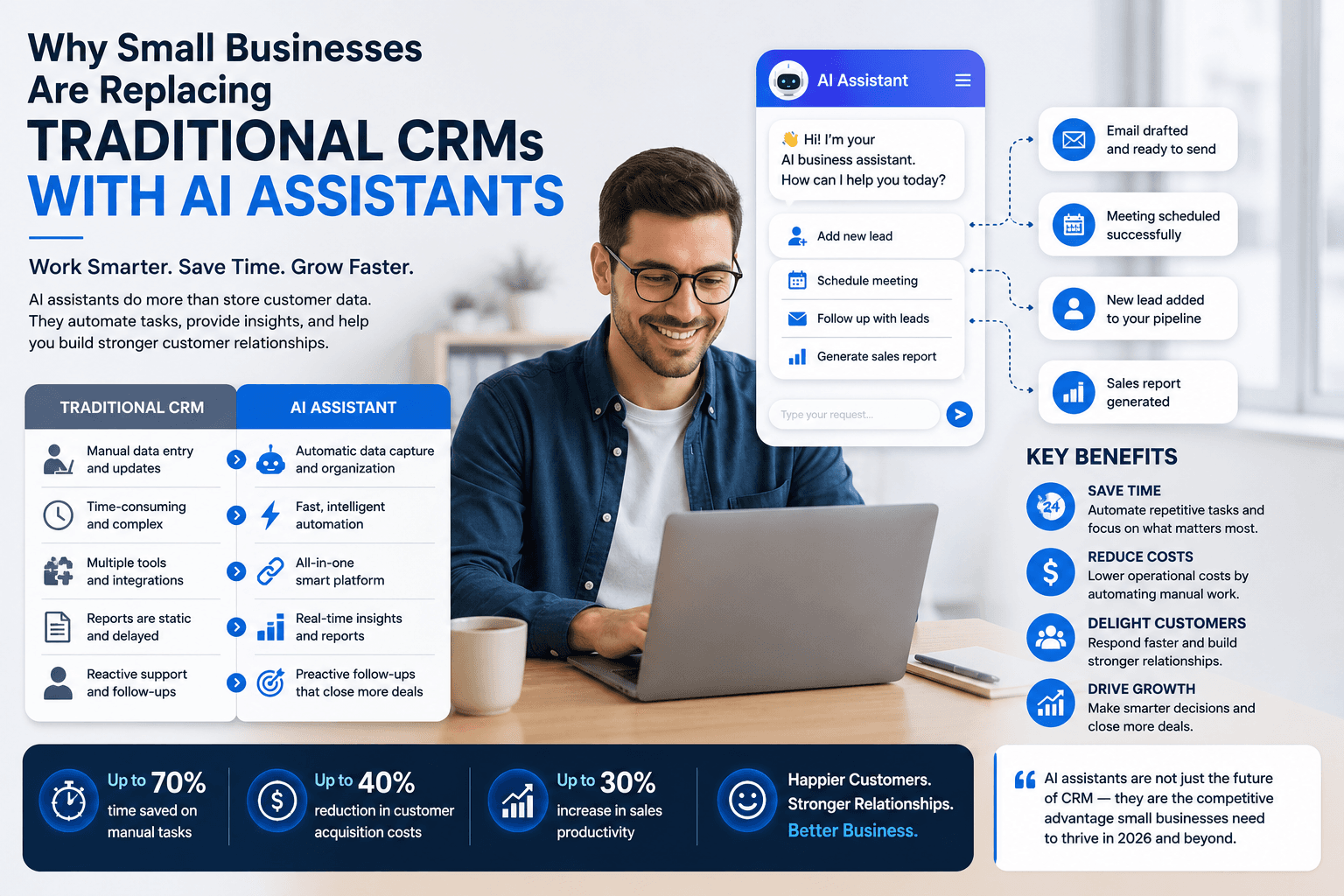

Small businesses are embracing artificial intelligence faster than ever. In 2026, many are replacing traditional Customer Relationship Management (CRM) software with AI assistants that not only organize customer data but also automate tasks, generate insights, and help close more sales.
Instead of spending hours updating records and managing spreadsheets, business owners are letting AI handle repetitive work so they can focus on growth.
What Is an AI Business Assistant?
An AI business assistant is an intelligent system that manages customer relationships, schedules meetings, drafts emails, tracks sales opportunities, and provides business recommendations—all through natural language.
Unlike traditional CRM software, AI assistants don't just store information—they actively help businesses make smarter decisions.
Why Traditional CRMs Are Losing Popularity
Traditional CRM platforms often require manual data entry, constant updates, and employee training. AI assistants simplify the process by automatically capturing conversations, organizing customer information, and suggesting the next best actions.
This saves time and reduces administrative work.
Key Benefits of AI Assistants
1. Automatic Customer Management
AI records customer conversations, updates contact information, and organizes sales pipelines without manual effort.
2. Smarter Sales Support
AI identifies promising leads, predicts customer behavior, and recommends the best follow-up actions.
3. Faster Email Responses
AI drafts personalized emails, meeting summaries, and follow-up messages within seconds.
4. Improved Productivity
Employees spend less time on paperwork and more time serving customers and closing deals.
5. Better Business Insights
AI analyzes customer trends, sales performance, and revenue opportunities to help business owners make informed decisions.
Industries Benefiting Most
AI assistants are helping businesses across many sectors, including:
Marketing Agencies
Real Estate
E-commerce
Healthcare
Financial Services
Consulting Firms
Education
Professional Services
How Businesses Can Prepare
To successfully adopt AI assistants, companies should:
Choose AI tools that integrate with existing systems.
Keep customer data accurate and secure.
Train employees to work alongside AI.
Regularly review AI-generated recommendations.
Maintain compliance with data privacy regulations.
Challenges to Consider
Businesses should also address:
Data security
AI accuracy
Integration with legacy systems
Employee adoption
Responsible use of customer information
Human oversight remains essential for important business decisions.
The Future of Business Management
Experts predict that AI assistants will become the central hub for managing customer relationships. Instead of switching between multiple business applications, users will interact with a single AI assistant capable of handling sales, marketing, customer support, scheduling, and reporting.
Small businesses that adopt AI early will gain a significant competitive advantage through increased efficiency and better customer engagement.
Final Thoughts
AI assistants are changing how small businesses manage customers and daily operations. By automating repetitive tasks, improving communication, and providing real-time business insights, they are becoming a practical replacement for traditional CRM software.
Businesses that embrace AI-powered customer management today will be better prepared for the future of digital business.
FAQs: Why Small Businesses Are Replacing Traditional CRMs with AI Assistants
1. Why are small businesses replacing traditional CRMs with AI assistants?
Small businesses are increasingly exploring AI assistants because traditional CRM systems often require employees to manually enter customer information, update records, create follow-ups, and search through large amounts of data. AI assistants can automate many of these tasks and allow employees to interact with customer information using natural-language commands. Instead of spending significant time managing the CRM itself, sales and customer-service teams can focus more on conversations, relationships, and revenue-generating activities. The shift is therefore less about completely eliminating CRM software and more about making customer management faster, automated, and easier to use.
2. How are AI assistants different from traditional CRM software?
Traditional CRMs primarily function as structured databases and workflow-management systems where employees record customer information, track leads, manage sales pipelines, and schedule activities. AI assistants can add an intelligent interaction layer on top of these capabilities. They can summarize customer histories, identify important information, draft follow-up messages, recommend next actions, and answer questions about accounts using natural language. This can reduce the amount of manual navigation and data entry required from employees. However, AI assistants still depend on reliable customer data and appropriate business processes to provide useful results.
3. Can AI assistants reduce the amount of manual CRM data entry?
Yes. One of the major advantages of AI assistants is their ability to automate or reduce repetitive data-entry tasks. Depending on the system, AI can extract information from emails, meeting transcripts, forms, conversations, and other business interactions and use it to update customer records. This can help ensure that important information does not remain trapped inside individual employees' inboxes or notes. Reducing manual entry can also improve adoption because employees spend less time maintaining the CRM and more time using customer information to support sales and service activities.
4. Are AI assistants affordable for small businesses?
AI assistants can be cost-effective for small businesses when they eliminate enough manual work to justify their subscription and implementation costs. Traditional CRM systems may involve software licenses, customization, integrations, training, and ongoing administration. AI-powered systems can potentially reduce some of these burdens by automating routine workflows and making information easier to access. However, AI is not automatically cheaper. Businesses should evaluate total costs, including subscriptions, integrations, data migration, security, employee training, and human oversight. The right solution is the one that produces measurable business value rather than simply offering the most AI features.
5. How can AI assistants help small-business sales teams?
AI assistants can support sales teams throughout the customer journey. They can help identify promising leads, summarize previous conversations, prepare meeting briefs, draft personalized follow-up emails, recommend next steps, and highlight opportunities that may require attention. AI can also analyze customer interactions to identify common objections or signs of buying interest. These capabilities can help salespeople spend less time performing administrative tasks and more time speaking with prospects and customers. However, sales teams should review AI-generated recommendations and communications before sending them to customers.
6. Can AI assistants improve customer service for small businesses?
Yes. AI assistants can help customer-service teams quickly retrieve customer histories, summarize previous interactions, suggest responses, and identify relevant information from internal knowledge bases. They can also automate responses to routine questions when appropriately configured. This can help small businesses respond more quickly without requiring a large customer-support department. At the same time, companies should provide customers with a clear path to human assistance for complex, sensitive, or unusual issues. AI should improve customer service without making customers feel that they cannot reach a real person when necessary.
7. Will AI assistants completely replace CRM platforms?
Not necessarily. In many cases, AI assistants are more likely to transform how businesses interact with CRM systems than eliminate the underlying CRM completely. Customer records, sales pipelines, permissions, reporting, integrations, and historical information still need reliable systems of record. AI can sit on top of these systems and make them easier to use by allowing employees to access and update information through conversational interfaces. Over time, some businesses may move toward AI-first customer-management platforms, but traditional CRM infrastructure is likely to remain important for many organizations.
8. What are the risks of using AI assistants for customer management?
AI assistants introduce risks involving inaccurate information, privacy, security, unauthorized access, and inappropriate automated communication. An AI system could potentially misunderstand a customer interaction, generate an incorrect recommendation, or expose information to an employee who should not have access to it if permissions are poorly configured. Businesses should therefore establish strong access controls, data-governance policies, monitoring procedures, and human-review requirements. Companies should also understand how their AI provider handles customer data and whether information is used for model training or other purposes.
9. How should a small business transition from a traditional CRM to an AI assistant?
A small business should avoid replacing an existing CRM simply because an AI alternative is available. The first step should be identifying the biggest problems with the current system, such as excessive data entry, poor adoption, complicated workflows, or difficulty retrieving customer information. The company can then evaluate AI solutions against those specific problems. A pilot program involving one team or workflow can help measure time savings and accuracy before a broader rollout. Businesses should also clean customer data, establish permissions, train employees, and create clear rules for reviewing AI-generated actions.
10. What is the future of AI-powered customer relationship management for small businesses?
The future of customer relationship management is likely to become increasingly AI-driven, with assistants handling more routine administrative and analytical tasks. Instead of requiring employees to manually search records and update numerous fields, AI systems may continuously organize customer information, summarize interactions, identify opportunities, and recommend actions. Small businesses could gain access to capabilities that previously required large sales or operations teams. Nevertheless, successful adoption will depend on high-quality data, responsible AI governance, integration with existing systems, and human judgment. The most effective approach will likely combine AI automation with the relationship-building skills that remain uniquely valuable in customer-facing businesses.