Introduction
Artificial intelligence (AI) is no longer reserved for large corporations with massive technology budgets. In 2026, affordable and accessible AI tools have leveled the playing field, allowing small businesses to automate routine tasks, improve customer experiences, make smarter decisions, and compete more effectively in crowded markets.
From content creation and customer support to marketing automation and data analysis, AI is helping entrepreneurs accomplish more with fewer resources. Small businesses that embrace AI are finding new ways to increase productivity, reduce costs, and accelerate growth without significantly expanding their teams.
Whether you're launching a startup or managing an established small business, understanding how to use AI strategically can provide a lasting competitive advantage.
Why AI Matters for Small Businesses
Small businesses often face challenges such as limited budgets, small teams, and increasing competition. AI helps overcome these obstacles by automating repetitive work and providing insights that support better decision-making.
Instead of replacing employees, AI enhances productivity by allowing teams to focus on creativity, customer relationships, and strategic planning.
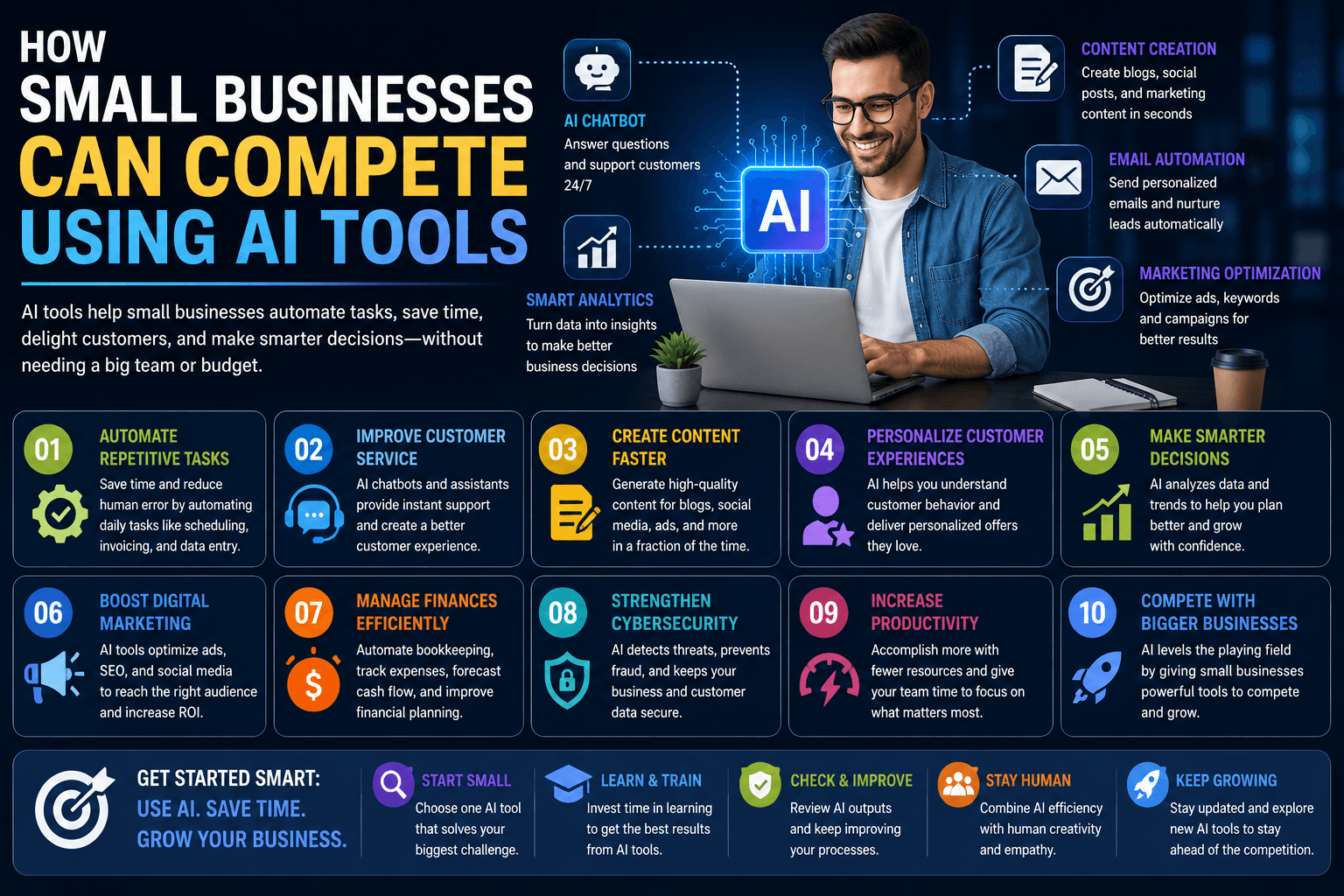
1. Automating Repetitive Tasks
One of the biggest advantages of AI is automation.
Small businesses can use AI to handle routine tasks such as:
Email responses
Appointment scheduling
Invoice generation
Data entry
Inventory tracking
Report creation
Calendar management
Automation saves valuable time while reducing human error and operational costs.
2. Improving Customer Service
Customer expectations continue to rise, and fast responses are essential.
AI-powered chatbots and virtual assistants can:
Answer frequently asked questions
Process basic customer requests
Track orders
Book appointments
Provide product recommendations
Offer 24/7 customer support
This allows businesses to deliver excellent service even outside normal working hours.
3. Creating Marketing Content Faster
Marketing can be time-consuming for small teams.
AI writing and design tools help businesses create:
Blog articles
Social media posts
Product descriptions
Email newsletters
Advertising copy
Marketing images
Video scripts
These tools speed up content production while helping maintain a consistent brand presence across multiple platforms.
4. Personalizing Customer Experiences
Modern consumers expect personalized interactions.
AI analyzes customer behavior to deliver:
Personalized product recommendations
Customized email campaigns
Targeted promotions
Individual shopping experiences
Relevant content suggestions
Personalization increases customer engagement, improves conversion rates, and builds long-term loyalty.
5. Making Better Business Decisions
AI-powered analytics transform business data into valuable insights.
Small business owners can better understand:
Customer purchasing trends
Sales performance
Marketing effectiveness
Inventory demand
Revenue growth
Customer satisfaction
Data-driven decision-making reduces uncertainty and supports smarter business strategies.
6. Improving Digital Marketing
AI helps optimize digital marketing campaigns by:
Identifying target audiences
Recommending keywords
Scheduling social media posts
Improving SEO performance
Analyzing campaign results
Optimizing advertising budgets
These capabilities help businesses reach more customers while maximizing marketing return on investment.
7. Enhancing Financial Management
Managing finances is easier with AI-powered tools.
Businesses can automate:
Expense tracking
Budget forecasting
Cash flow analysis
Invoice processing
Financial reporting
Fraud detection
These insights help owners make informed financial decisions while improving overall business health.
8. Strengthening Cybersecurity
As businesses rely more on digital systems, cybersecurity becomes increasingly important.
AI enhances security by:
Detecting suspicious activity
Identifying unusual login attempts
Monitoring network behavior
Preventing fraud
Responding to cyber threats in real time
Protecting customer data strengthens trust and supports business continuity.
9. Increasing Productivity
AI allows small teams to accomplish work that previously required larger staffs.
Employees spend less time on repetitive administrative tasks and more time on:
Customer relationships
Business development
Product innovation
Strategic planning
Creative problem-solving
Higher productivity often leads to faster growth and improved profitability.
10. Competing with Larger Businesses
Perhaps the greatest advantage of AI is that it gives small businesses access to capabilities once available only to large enterprises.
Affordable AI tools enable small companies to:
Deliver personalized customer experiences
Automate operations
Analyze large amounts of data
Improve marketing performance
Provide professional customer support
Scale more efficiently
This helps level the competitive playing field while enabling sustainable growth.
Challenges to Consider
While AI offers significant opportunities, businesses should also be aware of potential challenges, including:
Data privacy and security
Employee training requirements
Integration with existing systems
Maintaining human oversight
Ensuring responsible AI use
Evaluating the accuracy of AI-generated outputs
Using AI responsibly and reviewing important work before publication or decision-making remains essential.
Best Practices for AI Adoption
Small businesses can maximize success by following these strategies:
Start with one or two AI tools that address your biggest business challenges.
Train employees to use AI effectively and responsibly.
Protect customer information with strong cybersecurity measures.
Combine AI automation with human expertise for the best results.
Regularly measure performance and refine AI workflows.
Stay informed about new AI developments and opportunities.
Conclusion
Artificial intelligence is transforming the way small businesses operate. By automating repetitive tasks, improving customer service, strengthening marketing, enhancing decision-making, and increasing productivity, AI enables entrepreneurs to compete more effectively in today's fast-changing marketplace.
Success with AI is not about replacing people—it is about empowering teams with smarter tools that improve efficiency and unlock new opportunities. Small businesses that adopt AI strategically will be better positioned to reduce costs, deliver exceptional customer experiences, and achieve sustainable growth.
As AI technology continues to evolve, businesses that embrace innovation today will be well prepared to compete, adapt, and thrive in the digital economy of tomorrow.
FAQs:
1. What are AI tools for small businesses?
AI tools are software applications that use artificial intelligence to automate tasks, analyze data, improve customer service, create content, and help businesses make smarter decisions with less manual effort.
2. Why should small businesses invest in AI tools?
AI helps small businesses reduce costs, increase productivity, improve customer experiences, automate repetitive work, and compete more effectively with larger companies.
3. Which AI tools are most useful for small businesses?
Popular AI tools include ChatGPT for content creation, Canva AI for design, Grammarly for writing, HubSpot AI for marketing, QuickBooks AI for accounting, and AI-powered chatbots for customer support.
4. Can AI help small businesses with marketing?
Yes. AI can generate social media posts, email campaigns, blog articles, SEO content, ad copy, and personalized marketing strategies while analyzing campaign performance.
5. How does AI improve customer service?
AI-powered chatbots and virtual assistants provide instant responses, answer frequently asked questions, handle customer inquiries 24/7, and reduce response times.
6. Is AI affordable for small businesses?
Many AI platforms offer free plans or affordable monthly subscriptions, making advanced technology accessible even for startups and small businesses with limited budgets.
7. Can AI automate administrative tasks?
Yes. AI can schedule appointments, manage emails, organize documents, generate reports, process invoices, and automate repetitive office tasks, saving valuable time.
8. How does AI help improve business productivity?
AI automates repetitive processes, provides real-time insights, streamlines workflows, and allows employees to focus on strategic and creative work.
9. Can AI improve sales performance?
Yes. AI analyzes customer behavior, identifies sales opportunities, recommends products, predicts buying patterns, and helps businesses personalize sales strategies.
10. How does AI support financial management?
AI-powered accounting software tracks expenses, manages invoices, forecasts cash flow, detects unusual transactions, and simplifies financial reporting.
11. Can AI help small businesses compete with larger companies?
Absolutely. AI provides affordable automation, data analysis, personalized customer experiences, and marketing capabilities that were once available only to large enterprises.
12. How does AI improve inventory management?
AI predicts customer demand, monitors stock levels, reduces overstocking, identifies purchasing trends, and helps businesses optimize inventory planning.
13. Is AI useful for e-commerce businesses?
Yes. AI recommends products, personalizes shopping experiences, automates customer support, manages pricing strategies, and improves online sales conversions.
14. Can AI assist with hiring and recruitment?
AI can screen resumes, match candidates to job descriptions, schedule interviews, and automate parts of the recruitment process, making hiring more efficient.
15. What challenges should small businesses consider before adopting AI?
Businesses should evaluate data privacy, employee training, implementation costs, cybersecurity, integration with existing systems, and choosing the right AI solutions for their needs.
16. How can AI improve decision-making?
AI analyzes large datasets, identifies trends, forecasts business outcomes, and provides actionable insights that support faster and more informed decisions.
17. Will AI replace employees in small businesses?
AI is designed to support employees by automating repetitive tasks. Human creativity, customer relationships, leadership, and strategic thinking remain essential for business success.
18. What industries benefit most from AI tools?
Retail, healthcare, finance, hospitality, real estate, education, manufacturing, professional services, and e-commerce businesses are among the industries seeing significant benefits from AI adoption.
19. How can a small business start using AI?
Businesses should identify repetitive tasks, choose affordable AI tools, train employees, start with one or two applications, monitor results, and gradually expand AI usage as needed.
20. What is the future of AI for small businesses?
AI is expected to become an essential business technology, enabling small companies to automate operations, enhance customer experiences, improve efficiency, reduce costs, and remain competitive in an increasingly digital marketplace.