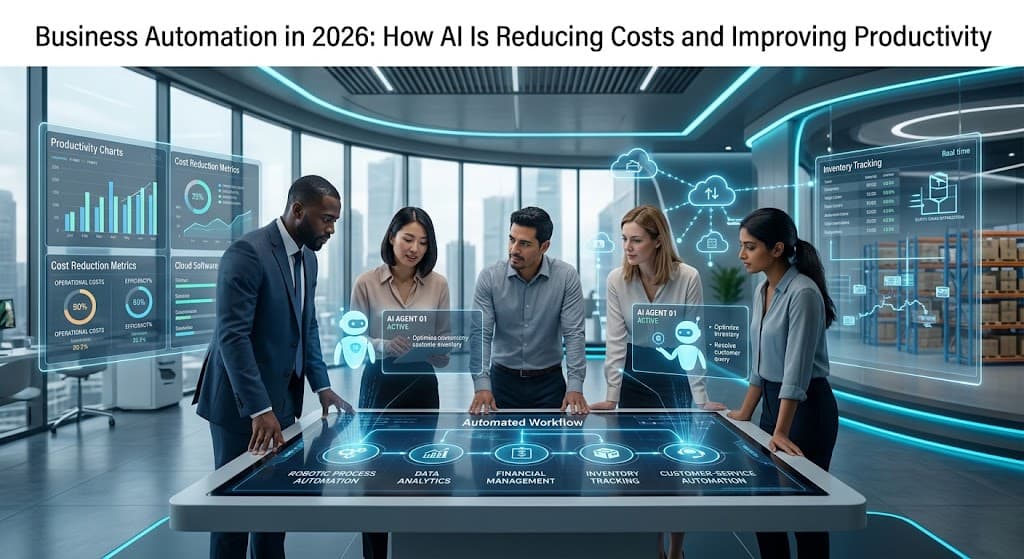
Artificial Intelligence (AI) is no longer reserved for large corporations with massive technology budgets. In 2026, AI has become more accessible, affordable, and practical than ever before, allowing small businesses to improve productivity, reduce costs, and compete more effectively in a rapidly evolving marketplace.
From automating repetitive tasks to improving customer service and analyzing business data, AI is helping entrepreneurs work smarter instead of harder. Businesses that embrace AI can streamline operations, enhance decision-making, and free up valuable time to focus on growth and innovation.
Why AI Matters for Small Businesses
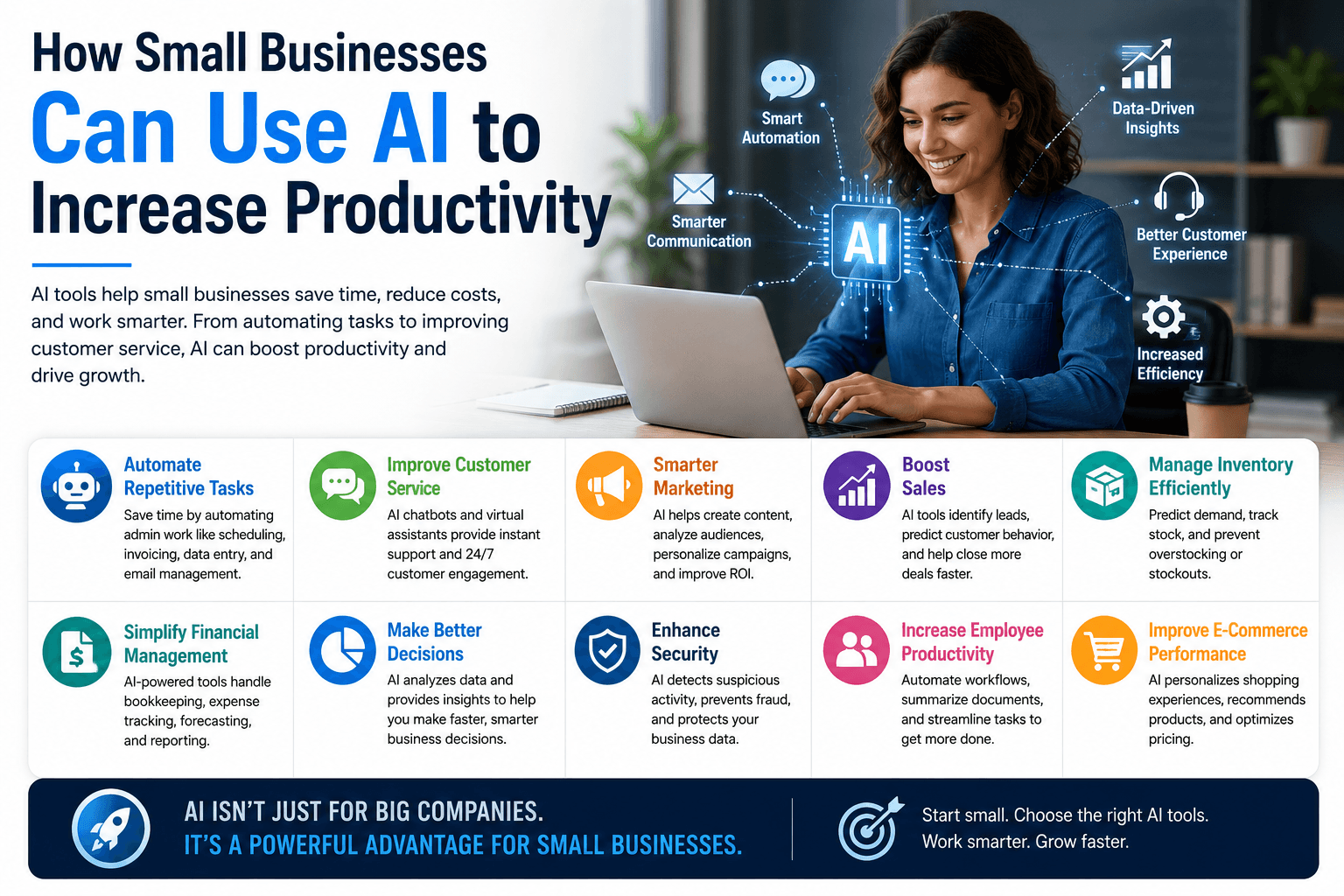
Small business often operate with limited staff and tight budgets. Every hour and every dollar count. AI helps maximize resources by automating routine work, reducing manual errors, and increasing operational efficiency.
Rather than replacing employees, AI supports teams by handling repetitive tasks so they can focus on activities that require creativity, strategic thinking, and personal interaction.
Automating Administrative Tasks
Many small businesses spend countless hours on administrative work.
AI-powered tools can automate:
Appointment scheduling
Email management
Invoice generation
Payroll processing
Expense tracking
Calendar organization
Automation reduces paperwork while allowing employees to spend more time serving customers and growing the business.
Improving Customer Service
Excellent customer service is essential for business success.
AI-powered chatbots and virtual assistants can answer common customer questions, provide product information, process basic requests, and offer support 24/7.
Benefits include:
Faster response times
Reduced support costs
Higher customer satisfaction
Increased availability
Human staff can then focus on more complex customer needs.
Smarter Marketing with AI
Marketing has become one of AI's most valuable applications.
Small businesses use AI to:
Generate content ideas
Write marketing copy
Create social media posts
Personalize email campaigns
Analyze customer behavior
Optimize advertising campaigns
AI also helps businesses identify which marketing channels generate the highest return on investment.
Better Sales Performance
Sales teams can use AI to improve productivity through:
Lead scoring
Customer segmentation
Sales forecasting
Automated follow-up emails
Personalized product recommendations
By identifying high-potential customers, AI helps businesses focus their efforts where they are most likely to generate revenue.
Managing Inventory More Efficiently
Inventory management is often challenging for small retailers and e-commerce businesses.
AI can:
Predict customer demand
Monitor stock levels
Recommend reorder quantities
Reduce waste
Prevent stock shortages
This improves cash flow while ensuring products remain available when customers need them.
Financial Management Made Easier
AI-powered accounting software simplifies financial management by automating routine processes.
Businesses can use AI to:
Track expenses
Generate invoices
Reconcile accounts
Forecast cash flow
Identify unusual transactions
Prepare financial reports
Automation reduces errors while providing better financial visibility.
Data-Driven Decision Making
Small businesses generate valuable data every day.
AI analyzes this information to identify trends, customer preferences, and business opportunities.
Business owners can make smarter decisions regarding:
Pricing
Inventory
Marketing
Staffing
Product development
Customer retention
Instead of relying on guesswork, companies gain actionable insights supported by real data.
Enhancing Cybersecurity
Cybersecurity threats continue to grow.
AI-powered security systems help protect businesses by:
Detecting suspicious activity
Monitoring networks
Identifying malware
Preventing fraud
Alerting administrators in real time
Even small businesses benefit from intelligent cybersecurity solutions that previously were available only to larger organizations.
Improving Employee Productivity
AI helps employees complete work more efficiently.
Examples include:
Document summarization
Meeting transcription
Translation services
Task management
Workflow automation
Knowledge management
Employees spend less time on repetitive work and more time solving customer problems and creating value.
AI for E-Commerce Businesses
Online retailers are increasingly using AI to:
Recommend products
Personalize shopping experiences
Optimize pricing
Improve search results
Reduce cart abandonment
Forecast customer demand
These improvements often lead to higher sales and stronger customer loyalty.
Choosing the Right AI Tools
Businesses should begin with solutions that address their most pressing challenges.
When selecting AI tools, consider:
Ease of use
Cost
Security
Integration with existing software
Scalability
Customer support
Starting with a few practical applications often delivers faster results than attempting a complete AI transformation at once.
Challenges to Consider
Although AI offers significant advantages, businesses should remain aware of potential challenges, including:
Data privacy concerns
Employee training
Initial implementation costs
Integration with existing systems
Responsible use of AI
Successful adoption requires careful planning and ongoing evaluation.
Preparing for an AI-Driven Future
As AI technology continues to evolve, small businesses should invest in digital skills, encourage innovation, and remain informed about emerging tools.
Organizations that embrace AI responsibly will be better positioned to adapt to changing customer expectations and market conditions.
Conclusion
Artificial Intelligence is transforming the way small businesses operate. From customer service and marketing to finance, inventory management, and cybersecurity, AI enables organizations to increase productivity while reducing costs and improving efficiency.
Small businesses no longer need large technology budgets to benefit from AI. Affordable, cloud-based solutions have made intelligent automation accessible to companies of every size.
Those that adopt AI strategically today will gain a competitive advantage, improve customer experiences, and build a stronger foundation for sustainable growth in the digital economy.
Frequently Asked Questions (FAQs)
1. What is AI for small businesses?
AI for small businesses refers to artificial intelligence tools and technologies that automate tasks, improve decision-making, and increase operational efficiency.
2. How can AI increase productivity in small businesses?
AI boosts productivity by automating repetitive tasks, streamlining workflows, improving customer service, and providing data-driven insights.
3. What are the best AI tools for small businesses?
Popular AI tools include ChatGPT, Microsoft Copilot, Google Gemini, Grammarly, Canva AI, Notion AI, Zapier AI, and HubSpot AI.
4. Is AI affordable for small businesses?
Yes. Many AI platforms offer free plans or affordable subscriptions, making them accessible for startups and small businesses.
5. How can AI improve customer service?
AI-powered chatbots and virtual assistants provide 24/7 customer support, answer common questions, and reduce response times.
6. Can AI help with marketing?
Yes. AI can generate content, personalize email campaigns, optimize social media posts, improve SEO, and analyze marketing performance.
7. How does AI automate repetitive tasks?
AI automates data entry, appointment scheduling, invoice processing, email responses, document creation, and workflow management.
8. Can AI improve business decision-making?
Yes. AI analyzes large datasets, identifies trends, predicts outcomes, and provides actionable insights for better business decisions.
9. How can AI help with sales?
AI can identify potential customers, score leads, personalize recommendations, automate follow-ups, and forecast sales trends.
10. Is AI secure for business operations?
AI can improve security when combined with strong cybersecurity practices, secure data management, and regular software updates.
11. Can AI help small businesses save money?
Yes. AI reduces manual labour, minimizes operational costs, improves efficiency, and helps businesses allocate resources more effectively.
12. How does AI support remote teams?
AI improves collaboration through smart scheduling, automated meeting summaries, project management, document sharing, and virtual assistants.
13. Can AI generate business content?
Yes. AI can create blog posts, emails, social media captions, product descriptions, marketing copy, and customer support responses.
14. What industries benefit most from AI?
Retail, healthcare, finance, education, manufacturing, logistics, hospitality, real estate, and professional services all benefit from AI adoption.
15. Does AI replace employees?
No. AI is designed to assist employees by automating repetitive work, allowing staff to focus on creative, strategic, and customer-facing tasks.
16. What challenges do small businesses face when adopting AI?
Common challenges include implementation costs, employee training, data privacy concerns, integration with existing systems, and selecting the right AI tools.
17. How can a small business start using AI?
Businesses should identify repetitive tasks, choose reliable AI tools, train employees, begin with small projects, and monitor results regularly.
18. Can AI improve inventory management?
Yes. AI predicts demand, tracks inventory levels, reduces waste, and helps businesses maintain optimal stock levels.
19. What is the future of AI for small businesses?
AI will continue to improve automation, customer experiences, decision-making, cybersecurity, and operational efficiency across industries.
20. Why should small businesses invest in AI now?
Early AI adoption helps businesses increase productivity, reduce costs, improve customer satisfaction, remain competitive, and prepare for future technological advancements.