

Introduction.
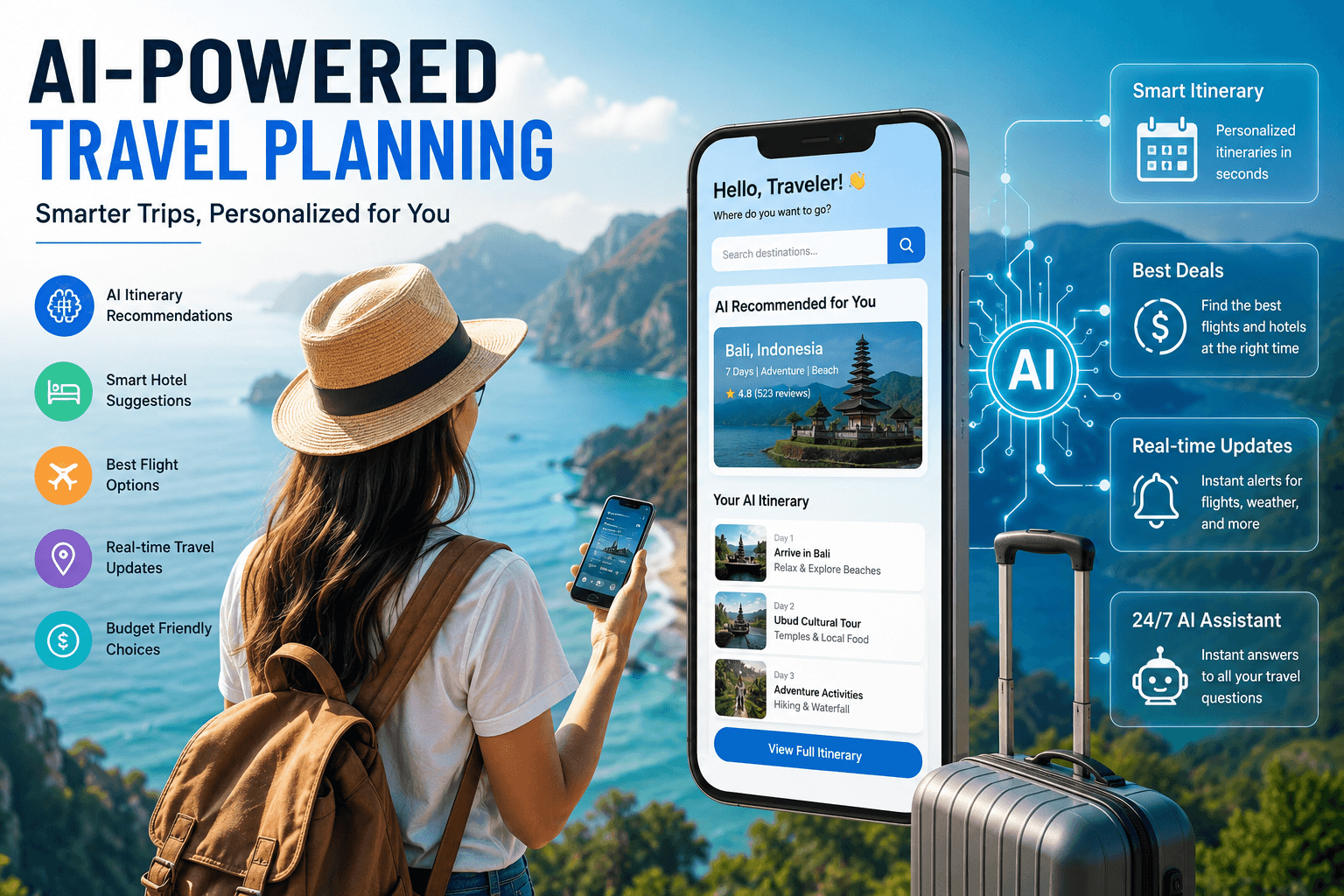
The travel industry has entered a new era where artificial intelligence is no longer a futuristic concept but an essential part of how people plan, book, and experience their journeys. In 2026, AI-powered travel planning is transforming tourism by making travel more personalized, efficient, and accessible than ever before. From recommending destinations based on individual preferences to optimizing flight schedules and providing real-time travel updates, AI is changing the way travelers explore the world.
For businesses in the tourism sector, including airlines, hotels, travel agencies, and destination management organizations, AI has become a strategic tool for improving customer experiences while increasing operational efficiency. Travelers, meanwhile, are enjoying smarter recommendations, faster bookings, and seamless travel experiences that save both time and money.
The Rise of AI in Tourism
Artificial intelligence has rapidly become one of the most influential technologies in tourism. Travel companies now rely on machine learning, predictive analytics, natural language processing, and automation to understand customer behavior and deliver highly personalized services.
Instead of spending hours researching destinations, comparing hotel prices, and building itineraries manually, travelers can now use AI-powered platforms that analyze millions of data points within seconds. These systems consider travel history, budgets, weather conditions, local events, and personal interests to create customized travel plans.
This shift represents a major evolution from traditional travel planning to intelligent travel experiences driven by real-time data.
Personalized Travel Experiences
One of AI's greatest strengths is personalization. Modern travelers expect recommendations tailored specifically to their preferences rather than generic travel packages.
AI analyzes various factors such as:
Previous travel destinations
Preferred airlines
Hotel preferences
Dining interests
Adventure activities
Family or solo travel habits
Budget limitations
Seasonal preferences
Travel Using this information, AI creates personalized travel itineraries that align closely with each traveler's needs.
For example, someone interested in history may receive recommendations for museums and heritage sites, while adventure seekers may see hiking trails, diving experiences, or mountain excursions.
Personalization improves customer satisfaction and encourages travelers to book additional experiences during their trips.
Smarter Flight and Hotel Booking
Finding the best flight and hotel combinations used to require extensive research. AI has simplified this process by comparing thousands of options instantly.
Modern booking platforms use predictive algorithms to:
Recommend the best booking times
Predict airfare changes
Suggest alternative airports
Compare accommodation prices
Identify seasonal discounts
Recommend bundled travel packages
These capabilities help travelers save money while making booking decisions with greater confidence.
Travel providers also benefit by improving occupancy rates and optimizing pricing strategies based on customer demand.
AI Travel Assistants
Virtual travel assistants have become increasingly sophisticated in 2026.
These AI assistants can:
Answer travel questions instantly
Recommend attractions
Suggest restaurants
Translate languages
Provide navigation assistance
Send flight notifications
Update gate changes
Monitor weather conditions
Recommend nearby activities
Unlike traditional customer support, AI assistants are available 24 hours a day and can support multiple languages simultaneously.
This significantly improves customer service while reducing operational costs for travel companies.
Real-Time Travel Intelligence
Travel conditions can change unexpectedly due to weather, transportation delays, political events, or natural disasters.
AI continuously analyzes real-time information from airlines, airports, weather systems, transportation networks, and local authorities.
Travelers receive instant alerts about:
Flight delays
Gate changes
Traffic congestion
Public transportation updates
Weather warnings
Safety advisories
This allows travelers to make informed decisions before problems disrupt their journeys.
Real-time intelligence has become one of AI's most valuable contributions to modern tourism.
Smart Destination Recommendations
Rather than promoting only famous tourist attractions, AI now recommends destinations based on individual interests and current travel conditions.
Recommendation engines consider:
Traveler reviews
Weather forecasts
Crowd levels
Seasonal events
Local festivals
Budget options
Travel restrictions
Personal hobbies
As a result, travelers discover unique experiences that might otherwise remain hidden.
This trend also benefits smaller destinations by distributing tourism more evenly instead of concentrating visitors in overcrowded locations.
AI and Sustainable Tourism
Sustainability has become an important priority for both travelers and tourism organizations.
AI contributes by helping travelers make environmentally responsible decisions.
Examples include:
Suggesting eco-friendly hotels
Optimizing transportation routes
Reducing fuel consumption
Minimizing unnecessary travel
Promoting local businesses
Supporting responsible tourism activities
Travel companies also use AI to monitor energy consumption, reduce waste, and improve operational efficiency.
These initiatives contribute to a more sustainable tourism industry while maintaining high-quality travel experiences.
Enhanced Customer Support
Customer service has traditionally been one of the biggest challenges for travel companies.
AI-powered chatbots now provide immediate assistance for common travel questions including:
Visa requirements
Booking modifications
Cancellation policies
Baggage rules
Hotel amenities
Transportation options
Travel insurance
Refund requests
Many issues can now be resolved within minutes without waiting for human agents.
When complex situations arise, AI transfers conversations to human representatives along with complete customer histories, improving efficiency.
Better Business Intelligence for Travel Companies
AI is transforming not only customer experiences but also business operations.
Tourism companies analyze customer behavior to understand:
Popular destinations
Seasonal demand
Booking trends
Customer satisfaction
Revenue opportunities
Marketing performance
These insights help businesses make smarter investment decisions and develop services that match evolving customer expectations.
Hotels can forecast occupancy rates more accurately, while airlines optimize schedules and pricing using predictive analytics.
Language Translation and Communication
Language barriers have always presented challenges for international travelers.
AI-powered translation tools now offer instant communication between travelers and local businesses.
Travelers can:
Translate restaurant menus
Read road signs
Communicate with hotel staff
Understand local transportation
Ask for directions
Participate in guided tours
Real-time translation improves confidence and encourages travelers to explore destinations more independently.
AI in Airport Operations
Airports are becoming increasingly intelligent through AI adoption.
Many airports now use AI to improve:
Passenger check-in
Security screening
Boarding processes
Baggage handling
Crowd management
Flight scheduling
These improvements reduce waiting times while enhancing passenger safety and operational efficiency.
Travelers experience smoother airport journeys with fewer delays and better communication.
Challenges of AI in Tourism
Although AI offers tremendous advantages, challenges remain.
Data privacy continues to be a major concern because AI systems rely on large amounts of personal information.
Travel companies must ensure:
Secure data storage
Transparent privacy policies
Ethical AI practices
Regulatory compliance
Responsible use of customer information
Another challenge involves balancing automation with human interaction. While AI improves efficiency, many travelers still value personal service when making important travel decisions.
Successful tourism businesses combine intelligent automation with knowledgeable human support.
The Future of AI-Powered Travel
Looking ahead, AI will continue transforming tourism through increasingly advanced technologies.
Future innovations may include:
Fully autonomous travel assistants
Hyper-personalized travel planning
AI-generated virtual destination previews
Predictive travel risk analysis
Intelligent sustainability recommendations
Voice-controlled booking systems
Augmented reality travel guides
Seamless multimodal transportation planning
As AI becomes more integrated into every stage of the travel journey, travelers will enjoy experiences that are safer, smarter, and more personalized than ever before.
Conclusion
AI-powered travel planning is redefining tourism in 2026 by simplifying every stage of the travel experience. From personalized itineraries and intelligent booking systems to real-time travel updates and sustainable recommendations, artificial intelligence is helping travelers make better decisions while enabling businesses to operate more efficiently.
The tourism industry is no longer relying solely on traditional planning methods. Instead, it is embracing intelligent technologies that improve convenience, reduce costs, and create memorable travel experiences. As AI continues to evolve, its influence on global tourism will only grow stronger, making travel more connected, personalized, and enjoyable for millions of people around the world.