Introduction
Buy Now, Pay Later (BNPL) services have become increasingly popular among online shoppers and consumers who want to spread the cost of purchases over several payments. From clothing and electronics to furniture and travel bookings, installment payment options can make expensive items appear more affordable.
However, convenience can come with hidden costs. Multiple installment plans, missed payments, late fees, and overspending can place pressure on a household budget. Even when a service advertises interest-free payments, consumers may still face fees or other financial consequences depending on the provider and agreement.
Understanding how Buy Now, Pay Later works is essential before choosing this payment method. This guide explains the potential costs, budgeting risks, responsible use strategies, and practical ways to avoid installment payment problems.
What Is Buy Now, Pay Later?
Buy Now, Pay Later is a payment arrangement that allows consumers to purchase a product immediately and pay for it over time. Depending on the provider, payments may be divided into a few short-term installments or spread across a longer financing period.
BNPL options are commonly offered at online checkout and, in some markets, at physical stores.
How does BNPL work?
The process usually follows these steps:
A shopper selects a product and chooses a BNPL payment option.
The provider may perform an eligibility or affordability assessment.
The shopper pays an initial installment if required.
The remaining balance is collected according to the payment schedule.
Depending on the agreement, interest or fees may apply if payments are missed or longer-term financing is selected.
Terms differ between providers and countries. Consumers should read the specific agreement instead of assuming that every BNPL service works the same way.
Why do people choose installment payments?
Several factors make BNPL attractive:
Smaller payments can feel easier to manage than one large payment.
Some plans offer interest-free installments when payments are made on time.
Checkout processes may be quick and convenient.
Consumers can spread the cost of necessary purchases.
Some providers offer flexible payment schedules.
These advantages can be useful when a purchase is planned and the payments fit comfortably within the budget. Problems arise when consumers use installments to buy more than they can afford.
The Hidden Costs of Buy Now, Pay Later
An installment plan may advertise zero interest, but that does not automatically mean it is risk-free or completely cost-free.
1. Late payment fees
Some providers charge fees when scheduled payments are missed. Others may restrict account access or take additional steps to collect overdue balances.
Even a relatively small fee can become burdensome when a consumer has several active plans.
Before accepting an agreement, check whether late fees apply, whether there is a grace period, and what happens after a missed payment.
2. Interest on longer-term plans
Some BNPL products offer longer repayment periods with interest or other financing charges.
For example, a shopper might focus on a low monthly installment without calculating the total amount that will be repaid.
Always compare the total repayment amount with the original purchase price. If interest applies, review the annual percentage rate (APR) where available.
3. Overdraft and bank fees
Automatic installment payments can cause problems when the linked bank account does not have sufficient funds.
Depending on the bank and account terms, a failed payment may trigger an overdraft fee, insufficient-funds fee, or another charge. Some providers may also attempt to collect the payment again.
Keeping a sufficient balance in the linked account and tracking upcoming withdrawals can help reduce these risks.
4. Returns and refunds
Returning an item does not always mean that installment payments stop immediately.
The retailer and BNPL provider may need time to process the return and update the account. Consumers should follow the official return procedure, retain confirmation records, and check the installment balance afterward.
If payments remain scheduled while a refund is being processed, contact the provider to understand the correct procedure rather than assuming the balance has already been cleared.
5. The cost of buying things you do not need
One of the biggest hidden costs is behavioral rather than financial.
When a $300 purchase is presented as four payments of $75, it may feel much cheaper than paying $300 upfront. However, the total cost remains $300 before any fees or interest.
This framing can encourage impulsive purchases and make consumers underestimate how much money they have committed to future payments.
How BNPL Can Affect Your Monthly Budget
A budget is based on the money coming in, the money going out, and the amount left for savings or unexpected expenses.
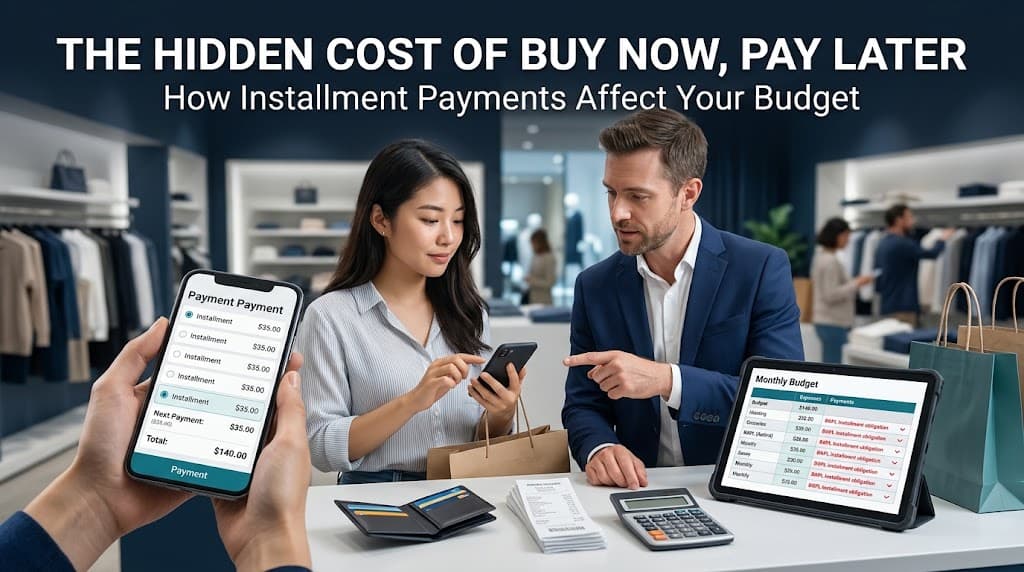
Installment payments create future obligations. A purchase that seems affordable today can become difficult to manage when several payment schedules overlap.
Example: Multiple installment plans
Imagine a consumer has the following active purchases:
Purchase | Monthly payment |
|---|---|
Clothing | $30 |
Headphones | $25 |
Home accessories | $40 |
Shoes | $35 |
Total monthly installments | $130 |
Each purchase may seem manageable on its own. Together, however, they require $130 every month.
If the consumer's budget is already tight, that amount could reduce money available for groceries, transport, utilities, savings, or emergency expenses.
This example excludes any additional interest or fees.
Why overlapping payments are risky
The main problem is that installment plans are easy to accumulate. Consumers may remember the monthly payment for each purchase but overlook the total amount committed across all providers.
A simple installment tracker can help.
Record:
The original purchase price
The remaining balance
The payment amount
The payment due date
Any applicable interest or fees
The expected final payment date
Reviewing these details before making another purchase can prevent unpleasant surprises.
Does BNPL Affect Your Credit Score?
The answer depends on the provider, the product, and the credit-reporting rules in the consumer's country.
Some providers may conduct credit checks or report payment activity to credit bureaus. Others may use different eligibility processes or report only certain types of accounts or events.
When credit checks may occur
A provider might conduct a soft inquiry to assess eligibility or a hard inquiry for certain financing products. The effect, if any, depends on the type of inquiry and the applicable credit-reporting system.
Consumers should check the provider's disclosures before applying.
How missed payments can matter
Depending on local rules and reporting practices, serious or overdue payments may be reported to credit bureaus or passed to debt collectors.
A missed payment does not affect every consumer's credit score in the same way. However, it can still create fees, collection activity, and financial stress.
What consumers should do
Before using a BNPL service, check whether it reports payment activity, whether it performs credit checks, and how overdue accounts are handled.
Do not assume that an installment plan is invisible to lenders simply because it does not resemble a traditional credit card.
Is Buy Now, Pay Later Better Than a Credit Card?
Neither payment method is automatically better for every purchase. The right choice depends on the terms, the consumer's spending habits, and the ability to repay the balance.
Feature | Buy Now, Pay Later | Credit card |
|---|---|---|
Repayment structure | Often scheduled installments | Usually a monthly statement with a minimum payment |
Interest | May be zero or charged, depending on the plan | May apply to carried balances and certain transactions |
Fees | May include late or other fees | May include late, annual, cash advance, or other fees |
Spending risk | Multiple plans can accumulate | A growing revolving balance can accumulate |
Credit reporting | Depends on provider and product | Depends on issuer and local reporting practices |
When BNPL may be appropriate
BNPL may suit a planned purchase when the consumer understands the terms, can comfortably afford every payment, and has a reliable way to track due dates.
When a credit card may be preferable
A credit card may offer useful protections, rewards, or a longer interest-free period for eligible purchases, depending on the issuer and local rules. However, these benefits can be outweighed by high interest or fees if the balance is not managed responsibly.
The most important comparison is the total cost, repayment flexibility, and financial risk—not simply the size of the first payment.
Seven Practical Ways to Use BNPL Responsibly
1. Buy only what you can afford
Ask yourself whether you could afford the full purchase price without relying on future income that is uncertain.
If the answer is no, consider delaying the purchase, choosing a cheaper option, or saving first.
2. Calculate the total repayment amount
Add all installments together and include applicable fees and interest.
Do not judge affordability solely by the first payment or the amount displayed at checkout.
3. Track every active plan
Keep a list of all installment agreements, including those from different providers. A spreadsheet, budgeting app, or simple notebook can work.
Update the list whenever you make a purchase or complete a payment.
4. Set payment reminders
Use calendar alerts or banking notifications to remind yourself of upcoming payments.
Where possible, keep enough money in the linked account before the scheduled withdrawal date. Automatic payments can be helpful, but they do not eliminate the need to monitor your balance.
5. Avoid stacking several purchases
Try to finish paying for existing nonessential purchases before opening another installment plan.
This reduces the risk of having too many obligations fall due in the same month.
6. Read the terms and conditions
Check late fees, interest, payment dates, refund rules, credit reporting, and the consequences of missed payments.
If a term is unclear, seek clarification before agreeing.
7. Maintain an emergency fund
Unexpected expenses can interfere with installment payments. Even a modest emergency fund can provide a buffer when income changes or an urgent bill arrives.
If you have high-interest debt, balance emergency savings with a realistic plan to manage that debt.
What to Do If You Are Already Struggling With BNPL Payments
If several installment plans are becoming difficult to manage, taking action early is generally better than ignoring payment reminders.
Step 1: List all outstanding balances
Write down each provider, remaining balance, minimum or scheduled payment, due date, and applicable charges.
This gives you a clear picture of the total obligation.
Step 2: Protect essential expenses
Prioritize necessities such as housing, food, utilities, transport, and required medical expenses. Do not take on additional installment plans to maintain discretionary spending.
Step 3: Contact the providers
Ask whether the provider offers a payment extension, revised schedule, hardship support, or another arrangement.
Availability depends on the provider and local regulations, so request confirmation in writing.
Step 4: Avoid borrowing to cover borrowing
Using another high-cost loan to pay BNPL installments can move the problem rather than solve it.
Before considering additional borrowing, calculate the full cost and explore alternatives.
Step 5: Seek reliable financial guidance
If debt is affecting your ability to meet essential expenses, a reputable nonprofit debt adviser or qualified financial counsellor may help you understand your options. Available services vary by country.
How BNPL Providers Can Make Costs Easier to Understand
Consumers are not the only people who can help reduce installment-related problems. Providers can improve transparency by presenting clear information before checkout.
Useful practices include:
Displaying the total purchase price prominently
Showing the amount and date of every installment
Clearly explaining late fees and interest
Making refund and cancellation procedures accessible
Providing reminders before payment dates
Explaining credit checks and credit-reporting practices
Offering clear support channels for customers in difficulty
Clear disclosures help consumers compare payment options and make more informed decisions.
Frequently Asked Questions (FAQs)
1. Is Buy Now, Pay Later a good idea?
It can be useful for a planned purchase when the payment schedule fits your budget and the terms are clear. It becomes risky when used for impulse purchases or when several installment plans compete with essential expenses.
2. Is Buy Now, Pay Later really interest-free?
Some plans are interest-free if payments are made according to the agreement. Others charge interest or fees. Read the specific terms rather than relying on general advertising.
3. What happens if I miss a BNPL payment?
Possible consequences include late fees, repeated payment attempts, account restrictions, collection activity, or credit-reporting consequences, depending on the provider and local rules.
4. Can BNPL put me into debt?
Yes. Each plan creates a repayment obligation. Multiple plans can become difficult to manage when total payments exceed the money available after essential expenses.
5. Does BNPL affect credit scores?
It may. Some providers perform credit checks or report payment activity, while others follow different practices. Check the product disclosures and local credit-reporting rules.
6. Is BNPL safer than a credit card?
Neither option is universally safer. Compare interest, fees, repayment terms, credit reporting, and the spending habits each payment method encourages.
7. Can I use more than one BNPL service?
Some consumers can open multiple plans, subject to provider eligibility requirements. However, having several accounts can make it harder to track payment dates and total outstanding debt.
8. Are late fees charged by every BNPL provider?
No. Fee policies vary. Some providers may not charge a late fee but can still restrict accounts or pursue overdue balances.
9. Can BNPL payments cause bank overdraft fees?
They may, depending on your bank account terms and what happens when an automatic payment is processed without sufficient funds.
10. What should I check before choosing a BNPL plan?
Review the total repayment amount, payment dates, interest, late fees, refund rules, credit-check policy, and the consequences of missed payments.
11. Can I return something purchased through BNPL?
Usually, returns are subject to the retailer's return policy and the provider's procedures. Confirm that the refund has been processed and check whether any remaining installments need to be adjusted.
12. Should I use BNPL for groceries?
Using installment credit for recurring necessities can be a warning sign that your regular income is not covering essential expenses. Review your budget and consider lower-cost assistance or financial guidance if necessary.
13. Is BNPL suitable for students?
Students with limited or irregular income should be particularly cautious. A small installment can become difficult to pay when income is uncertain or other expenses arise.
14. Can I pay off a BNPL plan early?
Some providers permit early repayment, while others have specific procedures or terms. Check whether early repayment changes the total cost or affects any fees.
15. What is the biggest disadvantage of BNPL?
One major disadvantage is that small installments can make purchases feel more affordable than they really are. Multiple plans can accumulate and reduce the money available for future expenses.
16. How can I stop overspending with BNPL?
Set a personal limit, track active plans, avoid impulse purchases, and wait before buying nonessential items. Consider using savings or a debit card to keep spending within money already available.
17. Does BNPL have hidden fees?
Potential costs include late fees, interest on certain plans, bank charges, and other charges specified in the agreement. Not every provider applies all these fees.
18. What happens if I cannot afford my next installment?
Contact the provider as early as possible and ask about available hardship options. Review your essential expenses, stop opening new plans, and seek qualified debt advice if necessary.
19. Can BNPL help build credit?
Some products may report positive payment history, but many factors determine whether this helps a credit profile. Verify the provider's reporting practices and do not assume that every installment plan builds credit.
20. What is the safest way to use installment payments?
Use installment payments only for purchases you can afford, understand the complete repayment terms, keep a record of every plan, and maintain enough money to cover scheduled payments without sacrificing essential needs.
Conclusion
Buy Now, Pay Later services can make purchases more convenient, but they should not be mistaken for extra income. Every installment represents money that must come from a future budget, and several small payments can add up to a substantial financial commitment.
Before choosing BNPL, compare the total repayment cost, read the terms, track all active plans, and consider whether the purchase is genuinely necessary. If your existing payments are already difficult to manage, avoid adding new obligations and contact your providers early.
The smartest financial decision is not always the smallest payment today. It is the payment plan you can comfortably afford without putting your future budget at risk.