
Introduction
As electricity prices continue to influence household budgets around the world, more homeowners are considering solar energy as a way to reduce their monthly bills. Solar panels can convert sunlight into electricity, helping households become less dependent on traditional power sources. However, installing a solar system requires an initial investment, and the financial benefits depend on several factors, including local electricity prices, sunlight availability, installation costs, and government policies.
In 2026, the question is not simply whether solar energy works. The more important question is whether installing solar panels makes financial sense for your home.
This guide explains the costs of residential solar systems, potential savings, payback periods, maintenance requirements, and the key factors homeowners should evaluate before making a decision.
What Is a Residential Solar Energy System?
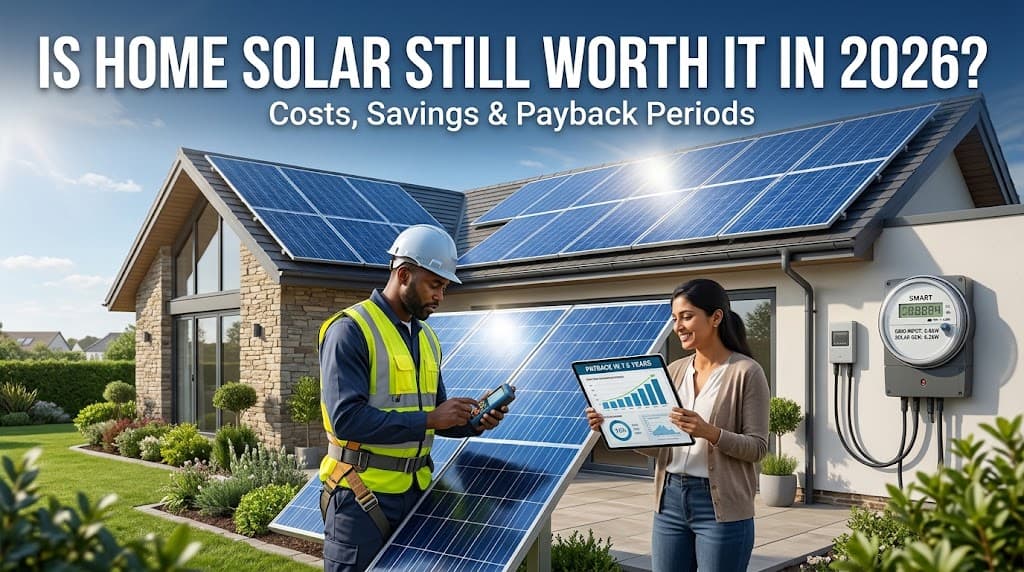
A residential solar energy system uses photovoltaic (PV) panels to convert sunlight into electricity. The electricity can power household appliances, lighting, cooling systems, and electronic devices.
A typical home solar installation includes several components.
Solar panels
Solar panels capture sunlight and convert it into direct current (DC) electricity. Their output depends on panel efficiency, sunlight exposure, temperature, shading, and installation quality.
Inverter
An inverter converts DC electricity into alternating current (AC), which most household appliances use. Some systems use hybrid inverters that can also manage battery storage.
Mounting equipment
Mounting structures secure the panels to a roof or another suitable surface. Correct positioning and secure installation help improve performance and protect the system.
Battery storage
A battery stores excess electricity for use when solar production is low or during certain power outages. Batteries can increase the upfront cost significantly, so not every household needs one.
How Much Do Home Solar Panels Cost in 2026?
The cost of installing solar panels varies by country, system size, equipment quality, labor rates, roof conditions, and whether batteries are included.
A smaller system may be suitable for basic household electricity needs, while a larger system may be necessary for homes with air conditioning, electric heating, electric vehicles, or other energy-intensive appliances.
The total installation price may include:
Solar panels and inverter equipment
Mounting structures and electrical wiring
Installation labor
Permits, inspections, and utility approvals where required
Battery storage, if included
Monitoring equipment and safety components
What affects installation costs?
System size: Larger systems generally cost more upfront, although their cost per unit of capacity may be lower.
Equipment quality: Higher-efficiency panels and advanced inverters may cost more but can offer advantages in particular installations.
Roof condition: Repairs, difficult access, unusual roof shapes, or structural reinforcement can increase the total expense.
Battery storage: Batteries add equipment, installation, and eventual replacement costs.
Local regulations: Permitting requirements, taxes, incentives, and utility connection rules differ by location.
Homeowners should obtain multiple itemized quotations rather than comparing installation prices alone. Each quotation should specify system capacity, equipment models, warranties, expected energy production, and any additional charges.
How Much Can You Save With Solar Panels?
Solar savings depend on how much electricity the system produces and how much of that electricity the household can use or receive credit for.
A solar system may generate electricity during daylight hours, reducing the amount purchased from the grid. However, excess electricity exported to the grid may be compensated at a different rate from the price charged for electricity imported later.
Understand self-consumption
Self-consumption refers to using solar electricity directly in your home rather than exporting it.
For example, running a washing machine, water pump, or other suitable appliance during daylight hours may allow you to use more of your own solar generation.
The financial value of each solar unit depends on the electricity bill it offsets or the export credit it earns.
An illustrative savings example
Suppose a household invests $8,000 in a solar system and saves an estimated $1,200 per year on electricity.
The simple payback period would be:
\[ \text{Payback period}=\frac{\text{Initial investment}}{\text{Annual savings}} \]
\[ =\frac{\$8,000}{\$1,200}\approx 6.7\text{ years} \]
This example is illustrative, not a prediction for every home. It excludes financing costs, maintenance, inverter or battery replacement, changes in electricity prices, and the time value of money.
Actual savings can be substantially higher or lower depending on local conditions.
What Is the Solar Payback Period?
The solar payback period is the estimated time required for cumulative financial benefits to recover the initial investment.
A shorter payback period generally makes a system more attractive financially, provided the assumptions are realistic.
Factors that influence payback
Electricity prices: Homes that avoid expensive grid electricity may recover their installation costs more quickly.
Sunlight availability: Areas with strong solar resources can produce more electricity from the same system, although heat and weather still affect performance.
Installation price: A lower purchase price can shorten the payback period if equipment quality and expected performance remain comparable.
Export compensation: Low payments for exported electricity can reduce the value of excess generation.
Maintenance and replacement: Repairs, inverter replacement, battery degradation, and other expenses affect the system's lifetime financial return.
Homeowners should ask installers for an estimated annual production figure and calculate savings using their actual electricity tariff rather than relying solely on generic payback claims.
Is Solar Worth It Without a Battery?
For many households, a solar system without battery storage can be financially attractive.
A grid-connected system without a battery generally costs less to install and has fewer components that may require replacement. It can work particularly well when household electricity consumption overlaps with daylight production.
However, conventional grid-connected solar systems usually shut down during a grid outage for safety reasons unless they include suitable backup equipment.
Advantages of going battery-free
Lower initial investment
Fewer components to maintain
No battery replacement expense
Potentially faster financial payback
Straightforward system design
When a battery may make sense
Battery storage may be useful when electricity outages are frequent, evening consumption is high, or grid export compensation is unattractive.
Before purchasing a battery, homeowners should calculate the value of the electricity it can supply during evening hours and outages. They should also account for usable battery capacity, efficiency losses, warranty conditions, and replacement costs.
A battery is not automatically the most economical option simply because it increases energy independence.
Solar Energy in Pakistan: What Homeowners Should Consider
Pakistan is an important market for residential solar because many regions receive substantial sunlight throughout the year. However, the financial benefits of a solar installation depend on local electricity tariffs, applicable regulations, system costs, and household consumption patterns.
Electricity tariffs and export rules
Before installing a system, homeowners should verify the latest rules governing rooftop solar connections, billing, and compensation for electricity exported to the grid.
These policies can change. A financial calculation based on an outdated net-metering arrangement may significantly overestimate potential savings.
Household consumption patterns
Homes that operate air conditioners, water pumps, refrigerators, and other appliances during daylight hours may be able to use a substantial share of their solar electricity directly.
Households that consume most of their electricity after sunset should carefully compare battery costs with the value of their expected savings.
Dust, heat, and maintenance
Dust accumulation can reduce panel output, while high temperatures can lower panel efficiency. Suitable installation, periodic inspection, and cleaning when necessary can help maintain performance.
Homeowners should also evaluate inverter warranties, installer experience, electrical safety, and access to after-sales service.
How to Choose the Right Solar System Size
Choosing the correct system size is essential for controlling costs and avoiding unrealistic savings expectations.
Step 1: Review electricity bills
Collect at least 12 months of electricity bills if possible. This helps identify seasonal changes in consumption and periods of unusually high demand.
Step 2: Identify daytime usage
Determine how much electricity your household uses during sunlight hours. This helps estimate how much solar generation you can consume directly.
Step 3: Estimate solar production
Ask an installer to estimate annual energy production using your location, roof orientation, shading, equipment specifications, and local weather patterns.
Step 4: Compare system options
Request quotations for different system sizes and compare their total cost, expected output, self-consumption, export assumptions, and warranties.
Step 5: Avoid unnecessary capacity
A system that produces more electricity than you can economically use may not deliver the expected financial return, especially where export compensation is limited.
How Long Do Solar Panels Last?
Solar panels are designed to operate for decades, although their electricity production generally declines gradually over time.
Many manufacturers offer performance warranties extending to approximately 25 years, but the exact terms vary by product. A performance warranty does not mean that every component of the system will last equally long.
Components that may need replacement
Inverters: Their service life may be shorter than that of the panels.
Batteries: Lifespan depends on chemistry, operating temperature, charging patterns, and cycle count.
Wiring and electrical protection: Components may need inspection, repair, or replacement.
Mounting equipment: Quality materials and proper installation help reduce long-term problems.
When calculating lifetime savings, homeowners should include realistic maintenance and replacement allowances rather than assuming that the entire system operates without expense.
Common Solar Investment Mistakes to Avoid
Choosing the cheapest installer automatically
A low quotation may exclude important equipment, installation work, permits, or warranties. Compare complete proposals instead of looking only at the initial price.
Ignoring roof condition
A roof that requires repairs shortly after solar installation can create additional costs. Address significant roof issues before mounting panels.
Overestimating electricity savings
Solar generation varies, and export electricity may not be credited at the same rate as imported electricity. Base estimates on realistic production and current billing rules.
Buying a battery without calculating its value
Battery storage can improve backup capability, but its financial return depends on how often it is used and what electricity costs it helps avoid.
Overlooking maintenance and warranties
Understand who will handle repairs, what the warranties cover, and whether local technical support is available.
A Practical Checklist Before Installing Solar
Use this checklist to evaluate a residential solar proposal.
Review electricity bills from the previous year.
Check current utility connection and export policies.
Obtain at least three itemized quotations.
Confirm equipment models and warranty terms.
Check roof condition and potential shading.
Compare battery and battery-free options.
Calculate payback using realistic annual savings.
Include maintenance and possible replacement costs.
Verify installer qualifications and after-sales support.
Confirm permits, inspections, and insurance requirements.
Frequently Asked Questions (FAQs)
1. Is home solar worth the investment in 2026?
Solar can be worthwhile when the system's lifetime savings exceed its total costs. The result depends on installation prices, electricity tariffs, sunlight, self-consumption, export compensation, and maintenance.
2. How many years does it take for solar panels to pay for themselves?
The payback period varies by location and system design. Calculate it by dividing the initial investment by realistic annual net savings, then adjust for maintenance, financing, and component replacement.
3. Do solar panels work on cloudy days?
Yes. Solar panels can generate electricity in cloudy conditions, but production is generally lower than under strong direct sunlight. The amount depends on cloud cover, panel technology, and weather conditions.
4. Do solar panels work at night?
Solar panels do not generate meaningful electricity at night because they require sunlight. A battery can provide stored solar energy after sunset, while a grid-connected household may draw electricity from the grid.
5. Is battery storage necessary for home solar?
No. A battery is optional in many grid-connected systems. It is most useful when backup power or evening electricity savings justify its additional cost.
6. Can solar panels eliminate electricity bills completely?
Not always. Fixed utility charges, grid electricity consumption, seasonal production changes, and local billing rules can leave homeowners with a remaining bill.
7. Does solar increase property value?
Solar installations may improve a property's appeal, but the effect on resale value varies by market. Ownership arrangements, system age, warranties, and local buyer preferences all matter.
8. Are solar panels difficult to maintain?
Generally, they require relatively little maintenance. Periodic inspections, checking electrical components, and cleaning when needed can help maintain performance.
9. Do solar panels work during a power outage?
Standard grid-connected systems usually shut down during outages for safety. Backup power generally requires a compatible inverter, appropriate isolation equipment, and often battery storage.
10. Is rooftop solar suitable for every house?
No. Roof condition, shading, available space, building orientation, local regulations, and electricity consumption all affect suitability. Ground-mounted systems may be alternatives where space permits.
11. How do I estimate solar savings accurately?
Use your electricity bills, expected solar production, daytime consumption, current electricity tariffs, and applicable export credits. Include maintenance, financing, and equipment replacement costs.
12. Are cheaper solar panels a good investment?
They can be, provided their performance, safety certifications, warranties, and supplier support meet your requirements. Compare total value rather than price alone.
13. What happens when solar panels become less efficient?
Panels generally experience gradual performance degradation. A well-designed system can continue generating electricity for many years, although output may decline over time.
14. Is solar better than investing the money elsewhere?
That depends on the alternative investment, risk, financing costs, and expected electricity savings. Compare solar's projected net financial return with other uses of the same money.
15. Can renters install solar panels?
Renters usually need permission from the property owner for a permanent rooftop installation. Depending on the location, community solar programs or portable solar products may offer alternatives.
16. What is the difference between grid-tied and off-grid solar?
Grid-tied systems connect to the utility network, while off-grid systems operate independently and typically need batteries and careful energy management. Hybrid systems combine grid connectivity with storage capabilities.
17. Does extreme heat reduce solar panel performance?
Yes. Solar panel output generally decreases as cell temperature rises above its rated operating conditions. Proper ventilation and suitable installation can help limit heat-related losses.
18. How much roof space is needed for solar panels?
The required area depends on system capacity, panel dimensions, efficiency, spacing, and roof layout. An installer can assess usable space after accounting for shading and access requirements.
19. Can I install solar panels myself?
Small portable systems may be suitable for some do-it-yourself applications, but permanent residential installations involve electrical and structural safety considerations. Professional installation is generally advisable, and local regulations may require qualified installers.
20. What is the most important factor when choosing a solar system?
The most important consideration is whether the system matches your electricity needs and offers reliable performance at a reasonable total cost. Expected production, equipment quality, local billing rules, and warranty support should all inform the decision.
Conclusion
Home solar can be a valuable long-term investment in 2026, but its financial benefits are not identical for every household. Installation costs, local electricity prices, sunlight exposure, battery requirements, and utility policies all influence the outcome.
The smartest approach is to begin with your electricity bills, compare reputable installers, estimate realistic annual savings, and calculate the payback period using current local rules. Avoid relying on guaranteed-savings claims or generic system prices that do not reflect your circumstances.
For households with suitable roofs and favorable electricity economics, a well-designed solar installation can reduce grid dependence and help control energy expenses over time. The key is to evaluate the numbers carefully before investing.