
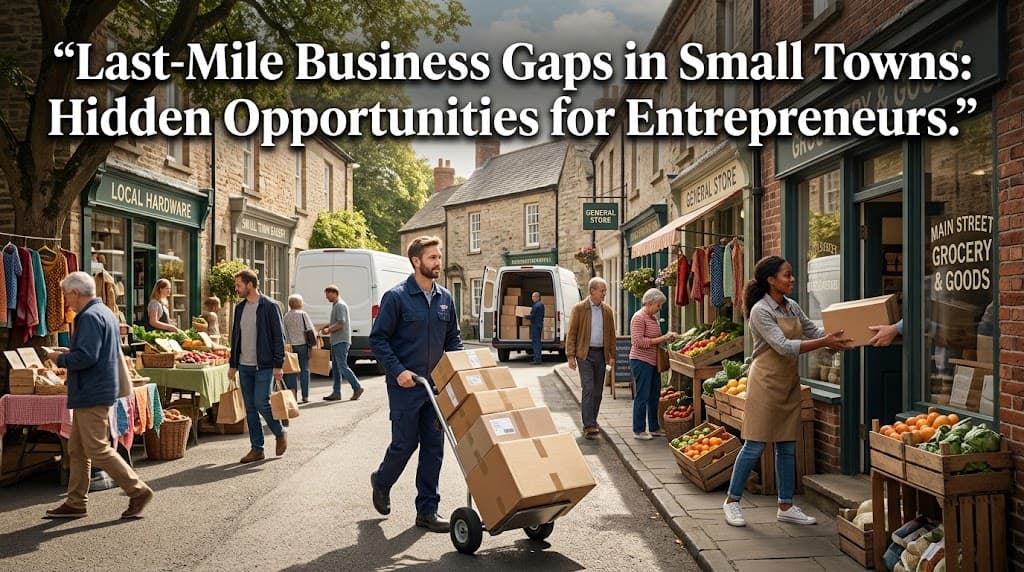
WPWhy Product Prices Change Without Warning: The Hidden World of Dynamic Pricing
Introduction
Small towns are often overlooked when people discuss business growth. Entrepreneurs tend to focus on major cities, where populations are larger, shopping options are more varied, and digital services are widely available. However, smaller communities can have their own unmet needs that create opportunities for innovative businesses.
From unreliable deliveries and limited repair services to gaps in healthcare access, digital support, and local transportation, many small towns face practical challenges that affect residents and local businesses. These challenges are not simply inconveniences. When approached carefully, they can reveal opportunities for entrepreneurs who understand their communities.
This article explores the most common last-mile business gaps in small towns, explains how to identify promising opportunities, and provides practical steps for building a sustainable business around local demand.
What Are Last-Mile Business Gaps?
Last-mile business gaps are problems that arise when products or services fail to reach customers conveniently, affordably, or reliably at the final stage of delivery or access.
The term “last mile” is often associated with delivering packages from a distribution centre to a customer's door. However, it can also describe the final connection between a service provider and the people who need that service.
For example, an online store may ship products to a regional warehouse but offer limited delivery to nearby villages. A local business may have a website but lack affordable delivery options. Residents may also struggle to find reliable technicians, convenient transport, or assistance with digital services.
These gaps vary by location. A business opportunity that works in one town may not succeed in another, so understanding local needs is essential.
Why Small Towns Can Offer Untapped Business Opportunities
1. Essential Services May Be Limited
Some small towns have fewer specialised service providers than major cities. Residents may need to travel to larger urban centres for certain repairs, professional services, or specialised products.
Entrepreneurs can investigate whether local demand is sufficient to support services such as appliance repair coordination, mobile phone maintenance, home cleaning, or scheduled collection and delivery.
2. Customers Value Convenience
Distance, transportation costs, work schedules, and limited opening hours can make routine tasks difficult. A business that saves residents time may provide meaningful value even if it does not offer the lowest price.
Convenience can include reliable appointment times, clear communication, transparent fees, and consistent service quality.
3. Local Businesses Need Better Distribution
Small retailers, farmers, food producers, and home-based businesses may have useful products but limited ways to reach customers outside their immediate neighbourhood.
Affordable delivery coordination, shared transport, packaging assistance, and simple online ordering may help these businesses reach a wider market.
4. Digital Access Does Not Always Mean Digital Confidence
People may have smartphones and internet access but still need help using online services. Small businesses may also lack the skills or time to manage digital catalogues, customer enquiries, online payments, and order tracking.
Digital support services can address these needs when they are affordable, trustworthy, and easy to understand.
Seven Last-Mile Business Opportunities in Small Towns
1. Local Delivery and Collection Services
A local delivery service can connect shops, pharmacies, grocery stores, restaurants, and customers within a defined area.
Instead of competing directly with large national delivery companies, an entrepreneur might focus on locations that are difficult to serve or on products that require dependable local coordination.
Possible services include:
Scheduled grocery deliveries.
Local shop-to-home delivery.
Parcel collection and drop-off.
Delivery coordination for small online sellers.
Regular deliveries to nearby villages where routes are practical.
How to get started: Speak with local retailers, identify their delivery problems, and test demand using a small delivery area. Calculate fuel, labour, packaging, vehicle maintenance, and failed-delivery costs before setting prices.
Do not promise delivery times that cannot be maintained. Reliability is often more valuable than offering an unrealistic delivery guarantee.
2. Mobile Repair and Maintenance
Residents may find it difficult to locate dependable technicians for phones, computers, household appliances, bicycles, or other everyday equipment.
A mobile repair business can offer home visits, scheduled collection, or partnerships with established repair professionals.
The business does not necessarily need to perform every repair itself. It may coordinate qualified technicians and manage bookings, customer communication, and service follow-up.
Key success factor: Build trust through clear estimates, written receipts, realistic completion times, and appropriate warranties. Protect customer data when handling phones or computers, and never access private information without permission.
3. Digital Assistance for Local Businesses
Many small businesses could benefit from basic digital services without hiring a full-time employee.
Potential services include:
Creating and updating online business listings.
Setting up simple digital product catalogues.
Managing customer enquiries.
Designing menus and promotional materials.
Helping businesses organise online orders.
Providing basic website maintenance.
A freelancer can begin with a few clients and expand through referrals. The most important skills are communication, reliability, basic digital knowledge, and the ability to demonstrate measurable value.
Avoid promising instant sales growth. Explain exactly what the service includes and provide realistic reports on enquiries, engagement, or completed tasks.
4. Farm-to-Town Delivery Networks
In agricultural regions, farmers and small food producers may struggle to reach urban customers efficiently. Meanwhile, households and retailers may want fresh produce from nearby suppliers.
A small business can coordinate orders, collection schedules, packaging, and delivery routes between producers and buyers.
Potential customers include restaurants, grocery shops, households, and local food businesses.
Before launching, investigate seasonal supply, food safety requirements, transport conditions, spoilage, and payment arrangements. Start with a limited selection of products and a manageable number of customers.
Profit depends on purchasing costs, delivery efficiency, waste, and the prices buyers are willing to pay.
5. Convenient Access to Essential Products
Some communities have limited access to specialised household supplies, repair parts, mobility accessories, school materials, or other frequently needed products.
A small retailer or order-based business could help residents obtain these items without making a long trip.
Rather than buying large amounts of inventory immediately, collect customer requests and identify products that people regularly struggle to find.
For regulated goods, including medicines and certain health products, follow local licensing, storage, prescription, and delivery requirements. Do not distribute regulated products without the necessary authorisation.
6. Local Transport Coordination
Transport gaps can affect workers, students, older adults, and people travelling between small towns and nearby service centres.
Potential models include pre-booked rides, shared transport on established routes, transport coordination for local businesses, or scheduled collection services.
A viable model requires careful attention to insurance, driver checks, passenger safety, vehicle standards, permits, and local transport regulations.
Demand should be measured before investing in vehicles. In some locations, coordinating existing licensed transport providers may be more affordable than operating a fleet.
7. Home and Community Support Services
Busy households may need reliable help with cleaning, gardening, basic maintenance, errands, or other everyday tasks.
A local service business can connect customers with suitable workers, arrange bookings, and provide clear pricing.
Trust is particularly important when workers enter private homes. Use appropriate screening, transparent policies, clear service agreements, and a process for handling complaints.
Start with a limited service area and a few well-defined offerings. Expanding too quickly can make quality control difficult.
How to Find the Right Opportunity in Your Town
Not every gap represents a profitable business. A problem may be real, but customers may not be willing or able to pay enough to support a solution.
Step 1: Talk to Potential Customers
Speak with residents, shop owners, workers, farmers, and service providers. Ask what takes too much time, what is difficult to find, and which services are unreliable.
Specific questions are more useful than simply asking whether someone likes a business idea.
Step 2: Study Existing Competitors
Look at local providers, their prices, opening hours, service areas, customer feedback, and waiting times.
Competition is not always a bad sign. It can demonstrate demand. Your goal is to discover whether customers are underserved and whether you can provide something meaningfully better.
Step 3: Calculate the Numbers
Estimate startup expenses, operating costs, expected orders, customer acquisition costs, and the amount you can realistically charge.
For a delivery business, for example, a high number of orders may still produce little profit if routes are inefficient or fuel costs are high.
Step 4: Run a Small Pilot
Test the service with a limited number of customers before investing heavily. Use a simple booking form, telephone number, messaging service, or basic website.
Track completed orders, repeat customers, complaints, expenses, and profit per transaction.
Step 5: Improve Before Expanding
Use customer feedback to adjust prices, schedules, service areas, and processes. Expand only when the initial operation is reliable and financially sustainable.
Common Challenges and How to Overcome Them
Low Population Density
Long distances between customers can increase delivery and travel costs. Use defined service zones, scheduled delivery days, and grouped orders to improve efficiency.
Limited Purchasing Power
Some customers may be highly price-sensitive. Offer clear pricing, essential service options, and transparent fees rather than relying on expensive subscriptions or hidden charges.
Trust and Reputation
Customers may hesitate to use an unfamiliar business. Build credibility through consistent service, verified contact details, clear policies, and genuine customer feedback.
Unreliable Infrastructure
Poor roads, weak mobile connectivity, weather disruptions, and inconsistent electricity can interrupt operations. Maintain backup communication methods and set realistic service expectations.
Cash Flow Problems
Businesses can struggle when customers pay late or operating expenses arise before revenue arrives. Track cash flow regularly, establish payment terms, and avoid expanding based solely on sales volume.
How Technology Can Help Without Making the Business Complicated
Technology can simplify last-mile operations, but a sophisticated app is rarely necessary at the beginning.
A small business may initially use a spreadsheet for orders, messaging for customer updates, mapping tools for route planning, and digital payment options where available.
As demand grows, the business can consider inventory management, automated booking reminders, customer relationship software, or route optimisation tools.
The technology should solve a genuine problem. Investing in an expensive platform before proving demand can create unnecessary financial pressure.
Measuring Business Success
Revenue alone does not show whether a last-mile business is healthy. Entrepreneurs should monitor several indicators:
Repeat-customer rate: How many customers return?
On-time completion: How reliably are orders or appointments completed?
Profit per transaction: What remains after direct costs?
Customer acquisition cost: How much does it cost to attract a new customer?
Complaint and refund rate: Where does the service fail?
Cash flow: Can the business pay its bills on time?
Review these figures regularly. They can reveal whether a business should improve its service, adjust prices, change its service area, or stop an unprofitable offering.
Conclusion
Small towns can contain overlooked business opportunities where essential products and services are inconvenient, unreliable, or difficult to access. Local delivery, repair coordination, digital assistance, agricultural distribution, transport coordination, and household services are possible starting points.
However, success is not guaranteed by the absence of a competitor. A sustainable business must solve a real problem, attract paying customers, control operating costs, and deliver consistent service.
Entrepreneurs who listen to local communities, test ideas on a small scale, and measure results can identify opportunities that larger providers may not be equipped to serve. In the last mile, understanding the customer and the local environment can be just as important as having a clever business idea.
Frequently Asked Questions
1. What does last-mile business mean?
Last-mile business refers to the final stage of delivering a product or making a service accessible to the customer. It can include home delivery, local transport, repair coordination, and other services that connect providers with end users.
2. Why can small towns have last-mile service gaps?
Some small towns have fewer providers, longer travel distances, limited delivery coverage, or less access to specialised services. These conditions vary by location and may create opportunities for local solutions.
3. Which last-mile business is best for a beginner?
The best option depends on local demand, skills, budget, competition, and operating costs. Digital assistance, local delivery coordination, and selected home services may be possible to test without major upfront investment.
4. Can a delivery business work in a small town?
Yes, if enough customers and businesses need the service and the routes can be operated economically. Demand, fuel costs, order density, and delivery reliability are important factors.
5. How much money is needed to start a last-mile business?
There is no universal startup cost. A service operated with existing equipment may require relatively little capital, while a vehicle-based operation can require substantial investment. Prepare a local budget before launching.
6. How can I identify an unmet local need?
Interview residents and business owners, examine customer complaints, observe service delays, and study which products or services require people to travel elsewhere. Validate findings with paying customers.
7. Do I need an app to start a local delivery service?
No. A phone, messaging service, simple order form, and spreadsheet may be enough for a small pilot. Build or purchase more advanced technology only when it solves a proven operational problem.
8. How can local delivery businesses compete with large companies?
They can focus on specific neighbourhoods, local relationships, reliable communication, specialised needs, and services that larger providers do not cover efficiently.
9. Can farmers benefit from last-mile delivery networks?
Potentially. Coordinated collection and delivery can help farmers reach shops, restaurants, and households. Profitability depends on demand, transport costs, product quality, and food safety.
10. What are the biggest risks of a last-mile business?
Common risks include low demand, high travel costs, unreliable service, cash flow problems, regulatory requirements, damage or loss of goods, and competition.
11. How can a business keep delivery costs low?
Group orders, plan efficient routes, set realistic delivery zones, use scheduled delivery windows, and monitor fuel and labour expenses.
12. Is digital assistance a good business opportunity in small towns?
It may be, particularly where local businesses need affordable help with online listings, digital catalogues, websites, and customer communication. Success depends on clients' willingness to pay and the quality of the service.
13. How can a new business earn customer trust?
Provide clear pricing, reliable contact information, realistic promises, receipts, transparent complaint handling, and consistent service. Genuine customer reviews can also help build credibility.
14. Can last-mile businesses operate in rural areas?
Yes, but lower population density and longer distances can make operations more expensive. Shared routes, scheduled service days, and partnerships may help.
15. How do I know if my business idea can make a profit?
Estimate revenue and all relevant costs, including labour, travel, supplies, insurance, marketing, refunds, and maintenance. Test the idea with real customers and review profit per transaction.
16. What role does technology play in last-mile services?
Technology can help manage orders, communicate with customers, plan routes, track expenses, and coordinate workers. The simplest effective tools are often best during the early stages.
17. Should I borrow money to start a local service business?
Borrowing adds repayment obligations before demand is certain. Validate the business model and estimate cash flow first. Compare financing options carefully and avoid debt you cannot reasonably repay.
18. How can small retailers benefit from delivery partnerships?
Partnerships can help retailers serve more customers without managing every delivery themselves. Agreements should define pricing, responsibilities, delivery standards, and procedures for lost or damaged goods.
19. What skills are useful for last-mile entrepreneurs?
Useful skills include customer service, scheduling, budgeting, communication, problem-solving, basic digital literacy, and operational planning. Industry-specific training may also be necessary.
20. How can a last-mile business handle customer complaints?
Respond promptly, investigate the issue, explain the available solution, and record recurring problems. A clear refund or replacement policy can reduce misunderstandings.
21. Are home-based service businesses suitable for small towns?
They can be suitable when customers need convenient, dependable help and the provider can operate safely and legally. Demand, trust, and scheduling are key considerations.
22. How can a business avoid cash flow problems?
Track money coming in and going out, establish clear payment terms, maintain an appropriate reserve, and avoid taking on fixed costs before revenue can support them.
23. Can local transport coordination be profitable?
It may be where sufficient demand exists and legal requirements can be met. Profitability depends on vehicle and driver costs, route utilisation, safety standards, and local competition.
24. How long does it take to establish a successful last-mile business?
There is no fixed timeline. It depends on demand, customer trust, competition, operating efficiency, and access to resources. Early pilots help entrepreneurs assess progress before making larger investments.
25. What is the most important factor in last-mile business success?
Solving a genuine customer problem at a price that supports sustainable operations is fundamental. Reliable service, local knowledge, cost control, and repeat customers help turn an opportunity into a lasting business.