

Introduction
Artificial intelligence is changing how businesses operate, compete, and grow in the digital economy. From small startups to multinational corporations, organizations are exploring AI technologies to automate repetitive tasks, improve customer experiences, analyze information, and make better business decisions.
In 2026, AI is no longer limited to advanced research laboratories or large technology companies. Businesses can access AI-powered writing assistants, customer service chatbots, predictive analytics platforms, marketing tools, and workflow automation systems without building their own AI technology from scratch.
However, adopting artificial intelligence does not automatically guarantee business success. Companies must choose the right applications, protect sensitive information, evaluate results, and ensure that automated systems support their business objectives.
Understanding how AI creates value can help entrepreneurs and business leaders identify opportunities to improve productivity, reduce operational friction, and develop sustainable growth strategies.
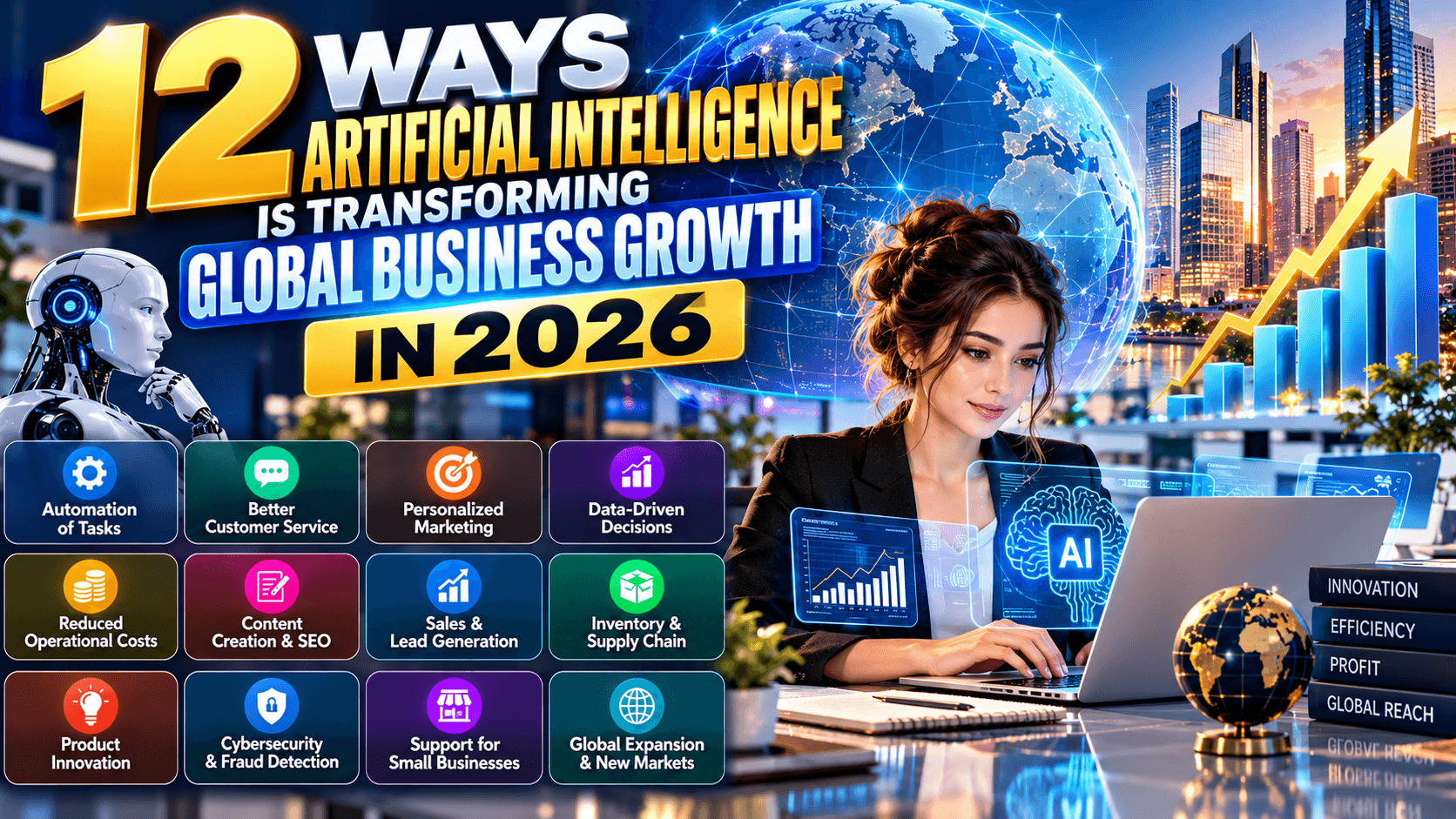
Here are 12 important ways artificial intelligence is transforming global business growth in 2026.
1. Automating Repetitive Business Tasks
One of the most practical applications of artificial intelligence is business process automation. Employees often spend significant time performing repetitive activities such as organizing information, preparing routine reports, sorting customer inquiries, and updating records.
AI-powered systems can assist with these activities, allowing employees to focus on tasks that require judgment, creativity, and personal communication.
For example, a business can use automation to categorize incoming emails, extract information from documents, generate report drafts, or route customer requests to the appropriate department.
Tools such as Microsoft Copilot, Zapier, and other workflow automation platforms can help organizations connect different applications and simplify routine processes.
How this supports business growth:
Reduces manual administrative work.
Helps teams process routine tasks more efficiently.
Supports consistent workflows.
Allows businesses to handle more work without increasing every administrative task proportionally.
Businesses should begin with low-risk, repetitive tasks and review automated outputs before expanding automation to more important processes.
2. Improving Customer Service With AI Chatbots
Customer service plays an important role in customer satisfaction, retention, and brand reputation. However, answering the same questions repeatedly can consume valuable time and resources.
AI chatbots and virtual assistants can help customers find information about products, shipping, opening hours, account procedures, and common problems. Depending on how they are configured, they may also help customers navigate a website or initiate a support request.
For example, an online store can use a chatbot to answer common questions about delivery policies while directing refund disputes or complicated complaints to a human support representative.
Modern conversational AI systems can interpret natural language and maintain more flexible interactions than traditional rule-based chatbots. Nevertheless, they can still misunderstand questions or provide inaccurate answers.
Business benefits include:
Faster responses to common inquiries.
Support outside normal business hours.
Reduced pressure on customer support teams.
More consistent answers to frequently asked questions.
The most effective approach combines AI assistance with clear escalation procedures for sensitive, unusual, or complicated customer issues.
3. Personalizing Marketing Campaigns
Customers respond differently to products, messages, offers, and promotions. Artificial intelligence can help businesses analyze customer behavior and create more relevant marketing experiences.
AI-powered marketing platforms can assist with audience segmentation, campaign analysis, email personalization, content recommendations, and advertising optimization.
For example, an e-commerce business may use customer purchase history and browsing behavior to recommend related products or send relevant follow-up emails, subject to applicable privacy requirements.
Marketing teams can also use AI to develop different versions of an advertisement and test which message resonates with a particular audience.
How AI improves marketing:
Helps identify customer segments.
Supports personalized product recommendations.
Speeds up campaign planning and content production.
Helps marketers evaluate campaign performance.
Can assist with allocating advertising budgets.
Personalization should remain relevant and respectful. Businesses should follow applicable privacy laws and avoid collecting or using customer information without an appropriate legal basis.
4. Making Data-Driven Business Decisions
Businesses generate information from sales, customer interactions, website traffic, inventory, advertising, and financial transactions. Analyzing these sources manually can be time-consuming, especially when information is spread across multiple systems.
AI-powered analytics tools can help identify patterns, summarize reports, detect unusual activity, and generate forecasts based on available data.
For example, a retailer can analyze historical sales and seasonal patterns to estimate future product demand. A marketing agency can compare campaign results to identify which channels appear to generate the most qualified leads.
AI can support decision-making, but predictions depend on the quality and relevance of the underlying data.
Potential advantages include:
Faster analysis of large datasets.
Better visibility into business performance.
Earlier identification of unusual patterns.
More informed planning and resource allocation.
Business leaders should validate important findings, check the assumptions behind forecasts, and avoid treating AI-generated predictions as guaranteed outcomes.
5. Reducing Operational Costs
Operational costs can limit business growth when expenses increase faster than revenue. Artificial intelligence may help organizations identify inefficiencies and improve how resources are used.
For example, manufacturers can use predictive maintenance systems to analyze equipment data and identify warning signs that may indicate a future failure. Logistics businesses can use optimization software to evaluate delivery routes, while service companies can automate parts of their administrative workflows.
These applications can reduce avoidable work, improve planning, and help businesses identify opportunities to use resources more efficiently.
However, implementing AI also involves costs such as software subscriptions, integration, employee training, data management, and ongoing monitoring.
Before adopting a solution, businesses should compare its total cost with measurable benefits.
A useful evaluation framework includes:
Initial implementation expenses.
Recurring subscription and maintenance costs.
Time saved by employees.
Changes in error rates and operating expenses.
The effect on service quality and revenue.
AI creates business value when the improvement justifies the investment, not simply because a company has adopted new technology.
6. Creating Better Content and Supporting SEO
Content marketing helps businesses attract potential customers, explain their products, and build visibility in search engines. Artificial intelligence can support the content creation process by helping teams research topics, organize outlines, generate draft text, summarize information, and brainstorm headlines.
For websites such as 1st4ebusiness.com, AI can assist with developing content ideas related to business technology, e-commerce, entrepreneurship, digital marketing, and industry trends.
AI can also help SEO teams organize keyword research, identify content gaps, review page structure, and create initial meta descriptions.
However, generating a large volume of AI-written articles without meaningful review can produce repetitive, inaccurate, or unhelpful content. Search visibility is not guaranteed by using AI or inserting keywords into every heading.
A stronger AI-assisted SEO workflow includes:
Researching a topic and understanding search intent.
Checking reliable sources and verifying important claims.
Creating a useful outline based on the reader's needs.
Adding original analysis, examples, and practical advice.
Reviewing titles, headings, internal links, and metadata.
Updating the article when information changes.
The objective should be to publish useful, trustworthy content that answers readers' questions more effectively, rather than simply increasing the number of pages on a website.
7. Improving Sales and Lead Generation
Finding qualified customers is essential for business growth. AI can help sales teams organize leads, summarize customer interactions, identify potential opportunities, and prioritize follow-ups.
Customer relationship management systems increasingly include AI-assisted features that can analyze sales activity and help representatives prepare for conversations.
For example, a business-to-business company may use its CRM data to identify leads that match its target customer profile. Sales staff can then review those prospects and decide which opportunities deserve attention first.
AI can also help draft personalized outreach messages, summarize meetings, and prepare proposals. Human review remains important because automated messages can be inaccurate or feel impersonal.
Sales applications include:
Lead classification and prioritization.
Customer interaction summaries.
Sales forecasting assistance.
Personalized follow-up drafts.
Identification of possible cross-selling opportunities.
Businesses should measure qualified leads, conversion rates, customer acquisition costs, and revenue rather than judging sales automation only by the number of messages sent.
8. Optimizing Inventory and Supply Chains
Inventory management is particularly important for retailers, manufacturers, distributors, and e-commerce businesses. Too much inventory can tie up cash, while insufficient stock can lead to missed sales and disappointed customers.
AI-supported forecasting tools can analyze historical sales, seasonal demand, supplier performance, and other relevant information to help businesses plan inventory levels.
In supply chains, optimization systems may help evaluate shipping routes, warehouse operations, delivery schedules, and possible disruptions.
For example, an online retailer can use sales trends and stock data to identify products that may need replenishment before a busy shopping period.
Potential business benefits include:
Better inventory planning.
Fewer avoidable stock shortages.
Improved warehouse organization.
More efficient delivery planning.
Greater visibility into supply chain risks.
These systems work best when businesses maintain accurate inventory records and account for unexpected changes in customer demand, supplier availability, and transportation conditions.
9. Supporting Product Development and Innovation
Businesses need to improve existing products and identify new opportunities to remain competitive. Artificial intelligence can assist research and development teams by summarizing customer feedback, analyzing market information, exploring design alternatives, and supporting software development.
For example, a software company can use AI coding assistants to generate code suggestions or explain unfamiliar code. Developers must still test the software, review security implications, and verify that the code meets project requirements.
A consumer products company may analyze product reviews to identify common complaints or features customers want to see improved.
AI can help teams explore ideas faster, but successful innovation still depends on customer research, sound engineering, commercial judgment, and real-world testing.
Businesses can use AI to support innovation by:
Identifying recurring customer problems.
Organizing feedback from multiple sources.
Generating early-stage product concepts.
Supporting prototyping and testing.
Summarizing technical and market research.
The goal is to improve the development process while ensuring that the resulting products solve genuine customer problems.
10. Strengthening Cybersecurity and Fraud Detection
As businesses conduct more transactions online, protecting systems, customer information, and financial assets becomes increasingly important.
AI-supported security systems can analyze network activity, login behavior, transaction patterns, and other signals to identify activity that may require investigation.
For example, a payment provider may use machine learning to flag transactions that differ significantly from a customer's normal activity. Security teams can then investigate suspicious cases using additional evidence.
AI can also assist with identifying unusual system behavior and prioritizing security alerts. However, attackers can use AI too, and automated systems may generate false positives or miss sophisticated threats.
Businesses should combine AI-assisted detection with established security practices, including:
Multi-factor authentication.
Regular software updates.
Employee security training.
Data backups and recovery plans.
Access controls and monitoring.
Incident response procedures.
AI should complement a comprehensive cybersecurity strategy rather than replace security professionals or basic safeguards.
11. Helping Small Businesses Compete With Larger Companies
Small businesses often operate with limited budgets, smaller teams, and fewer specialized resources than large corporations. Affordable AI tools can help reduce some of these disadvantages.
An independent consultant can use AI to organize research and draft client documents. A small retailer can use AI-assisted tools to improve product descriptions and customer communication. A local service business can automate appointment reminders and routine inquiries.
These applications may allow small teams to manage more work and provide better service without immediately hiring additional staff for every task.
However, smaller businesses should avoid adopting too many tools at once. Subscription fees, complicated integrations, and employee training can create unnecessary expenses.
A practical starting strategy is to identify one recurring problem, test a suitable tool, and measure the result.
For example, a business could compare how much time employees spend preparing weekly reports before and after introducing an AI-assisted workflow.
If the tool delivers measurable value and works reliably, the company can consider expanding its use.
12. Enabling Global Expansion and International Business
Artificial intelligence can help businesses serve customers in multiple countries by supporting translation, multilingual customer service, market research, document processing, and communication.
For example, an e-commerce company entering a new market may use AI-assisted translation to prepare initial versions of product descriptions and support materials. Local experts should review important translations to ensure that terminology, cultural context, and legal requirements are correct.
AI can also help teams summarize information about international markets and compare potential opportunities. However, businesses must verify market data and account for differences in regulations, taxes, logistics, payment methods, and customer preferences.
AI can support international growth through:
Multilingual communication.
Faster preparation of localized content.
Analysis of customer feedback across markets.
Assistance with international market research.
Streamlined administrative processes.
Successful expansion still requires local knowledge, appropriate compliance procedures, dependable distribution, and a clear understanding of customer demand.
Best AI Tools Businesses Can Explore in 2026
Businesses do not need to build their own AI models to benefit from artificial intelligence. They can explore established products according to their specific requirements.
AI Tool | Potential Business Use |
|---|---|
ChatGPT | Research assistance, brainstorming, drafting, and analysis |
Microsoft Copilot | Assistance within supported Microsoft applications |
Google Gemini | Research, writing, and supported productivity workflows |
Zapier | Connecting applications and automating workflows |
HubSpot AI features | Sales, marketing, and customer relationship workflows |
Canva AI features | Visual content creation and design assistance |
Grammarly | Writing feedback and communication support |
GitHub Copilot | Code suggestions and developer productivity |
Features, availability, pricing, and integrations vary by product and subscription plan. Businesses should check current product documentation before choosing a tool.
The best option is not necessarily the one with the most features. It is the one that fits the company's workflow, budget, security requirements, and business objectives.
Challenges Businesses Should Consider Before Adopting AI
Although artificial intelligence offers opportunities, its implementation also presents risks.
Data Privacy and Security
AI tools may process customer records, business documents, and confidential information. Companies should understand how data is handled and avoid entering sensitive information into services without appropriate authorization and safeguards.
Accuracy and Reliability
AI systems can produce incorrect information, misleading summaries, and flawed recommendations. Important outputs should be verified before they are used for financial, legal, operational, or customer-facing decisions.
Implementation Costs
Software fees are only part of the total cost. Businesses may also need training, technical support, data preparation, integration, and ongoing monitoring.
Employee Training
Employees need to understand when AI is useful, how to check its output, and when a task requires human judgment.
Responsible Use
Companies should establish clear policies for AI-generated content, customer communication, sensitive decisions, and access to company data.
A thoughtful adoption strategy helps businesses pursue productivity gains without ignoring reliability, accountability, or customer trust.
How to Create an AI Business Growth Strategy
Businesses can approach AI adoption through a simple, measurable process.
Step 1: Identify a real problem. Choose a recurring task, customer issue, or operational bottleneck that affects performance.
Step 2: Select an appropriate tool. Compare functionality, cost, privacy protections, integration requirements, and ease of use.
Step 3: Run a small pilot. Test the tool on a limited workflow before deploying it across the organization.
Step 4: Measure the results. Track time saved, error rates, customer satisfaction, conversion rates, or cost changes, depending on the objective.
Step 5: Review risks and quality. Check whether the tool produces reliable results and whether staff can identify mistakes.
Step 6: Expand carefully. Scale successful applications and discontinue tools that do not deliver sufficient value.
This approach allows businesses to make decisions based on evidence rather than adopting AI solely because it is a popular technology trend.
Frequently Asked Questions
How is artificial intelligence transforming business growth?
Artificial intelligence is helping businesses automate repetitive tasks, analyze data, improve customer service, personalize marketing, support sales, and optimize operations. These applications can improve productivity and help companies make more informed decisions, although results depend on implementation and business context.
What are the main benefits of AI for businesses?
Key potential benefits include faster task completion, improved data analysis, more personalized customer experiences, assistance with content creation, operational optimization, and better access to analytical capabilities.
Which AI tools are useful for small businesses?
Depending on their needs, small businesses can explore ChatGPT, Microsoft Copilot, Google Gemini, Zapier, Canva's AI features, and AI-enabled CRM platforms. The best choice depends on the task, budget, privacy requirements, and existing software.
Can AI help a small business increase revenue?
AI may help a business improve lead management, personalize marketing, identify customer needs, and reduce delays in customer service. Revenue growth is not guaranteed and depends on whether these improvements lead to more sales, better retention, or improved profitability.
Is AI expensive for businesses to implement?
Costs vary considerably. Some tools offer free or low-cost entry plans, while enterprise systems and customized implementations can require substantial investment. Businesses should consider the full cost of software, integration, training, and ongoing oversight.
Will artificial intelligence replace human employees?
AI can automate or change certain tasks, but its impact varies by occupation and industry. Many organizations use AI to assist employees rather than remove the need for human judgment, relationship-building, accountability, and specialized expertise.
How can a business start using AI safely?
Start with a low-risk task, select a reputable tool, review its privacy and security terms, train employees, and verify important outputs. Establish clear rules for sensitive information and require human review where errors could cause significant harm.
How does AI affect business productivity?
AI can reduce time spent on certain tasks, help organize information, and support faster analysis. Actual productivity improvements depend on the quality of the tool, the workflow, employee skills, and how much review or correction the output requires.
Conclusion
Artificial intelligence is transforming global business growth by changing how organizations manage operations, communicate with customers, analyze data, develop products, and reach new markets.
The 12 applications covered in this article demonstrate that AI is not limited to large technology companies. Small businesses, startups, retailers, marketing agencies, manufacturers, and international organizations can all explore practical uses for AI.
However, sustainable results require more than adopting new software. Businesses must identify real problems, choose appropriate tools, protect sensitive information, train employees, and measure performance.
For companies planning their next stage of growth in 2026, the most effective AI strategy is to start with a specific business need, test a solution carefully, and expand only when the results demonstrate genuine value.