
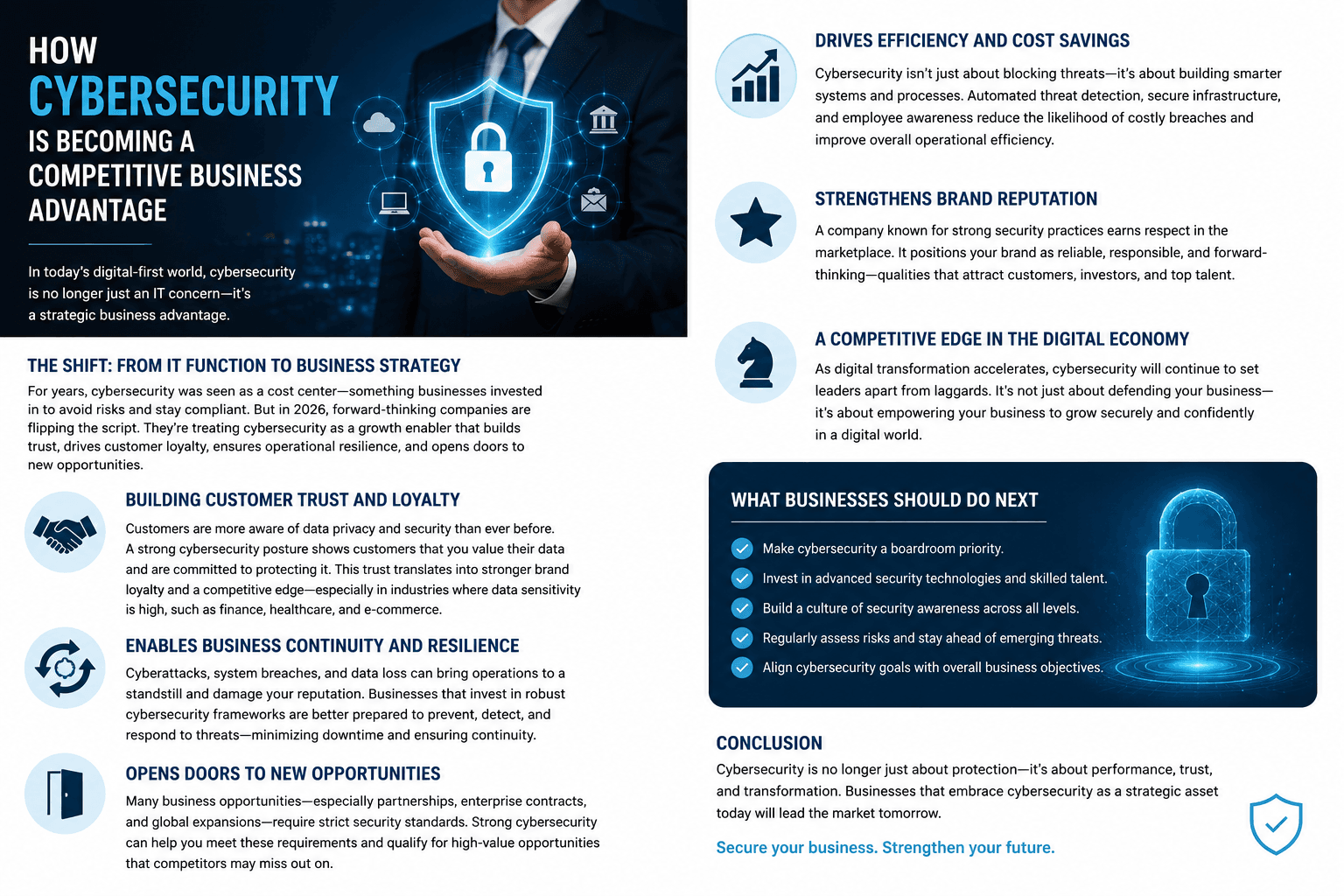

In today's digital economy, cybersecurity is no longer just an IT responsibility—it has become a critical business strategy. As organizations rely more on cloud computing, artificial intelligence, digital payments, and connected devices, protecting sensitive information has become essential for long-term success.
In 2026, businesses are investing more in cybersecurity not only to defend against cyber threats but also to strengthen customer trust, protect their reputation, meet regulatory requirements, and gain a competitive edge. Companies that prioritize cybersecurity are better positioned to attract customers, build investor confidence, and support sustainable growth.
The Growing Cyber Threat Landscape
Cyberattacks are becoming more sophisticated and frequent.
Businesses face threats such as ransomware, phishing attacks, data breaches, identity theft, insider threats, and supply chain attacks. Criminals are using advanced technologies, including artificial intelligence, to identify vulnerabilities and launch more targeted attacks.
Because organizations store increasing amounts of customer and financial data, cybersecurity has become one of the most important investments businesses can make.
Customer Trust Depends on Security
Consumers expect businesses to protect their personal information.
A single data breach can damage a company's reputation, reduce customer confidence, and lead to financial losses. In contrast, businesses with strong cybersecurity practices demonstrate that they value customer privacy and data protection.
Organizations that communicate their commitment to security often strengthen customer relationships and improve brand loyalty.
Trust has become a valuable competitive advantage.
Cybersecurity Supports Business Growth
Many businesses now consider cybersecurity an essential part of digital transformation.
As companies adopt cloud computing, remote work, automation, and artificial intelligence, secure technology infrastructure becomes increasingly important.
Businesses that invest in cybersecurity can expand digital services more confidently while reducing operational risks.
Strong security practices also make it easier to introduce new technologies without exposing sensitive systems to unnecessary threats.
Regulatory Compliance Is Increasing
Governments and regulatory agencies continue strengthening data protection requirements.
Businesses must comply with privacy laws, financial regulations, and industry security standards designed to protect customer information.
Failure to meet compliance requirements can result in financial penalties, legal challenges, and reputational damage.
Organizations that establish strong cybersecurity programs are generally better prepared to meet changing regulatory expectations.
Cybersecurity Improves Investor Confidence
Investors increasingly evaluate cybersecurity when assessing business performance.
Companies with strong security frameworks often demonstrate better risk management, operational resilience, and corporate governance.
Cybersecurity incidents can significantly affect financial performance, making security an important consideration for shareholders and investment professionals.
Organizations that proactively manage cyber risks may improve long-term investor confidence.
Artificial Intelligence Strengthens Security
Artificial intelligence is helping businesses detect and respond to cyber threats more efficiently.
AI-powered security platforms monitor network activity, identify suspicious behavior, detect unusual login attempts, and respond to threats in real time.
Machine learning algorithms continuously improve detection capabilities by analyzing millions of security events, helping businesses reduce response times and minimize potential damage.
AI has become an essential tool in modern cybersecurity strategies.
Employee Awareness Remains Critical
Technology alone cannot prevent every cyberattack.
Employees play an important role in protecting business systems by recognizing phishing emails, using strong passwords, following security policies, and reporting suspicious activity.
Many organizations now provide regular cybersecurity awareness training to reduce human error and strengthen overall security culture.
Well-trained employees are often the first line of defense against cyber threats.
Cybersecurity Creates a Competitive Advantage
Businesses that prioritize cybersecurity gain benefits beyond risk reduction.
Strong security practices improve customer confidence, support digital innovation, strengthen partnerships, protect intellectual property, and reduce business disruptions.
Organizations known for protecting customer information often differentiate themselves in competitive markets, especially in industries such as finance, healthcare, e-commerce, and technology.
Cybersecurity has become an important factor influencing purchasing decisions and business relationships.
Preparing for the Future
Cyber threats will continue evolving as technology advances.
Businesses should regularly assess security risks, update software, strengthen access controls, invest in advanced monitoring systems, and develop incident response plans.
Cybersecurity should be integrated into overall business strategy rather than treated as a separate technical function.
Organizations that remain proactive will be better prepared to manage future challenges.
Conclusion
Cybersecurity is no longer simply about preventing attacks—it has become a key driver of business resilience, customer trust, and long-term competitiveness.
Companies that invest in strong cybersecurity programs can better protect sensitive information, comply with evolving regulations, support digital transformation, and build lasting relationships with customers and investors.
As the digital economy continues expanding, cybersecurity will remain one of the most valuable competitive advantages for businesses seeking sustainable growth in 2026 and beyond.
FAQs:
1. Why is cybersecurity becoming a competitive business advantage?
Cybersecurity has evolved beyond risk management. Businesses with strong security practices build customer trust, protect sensitive data, reduce operational disruptions, and gain a competitive edge by demonstrating reliability and compliance.
2. How does cybersecurity improve customer trust?
Customers are more likely to do business with companies that protect personal and financial information. Strong cybersecurity measures reduce the risk of data breaches and strengthen brand reputation.
3. What are the main cybersecurity threats businesses face today?
Common threats include ransomware, phishing attacks, malware, data breaches, insider threats, business email compromise (BEC), supply chain attacks, and distributed denial-of-service (DDoS) attacks.
4. How can cybersecurity help businesses win new customers?
Many clients, especially enterprise customers, evaluate a company's cybersecurity standards before signing contracts. Strong security certifications and compliance practices can help businesses secure new partnerships and customers.
5. What role does artificial intelligence play in cybersecurity?
AI helps organizations detect threats faster, analyze unusual behavior, automate incident response, identify vulnerabilities, and improve overall security monitoring using real-time data analysis.
6. Why is employee cybersecurity training important?
Employees are often the first line of defense against cyberattacks. Regular training helps staff recognize phishing emails, use secure passwords, avoid social engineering attacks, and follow security best practices.
7. How does cybersecurity protect business continuity?
Strong cybersecurity reduces downtime caused by cyberattacks, protects critical systems, ensures faster disaster recovery, and minimizes financial losses resulting from security incidents.
8. What is Zero Trust security, and why is it gaining popularity?
Zero Trust is a security model that assumes no user or device should be trusted automatically. Every access request is continuously verified, reducing the risk of unauthorized access and insider threats.
9. How does cybersecurity support regulatory compliance?
Cybersecurity helps businesses comply with data protection regulations by implementing encryption, access controls, security monitoring, audit trails, and secure data management practices.
10. Can small businesses benefit from investing in cybersecurity?
Yes. Small businesses are frequent targets of cybercriminals. Investing in cybersecurity protects customer data, prevents financial losses, strengthens reputation, and supports long-term business growth.
11. How does cybersecurity impact a company's reputation?
A strong cybersecurity posture demonstrates responsibility and professionalism, while a data breach can damage customer confidence, reduce sales, and negatively affect brand value.
12. What cybersecurity technologies are businesses adopting in 2026?
Organizations are adopting AI-powered threat detection, multi-factor authentication (MFA), endpoint detection and response (EDR), cloud security platforms, Zero Trust architecture, and automated security operations.
13. How does cybersecurity protect remote and hybrid workforces?
Businesses secure remote employees using virtual private networks (VPNs), secure cloud access, endpoint protection, identity verification, encrypted communications, and continuous monitoring.
14. Why is cloud security becoming more important?
As businesses move operations to the cloud, protecting cloud applications, storage, and infrastructure becomes essential for preventing unauthorized access, data leaks, and cyberattacks.
15. What is cyber resilience?
Cyber resilience refers to an organization's ability to prevent, detect, respond to, and recover from cyber incidents while maintaining essential business operations with minimal disruption.
16. How can cybersecurity reduce business costs?
Although cybersecurity requires investment, it helps avoid expensive data breaches, legal penalties, regulatory fines, business interruptions, ransom payments, and reputational damage.
17. How does cybersecurity influence business partnerships?
Many organizations require vendors and partners to meet cybersecurity standards before sharing sensitive information or entering business agreements, making strong security a competitive differentiator.
18. What cybersecurity metrics should businesses monitor?
Key metrics include attempted attacks, incident response time, vulnerability remediation, phishing success rates, security awareness training completion, system uptime, and compliance performance.
19. How can businesses strengthen their cybersecurity strategy?
Organizations should conduct regular risk assessments, update software, enforce multi-factor authentication, encrypt sensitive data, train employees, perform security audits, and develop an incident response plan.
20. What is the future of cybersecurity in business?
Cybersecurity will continue evolving with AI-driven defense systems, Zero Trust security, automated threat detection, stronger privacy regulations, cloud-native security, and proactive risk management, making it a core business advantage rather than simply an IT requirement.