
TFThe Future of Smart Homes in 2026: AI, Automation & Connected Living
Quantum computing is rapidly emerging as one of the most promising technologies of the decade. While traditional computers have powered digital transformation for decades, quantum computers have the potential to solve complex problems that are beyond the capabilities of today's most advanced systems. As businesses prepare for the next wave of technological innovation, enterprise leaders are increasingly exploring how quantum computing could transform industries, improve decision-making, and unlock new competitive advantages.
Although the technology is still developing, major investments from governments, technology companies, and research institutions are accelerating progress. Organizations that begin preparing today may be better positioned to benefit from future breakthroughs.
Understanding Quantum Computing
Unlike traditional computers that process information using bits represented as either 0 or 1, quantum computers use quantum bits, or qubits.
Qubits can exist in multiple states simultaneously through quantum principles, allowing quantum computers to perform certain calculations much faster than conventional systems.
This capability enables quantum computing to tackle highly complex optimization, simulation, and data analysis problems that would require enormous computing resources using traditional technology.
Why Enterprises Are Paying Attention
Business leaders are closely monitoring quantum computing because of its potential to solve problems that directly impact profitability, operational efficiency, and innovation.
Potential business benefits include:
Faster data analysis
Improved forecasting
Better resource optimization
Enhanced scientific research
Accelerated product development
More advanced Artificial Intelligence
While widespread commercial adoption may still take time, organizations are already exploring practical applications.
Accelerating Drug Discovery and Healthcare
Healthcare is expected to become one of the biggest beneficiaries of quantum computing.
Researchers may use quantum systems to:
Simulate molecular interactions
Discover new medicines
Improve personalized treatments
Accelerate vaccine research
Optimize clinical trials
These capabilities could significantly reduce research timelines while improving medical innovation.
Revolutionizing Financial Services
Financial institutions process enormous volumes of complex information every day.
Quantum computing may improve:
Portfolio optimization
Risk analysis
Fraud detection
Market forecasting
Financial modeling
Investment strategies
Banks and investment firms are actively researching quantum technologies to improve speed and decision-making.
Optimizing Supply Chains
Global supply chains involve thousands of interconnected variables.
Quantum computing could help businesses:
Optimize delivery routes
Improve inventory management
Reduce transportation costs
Predict disruptions
Enhance warehouse efficiency
Even small improvements in supply chain optimization can generate substantial financial savings for large enterprises.
Artificial Intelligence and Quantum Computing
Artificial Intelligence and quantum computing may become highly complementary technologies.
Quantum computing has the potential to accelerate machine learning by:
Processing larger datasets
Improving optimization
Reducing training times
Solving complex algorithms
Enhancing predictive analytics
Future AI systems may become significantly more capable with the support of quantum computing.
Cybersecurity Challenges
Quantum computing also presents important cybersecurity considerations.
Future quantum systems may eventually be capable of breaking some existing encryption methods that protect today's digital communications.
As a result, organizations are beginning to explore post-quantum cryptography to strengthen future cybersecurity.
Businesses should monitor developments and prepare long-term security strategies.
Manufacturing Innovation
Manufacturers may use quantum computing to improve:
Production planning
Material science
Factory automation
Equipment optimization
Quality control
Predictive maintenance
These improvements could reduce costs while increasing operational efficiency.
Supporting Sustainability
Quantum computing may also contribute to environmental sustainability.
Potential applications include:
Energy optimization
Climate modeling
Renewable energy research
Battery development
Carbon reduction strategies
Smart resource management
These innovations could help organizations achieve both financial and environmental objectives.
Current Challenges
Despite its enormous potential, quantum computing remains in an early stage of development.
Businesses still face several challenges:
High development costs
Limited commercial availability
Specialized expertise requirements
Hardware limitations
Error correction challenges
Software development complexity
Organizations should view quantum computing as a long-term strategic investment rather than an immediate replacement for traditional computing.
Preparing for the Quantum Era
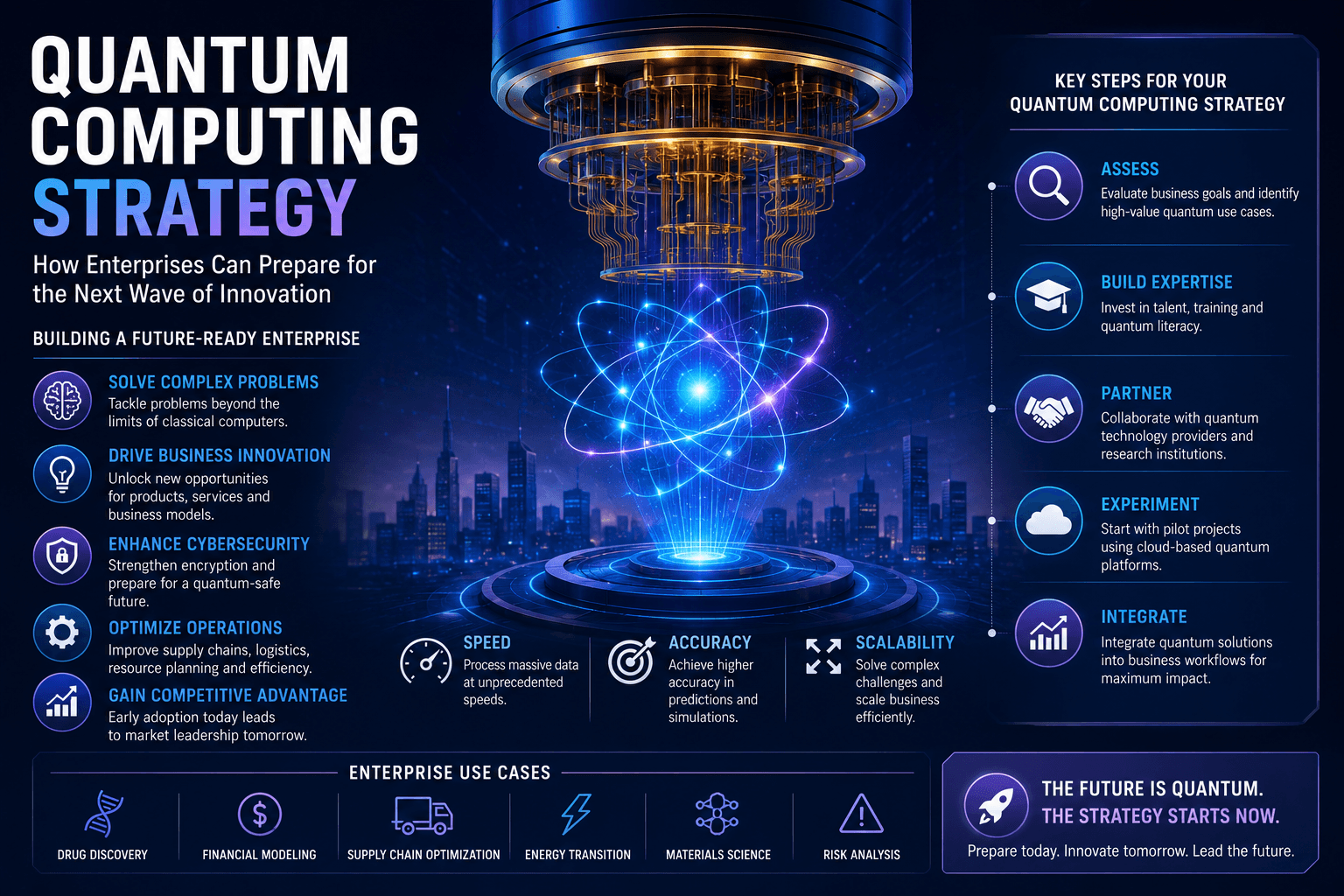
Businesses can begin preparing by:
Monitoring technological developments
Educating leadership teams
Investing in research partnerships
Identifying potential business applications
Evaluating cybersecurity readiness
Building internal AI and data science capabilities
Early preparation can help organizations adapt more quickly as commercial quantum solutions mature.
Industries Expected to Benefit
Several industries are likely to experience significant transformation, including:
Financial services
Healthcare
Manufacturing
Logistics
Energy
Telecommunications
Pharmaceuticals
Aerospace
Automotive
Government research
These sectors often rely on solving complex optimization and simulation problems, making them well suited for quantum innovation.
The Future of Enterprise Innovation
Quantum computing is not expected to replace classical computers. Instead, businesses will likely use both technologies together, selecting the most appropriate platform for each type of workload.
Cloud-based quantum computing services may also make the technology more accessible to organizations that do not own specialized hardware.
As quantum technology continues advancing, enterprise adoption is expected to expand across multiple industries.
Conclusion
Quantum computing represents one of the most exciting opportunities for enterprise innovation. Although the technology is still evolving, its potential to transform healthcare, finance, manufacturing, logistics, Artificial Intelligence, and cybersecurity is attracting unprecedented investment.
Organizations that begin understanding quantum computing today will be better prepared to capitalize on future breakthroughs. By combining strategic planning, workforce education, and ongoing technological investment, businesses can position themselves at the forefront of the next generation of digital transformation.
The quantum era is approaching, and enterprises that embrace innovation early may gain significant competitive advantages in tomorrow's global economy.
Frequently Asked Questions (FAQs)
1. What is quantum computing?
Quantum computing is an advanced computing technology that uses quantum bits (qubits) to process complex calculations much faster than traditional computers.
2. Why is quantum computing important for enterprises?
Quantum computing can help enterprises solve complex problems, improve operational efficiency, enhance cybersecurity, and accelerate innovation.
3. What is a quantum computing strategy?
A quantum computing strategy is a long-term plan that helps businesses evaluate, adopt, and prepare for quantum technologies to achieve competitive advantages.
4. Which industries will benefit the most from quantum computing?
Industries such as healthcare, finance, manufacturing, logistics, energy, telecommunications, pharmaceuticals, and cybersecurity are expected to benefit significantly.
5. How does quantum computing differ from classical computing?
Classical computers use bits that are either 0 or 1, while quantum computers use qubits that can exist in multiple states simultaneously, enabling much faster problem-solving for certain tasks.
6. Can small and medium-sized businesses benefit from quantum computing?
Yes. As cloud-based quantum services become more accessible, small and medium-sized businesses will be able to explore quantum-powered solutions without owning quantum hardware.
7. How can enterprises prepare for quantum computing?
Businesses can prepare by developing a quantum strategy, investing in employee training, identifying potential use cases, and monitoring advancements in quantum technology.
8. What are the biggest challenges of adopting quantum computing?
Challenges include high implementation costs, limited quantum hardware, skills shortages, technical complexity, and evolving standards.
9. How does quantum computing improve cybersecurity?
Quantum computing can strengthen encryption, improve threat detection, and support the development of quantum-resistant security algorithms.
10. What is quantum-safe encryption?
Quantum-safe encryption refers to cryptographic methods designed to remain secure against attacks from future quantum computers.
11. How will quantum computing impact artificial intelligence?
Quantum computing may accelerate AI training, optimize machine learning models, and solve complex data analysis problems more efficiently.
12. What role does cloud computing play in quantum adoption?
Cloud platforms provide access to quantum computing resources, allowing businesses to experiment with quantum technologies without purchasing expensive infrastructure.
13. Is quantum computing commercially available today?
Yes, several technology companies offer cloud-based quantum computing services, although the technology is still in its early stages of development.
14. What business problems can quantum computing solve?
Quantum computing can optimize supply chains, improve financial modeling, accelerate drug discovery, enhance logistics, and solve complex optimization problems.
15. How should enterprises start building a quantum computing strategy?
Organizations should assess business goals, identify high-value use cases, develop internal expertise, partner with technology providers, and begin with pilot projects.
16. Will quantum computing replace classical computers?
No. Quantum computers are expected to complement classical computers by handling highly complex calculations while traditional systems continue managing everyday business tasks.
17. What skills are important for a quantum-ready workforce?
Important skills include quantum computing fundamentals, programming, mathematics, data science, cybersecurity, artificial intelligence, and cloud computing.
18. What are the risks of ignoring quantum computing?
Businesses that delay preparation may lose competitive advantages, struggle with future cybersecurity challenges, and miss opportunities for innovation.
19. How long will it take for quantum computing to become mainstream?
While adoption timelines vary, many experts expect enterprise use cases to expand significantly over the next decade as hardware and software mature.
20. Why should enterprises invest in quantum computing now?
Early investment enables businesses to build expertise, test real-world applications, strengthen innovation strategies, and prepare for the future of digital transformation.Frequently Asked Questions (FAQs)
1. What is quantum computing?
Quantum computing is an advanced computing technology that uses quantum bits (qubits) to process complex calculations much faster than traditional computers.
2. Why is quantum computing important for enterprises?
Quantum computing can help enterprises solve complex problems, improve operational efficiency, enhance cybersecurity, and accelerate innovation.
3. What is a quantum computing strategy?
A quantum computing strategy is a long-term plan that helps businesses evaluate, adopt, and prepare for quantum technologies to achieve competitive advantages.
4. Which industries will benefit the most from quantum computing?
Industries such as healthcare, finance, manufacturing, logistics, energy, telecommunications, pharmaceuticals, and cybersecurity are expected to benefit significantly.
5. How does quantum computing differ from classical computing?
Classical computers use bits that are either 0 or 1, while quantum computers use qubits that can exist in multiple states simultaneously, enabling much faster problem-solving for certain tasks.
6. Can small and medium-sized businesses benefit from quantum computing?
Yes. As cloud-based quantum services become more accessible, small and medium-sized businesses will be able to explore quantum-powered solutions without owning quantum hardware.
7. How can enterprises prepare for quantum computing?
Businesses can prepare by developing a quantum strategy, investing in employee training, identifying potential use cases, and monitoring advancements in quantum technology.
8. What are the biggest challenges of adopting quantum computing?
Challenges include high implementation costs, limited quantum hardware, skills shortages, technical complexity, and evolving standards.
9. How does quantum computing improve cybersecurity?
Quantum computing can strengthen encryption, improve threat detection, and support the development of quantum-resistant security algorithms.
10. What is quantum-safe encryption?
Quantum-safe encryption refers to cryptographic methods designed to remain secure against attacks from future quantum computers.
11. How will quantum computing impact artificial intelligence?
Quantum computing may accelerate AI training, optimize machine learning models, and solve complex data analysis problems more efficiently.
12. What role does cloud computing play in quantum adoption?
Cloud platforms provide access to quantum computing resources, allowing businesses to experiment with quantum technologies without purchasing expensive infrastructure.
13. Is quantum computing commercially available today?
Yes, several technology companies offer cloud-based quantum computing services, although the technology is still in its early stages of development.
14. What business problems can quantum computing solve?
Quantum computing can optimize supply chains, improve financial modeling, accelerate drug discovery, enhance logistics, and solve complex optimization problems.
15. How should enterprises start building a quantum computing strategy?
Organizations should assess business goals, identify high-value use cases, develop internal expertise, partner with technology providers, and begin with pilot projects.
16. Will quantum computing replace classical computers?
No. Quantum computers are expected to complement classical computers by handling highly complex calculations while traditional systems continue managing everyday business tasks.
17. What skills are important for a quantum-ready workforce?
Important skills include quantum computing fundamentals, programming, mathematics, data science, cybersecurity, artificial intelligence, and cloud computing.
18. What are the risks of ignoring quantum computing?
Businesses that delay preparation may lose competitive advantages, struggle with future cybersecurity challenges, and miss opportunities for innovation.
19. How long will it take for quantum computing to become mainstream?
While adoption timelines vary, many experts expect enterprise use cases to expand your significantly over the next decade as hardware and software mature.
20. Why should enterprises invest in quantum computing now?
Early investment enables businesses to build expertise, test real-world applications, strengthen innovation strategies, and prepare for the future of digital transformation.