The modern workplace is entering a new phase of digital transformation. For years, businesses used software to help employees perform their jobs more efficiently. Today, artificial intelligence is taking that concept further by creating AI-powered digital employees capable of performing tasks, analyzing information, communicating with users, and supporting business operations.
These digital workers are not simply chatbots or traditional automation tools. Increasingly, they can understand instructions, reason through problems, use software applications, retrieve information, generate content, and complete multi-step workflows with limited human intervention.
As artificial intelligence becomes more capable, organizations are beginning to rethink how work itself is structured. Instead of viewing AI exclusively as a tool used by employees, businesses are starting to treat AI systems as digital members of the workforce.
This shift could fundamentally change productivity, collaboration, customer service, and organizational design.
What Are AI-Powered Digital Employees?
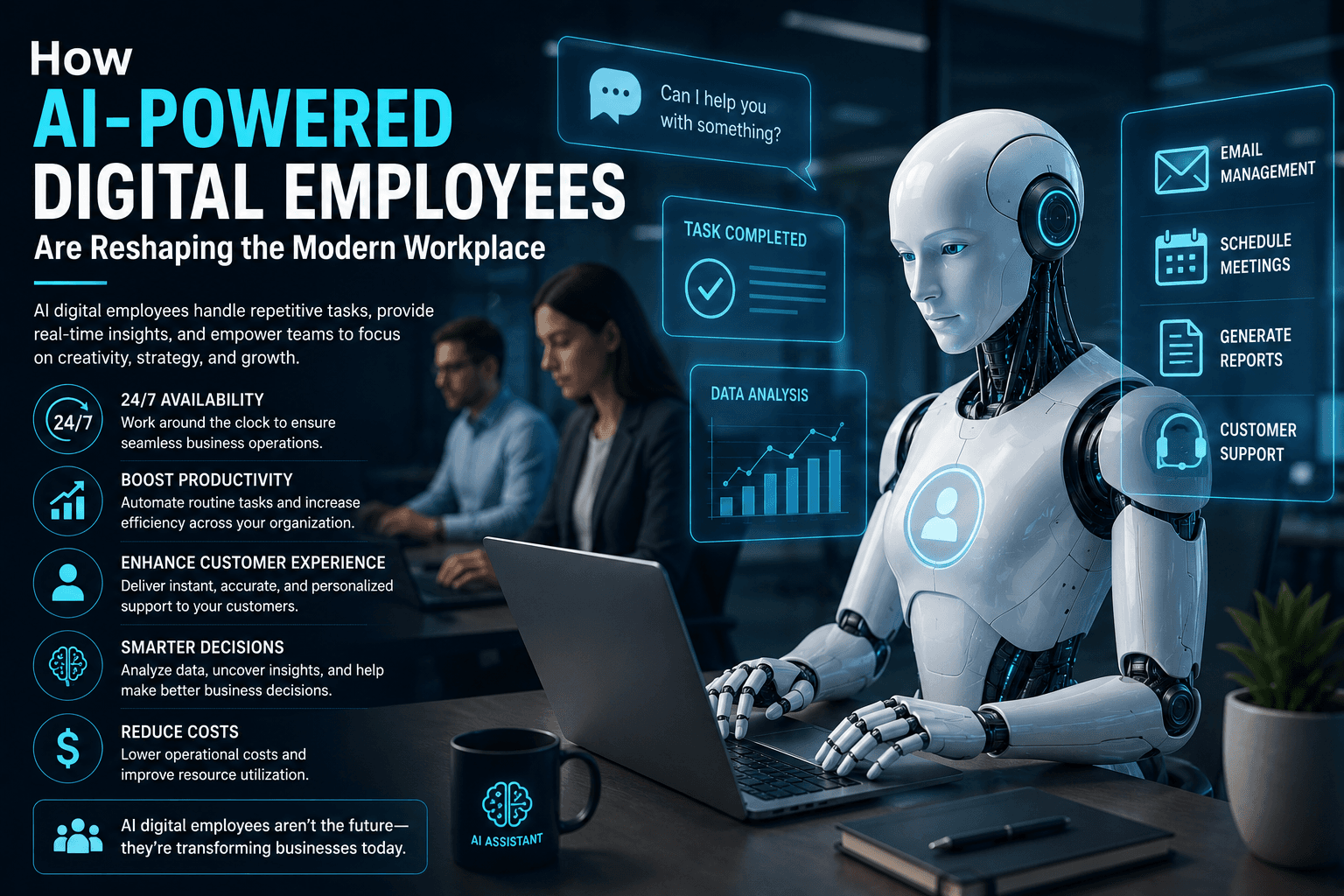
AI-powered digital employees are software-based AI systems designed to perform specific business responsibilities or workflows.
A digital employee might operate as a virtual customer-support representative, research assistant, sales development representative, financial analyst, HR assistant, software engineering assistant, or operations coordinator.
Unlike conventional automation, which usually follows predetermined rules, AI-powered systems can interpret natural-language instructions and adapt their actions based on available information.
For example, a traditional automation system might send an email whenever a customer submits a form.
An AI-powered digital employee could potentially review the customer's request, identify the issue, search a knowledge base, prepare an appropriate response, update the CRM, and escalate the case if human intervention is required.
This ability to manage multiple steps makes digital employees particularly valuable for knowledge-intensive work.
Why Businesses Are Adopting Digital Employees
Businesses face increasing pressure to improve productivity while controlling operating costs.
At the same time, employees spend significant portions of their working hours on repetitive administrative tasks, information retrieval, documentation, scheduling, reporting, and routine communication.
AI-powered digital employees can automate portions of this work.
The objective is not necessarily to eliminate human employees. Instead, organizations can use AI to handle repetitive or highly structured activities while allowing human workers to focus on judgment, creativity, relationships, strategy, and complex problem-solving.
This creates a new model in which humans and AI systems work together.
From Automation to Autonomous Workflows
Traditional business automation usually depends on predefined rules.
For example:
If X happens → perform Y.
AI-powered digital employees can operate with greater flexibility.
A manager could provide an instruction such as:
"Review this week's customer complaints, identify the most common problems, summarize the causes, and prepare recommendations for the support team."
An AI system could potentially retrieve the relevant information, analyze it, identify patterns, generate a summary, and prepare an actionable report.
The difference is important.
The system is not simply executing one predefined action. It is coordinating multiple tasks toward a broader objective.
AI Digital Employees Across Departments
The potential applications of digital employees extend across almost every business function.
Customer Service
AI digital employees can handle common customer questions, locate relevant information, summarize customer histories, classify requests, and assist human support agents.
More advanced systems can potentially manage complete customer-service workflows while escalating complex or sensitive cases to human representatives.
Sales
AI-powered sales assistants can research prospects, summarize company information, identify potential opportunities, prepare outreach messages, and update customer relationship management systems.
Digital employees can also help sales teams prioritize prospects based on predefined business criteria.
Marketing
Marketing teams can use AI digital employees for content research, campaign analysis, competitor monitoring, audience segmentation, reporting, and content production.
AI can help marketers process large amounts of information quickly while humans remain responsible for strategic direction and brand decisions.
Human Resources
HR departments can use AI assistants to answer employee questions, locate policies, support onboarding, organize documentation, and assist with administrative processes.
Because HR involves sensitive employee information, security, privacy, and human oversight are especially important.
Finance
AI systems can assist with financial reporting, invoice processing, expense categorization, anomaly detection, forecasting, and data analysis.
Human financial professionals can then focus on interpretation, strategic planning, compliance, and decisions requiring professional judgment.
Software Development
AI-powered development assistants can help programmers write code, explain existing systems, identify potential bugs, generate tests, document projects, and research technical solutions.
As these systems become more capable, software teams may increasingly operate with AI assistants that participate in multiple stages of the development lifecycle.
Digital Employees Can Operate Around the Clock
One advantage of software-based workers is their ability to operate continuously.
A digital customer-support employee can process requests outside traditional business hours. An AI monitoring system can analyze operational information overnight. A research agent can prepare information before employees begin their workday.
This does not mean every business process should operate continuously.
Instead, organizations can use digital employees where continuous availability provides genuine value.
Productivity Gains Go Beyond Speed
The biggest benefit of digital employees may not simply be completing tasks faster.
AI can reduce cognitive friction.
Employees often spend time searching for information, switching between applications, preparing repetitive documents, copying data, and organizing routine work.
A digital employee can potentially handle these activities in the background.
For example, an employee preparing a business proposal might ask an AI system to collect previous proposals, identify relevant customer information, summarize market research, and organize the findings.
The employee can then focus on the strategic content of the proposal rather than administrative preparation.
The Rise of Human-AI Teams
The workplace of the future may not be divided into "human jobs" and "AI jobs."
Instead, teams may contain both human employees and digital workers.
A marketing manager might supervise several AI systems responsible for research, content analysis, campaign reporting, and customer insights.
A software engineering manager could oversee human developers supported by AI coding and testing agents.
A customer-service manager might coordinate human representatives alongside AI systems handling routine requests.
This creates a new management challenge: organizations must learn how to manage digital workers as part of broader workflows.
Digital Employees Are Changing Organizational Design
Traditional organizations are often structured around departments and job descriptions.
AI-powered systems can operate across these boundaries.
For example, an AI workflow might retrieve information from sales, analyze customer-support data, communicate with finance, and prepare a report for management.
This creates opportunities for businesses to redesign processes around outcomes rather than individual departmental responsibilities.
Instead of asking:
"Which employee performs this task?"
organizations may increasingly ask:
"Which combination of humans, AI systems, and software can complete this workflow most effectively?"
AI Agents Are Expanding Digital Employee Capabilities
AI agents are an important development in the digital employee movement.
An AI agent can be designed to pursue a goal, make decisions within defined boundaries, use digital tools, and complete multiple steps.
For example, a procurement agent could potentially compare approved suppliers, review pricing information, prepare purchase recommendations, and route the request for human approval.
The agent does not necessarily need to perform every action independently.
Instead, it can work within a controlled workflow where humans remain responsible for important decisions.
Human Oversight Remains Essential
Despite rapid advances in AI, digital employees should not automatically receive unlimited authority.
Human oversight remains important for decisions involving significant financial, legal, security, employment, or customer consequences.
Businesses should establish clear rules about what an AI system can do independently and what requires human approval.
A useful model is:
AI handles → Human reviews → AI executes
for higher-risk workflows.
Lower-risk tasks may allow greater autonomy, while sensitive decisions should remain under stronger human control.
Security and Privacy Challenges
Digital employees may require access to internal business systems.
That creates significant security considerations.
An AI system might have access to customer information, financial records, internal documents, or company databases. If permissions are poorly configured, the system could expose sensitive information or perform unauthorized actions.
Businesses should therefore implement:
Role-based access controls
Identity verification
Data encryption
Audit logs
API security
Permission management
Activity monitoring
Data governance
Human approval controls
AI employees should receive only the access required for their responsibilities.
Measuring the ROI of Digital Employees
Companies should not adopt AI workers simply because artificial intelligence is popular.
Each digital employee should have a measurable business purpose.
Organizations can evaluate:
Hours saved
Tasks completed
Response times
Error rates
Customer satisfaction
Revenue influenced
Operating costs
Employee productivity
Workflow completion rates
For example, if an AI customer-support employee reduces average response time while maintaining customer satisfaction, the organization has a measurable outcome.
This makes AI adoption more strategic and less experimental.
Digital Employees Will Change Employee Skills
As AI takes over more repetitive work, human employees will need to develop different skills.
Important capabilities may include:
Strategic thinking
Critical reasoning
AI literacy
Communication
Problem-solving
Creativity
Leadership
Data interpretation
AI supervision
Cross-functional collaboration
Employees will increasingly need to understand how to delegate work to AI systems, evaluate AI-generated results, and recognize situations where human judgment is necessary.
The New Role of Managers
Managers may also need to rethink their responsibilities.
Instead of managing only human employees, some managers may oversee hybrid teams containing people and AI agents.
This requires understanding:
Which tasks should be automated
Which decisions require human oversight
How AI performance should be measured
How digital workers interact with employees
How AI risks should be controlled
How workflows should be redesigned
Management may become less about supervising individual tasks and more about designing effective human-AI systems.
Challenges of Implementing AI Digital Employees
The technology has significant potential, but implementation can be difficult.
Businesses may encounter:
Integration Problems
AI systems often need to connect with existing software, databases, APIs, and workflows.
Data Quality Issues
Poor or outdated data can produce unreliable results.
Security Risks
Giving AI systems access to business applications creates additional attack surfaces.
Employee Resistance
Workers may worry that AI adoption threatens their roles or changes their responsibilities.
Governance Complexity
Companies need policies defining how AI systems can operate and make decisions.
Reliability Concerns
AI systems can make mistakes or produce incorrect information, making monitoring and verification important.
The Future of the AI-Powered Workplace
The workplace is likely to become increasingly hybrid.
Humans will continue to provide leadership, creativity, empathy, strategic judgment, and accountability. AI-powered digital employees will increasingly support information processing, automation, research, communication, analysis, and repetitive workflows.
The most successful companies may not be those that deploy the largest number of AI agents.
They may be the organizations that design the best human-AI workflows.
The competitive advantage will come from understanding which activities should remain human, which can be augmented by AI, and which can be delegated to digital workers.
Conclusion
AI-powered digital employees are transforming the workplace by moving artificial intelligence from a passive software tool toward an active participant in business operations.
They can help organizations automate workflows, improve productivity, accelerate information processing, support customers, assist employees, and create new operating models.
However, successful implementation requires more than deploying AI systems.
Businesses need strong data, secure infrastructure, clear governance, measurable objectives, employee training, and appropriate human oversight.
The future workplace will not necessarily be a world without human workers. Instead, it is likely to become a workplace where humans and digital employees collaborate.
Companies that learn how to combine human judgment with machine intelligence may gain a significant advantage as the next generation of enterprise work takes shape.