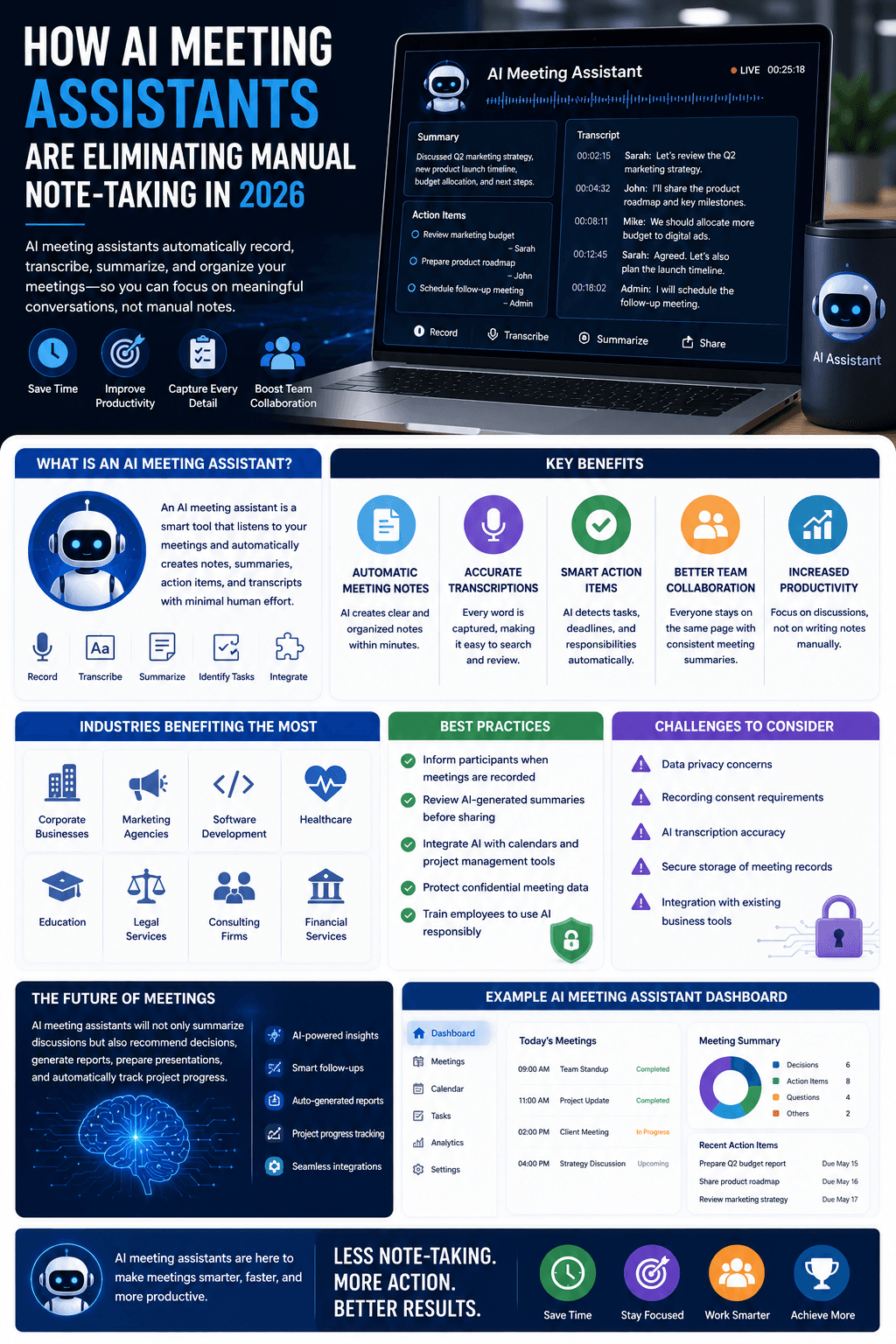

Meetings are essential for business collaboration, but taking notes, tracking action items, and creating summaries often consume valuable time. In 2026, AI meeting assistants are transforming workplace productivity by automatically recording conversations, generating accurate summaries, identifying action items, and organizing follow-up tasks.
Instead of focusing on writing notes, employees can fully participate in discussions while AI handles the documentation.
What Is an AI Meeting Assistant?
An AI meeting assistant is an intelligent software tool that listens to meetings, understands conversations, and automatically generates structured meeting notes.
These AI assistants can:
Record meetings
Transcribe conversations
Summarize discussions
Identify action items
Assign tasks
Schedule follow-ups
Translate conversations in multiple languages
This helps teams stay organized without manual effort.
Why Businesses Are Adopting AI Meeting Assistants
As remote and hybrid work continue to grow, businesses need efficient ways to manage meetings. AI meeting assistants reduce administrative work while improving communication and accountability.
Companies are adopting AI because it helps them:
Save time
Improve productivity
Reduce missed information
Increase collaboration
Keep better meeting records
Key Benefits
1. Automatic Meeting Notes
AI generates clear, organized summaries within minutes after the meeting ends.
2. Accurate Transcriptions
Every discussion is transcribed, making it easy to review important details later.
3. Smart Action Items
AI automatically detects tasks, deadlines, and responsibilities discussed during meetings.
4. Better Team Collaboration
Everyone receives the same meeting summary, reducing misunderstandings.
5. Increased Productivity
Employees can focus on meaningful discussions instead of taking notes.
Industries Benefiting the Most
AI meeting assistants are improving productivity across:
Corporate Businesses
Marketing Agencies
Software Development
Healthcare
Education
Legal Services
Consulting Firms
Financial Services
Any organization that conducts frequent meetings can benefit.
Best Practices
Businesses should:
Inform participants when meetings are being recorded.
Review AI-generated summaries before sharing.
Integrate AI with calendars and project management tools.
Protect confidential meeting data.
Train employees to use AI responsibly.
Human review remains important for sensitive discussions.
Challenges to Consider
Organizations should also prepare for:
Data privacy concerns
Recording consent requirements
AI transcription accuracy
Secure storage of meeting records
Integration with existing business tools
Responsible AI use builds trust among employees and clients.
The Future of Meetings
Experts predict AI meeting assistants will become a standard feature in business communication platforms. Future AI systems will not only summarize discussions but also recommend decisions, prepare presentations, and automatically track project progress based on meeting conversations.
Businesses adopting AI meeting assistants today will improve collaboration, reduce administrative work, and make meetings significantly more productive.
Final Thoughts
AI meeting assistants are changing how organizations collaborate by eliminating manual note-taking and automating meeting documentation. As businesses continue embracing AI, meetings will become more efficient, actionable, and focused on meaningful conversations rather than administrative tasks.
The future of workplace collaboration is intelligent, automated, and powered by AI.
FAQs: How AI Meeting Assistants Are Eliminating Manual Note-Taking in 2026
1. What are AI meeting assistants, and how do they eliminate manual note-taking?
AI meeting assistants are software tools that use artificial intelligence to record, transcribe, summarize, and organize information from meetings. Instead of requiring an employee to continuously write notes while listening to the discussion, the AI can capture the conversation and generate a structured summary afterward. Depending on the platform, it may identify key decisions, action items, deadlines, questions, and important discussion points. This allows participants to focus more closely on the conversation rather than dividing their attention between listening and documenting everything that is said.
2. Why are businesses adopting AI meeting assistants in 2026?
Businesses are adopting AI meeting assistants because employees spend significant amounts of time in meetings, and manually documenting those conversations can be inefficient. Important details can also be forgotten when employees are focused on participating in discussions. AI meeting assistants can create consistent records of meetings and make important information easier to retrieve later. They are particularly useful for remote and hybrid teams because participants may work across different locations and time zones. By automating documentation, companies can potentially reduce administrative work while improving access to meeting information.
3. Can AI meeting assistants accurately summarize entire meetings?
AI meeting assistants can produce useful summaries, but accuracy depends on factors such as audio quality, speaker clarity, meeting complexity, language, terminology, and the capabilities of the specific AI system. A summary may occasionally misunderstand a statement, omit an important detail, or incorrectly interpret context. For that reason, AI-generated meeting notes should not automatically be treated as a perfect record. Important decisions, deadlines, financial information, legal matters, and sensitive commitments should be reviewed by a human participant before being distributed or used for critical decisions.
4. How do AI meeting assistants identify action items and decisions?
AI meeting assistants analyze the language and context of conversations to identify statements that indicate tasks, responsibilities, decisions, deadlines, or follow-up requirements. For example, if a participant agrees to prepare a report by a particular date, the system may identify that statement as an action item. Advanced systems can organize these items into structured summaries and sometimes connect them with project-management or collaboration platforms. This can make it easier for teams to understand what was decided and who is responsible for the next steps without manually reviewing the entire meeting recording.
5. How can AI meeting assistants improve productivity for remote teams?
Remote teams can benefit because AI meeting assistants create searchable records of conversations that employees can review later. Team members who miss a meeting can potentially read a summary rather than watching an entire recording. Participants can also spend more time contributing to discussions instead of constantly taking notes. AI-generated action items can make follow-up more consistent, while searchable transcripts can help employees locate specific information from previous meetings. These capabilities can be particularly valuable for distributed organizations where asynchronous communication and documentation are essential for maintaining coordination.
6. Can AI meeting assistants integrate with other workplace tools?
Many AI meeting assistants are designed to work alongside common workplace applications, although available integrations vary by provider. Depending on the platform, meeting summaries and action items may be connected with calendars, communication applications, customer relationship management systems, project-management platforms, document tools, or task-management software. These integrations can turn meeting information into actionable workflow data. For example, a discussion during a sales meeting could be summarized and associated with a customer record, while a project meeting could generate tasks for a project-management system.
7. Are AI meeting assistants useful beyond simple note-taking?
Yes. Modern AI meeting assistants can potentially provide much more than automated notes. They can help identify recurring discussion topics, summarize customer conversations, generate follow-up emails, extract decisions, analyze meeting patterns, and make previous discussions easier to search. Over time, organizations may use aggregated meeting information to understand project progress, identify recurring problems, and improve collaboration. However, businesses should be careful when analyzing employee meetings because advanced meeting intelligence can involve sensitive workplace information and may require clear policies and appropriate employee consent.
8. What privacy concerns should businesses consider when using AI meeting assistants?
Privacy is one of the most important considerations because meeting assistants may process conversations containing confidential business information, customer data, employee discussions, or proprietary plans. Companies should understand how recordings and transcripts are stored, who can access them, how long they are retained, and whether the provider uses the information for other purposes. Participants should also be informed when meetings are being recorded or transcribed where applicable. Businesses should establish clear policies covering consent, access permissions, retention periods, sensitive meetings, and the handling of confidential information before deploying AI meeting assistants widely.
9. Will AI meeting assistants completely replace human note-taking?
For many routine meetings, AI meeting assistants can significantly reduce or even eliminate the need for traditional note-taking. However, human judgment remains valuable for interpreting complex discussions, understanding organizational context, and identifying subtle issues that an AI system may miss. Some meetings may also require carefully controlled documentation because of legal, financial, personnel, or strategic considerations. The most practical approach is likely to be a combination of automated documentation and human review. AI can handle the repetitive task of capturing information, while employees remain responsible for verifying important decisions and context.
10. What is the future of AI meeting assistants in 2026 and beyond?
AI meeting assistants are likely to evolve from passive note-taking tools into intelligent meeting and workflow assistants. Future systems may prepare meeting briefs before discussions, identify relevant information during meetings, automatically track decisions, update approved business systems, and remind participants about outstanding commitments afterward. AI could increasingly connect meeting conversations with projects, customers, documents, and organizational knowledge. This could turn meetings into more structured sources of business intelligence. However, successful adoption will depend on accuracy, privacy protections, transparent policies, and human oversight to ensure that automation improves collaboration without compromising trust.