
Unfortunately, this information is often scattered across emails, cloud drives, documents, and messaging apps, making it difficult for employees to find what they need.
In 2026, companies are solving this problem with AI knowledge bases—intelligent systems that organize business information and provide instant, accurate answers through natural conversation.
What Is an AI Knowledge Base?
An AI knowledge base is a centralized repository powered by artificial intelligence that stores, understands, and retrieves business information.
Instead of manually searching through folders or documents, employees can simply ask questions like:
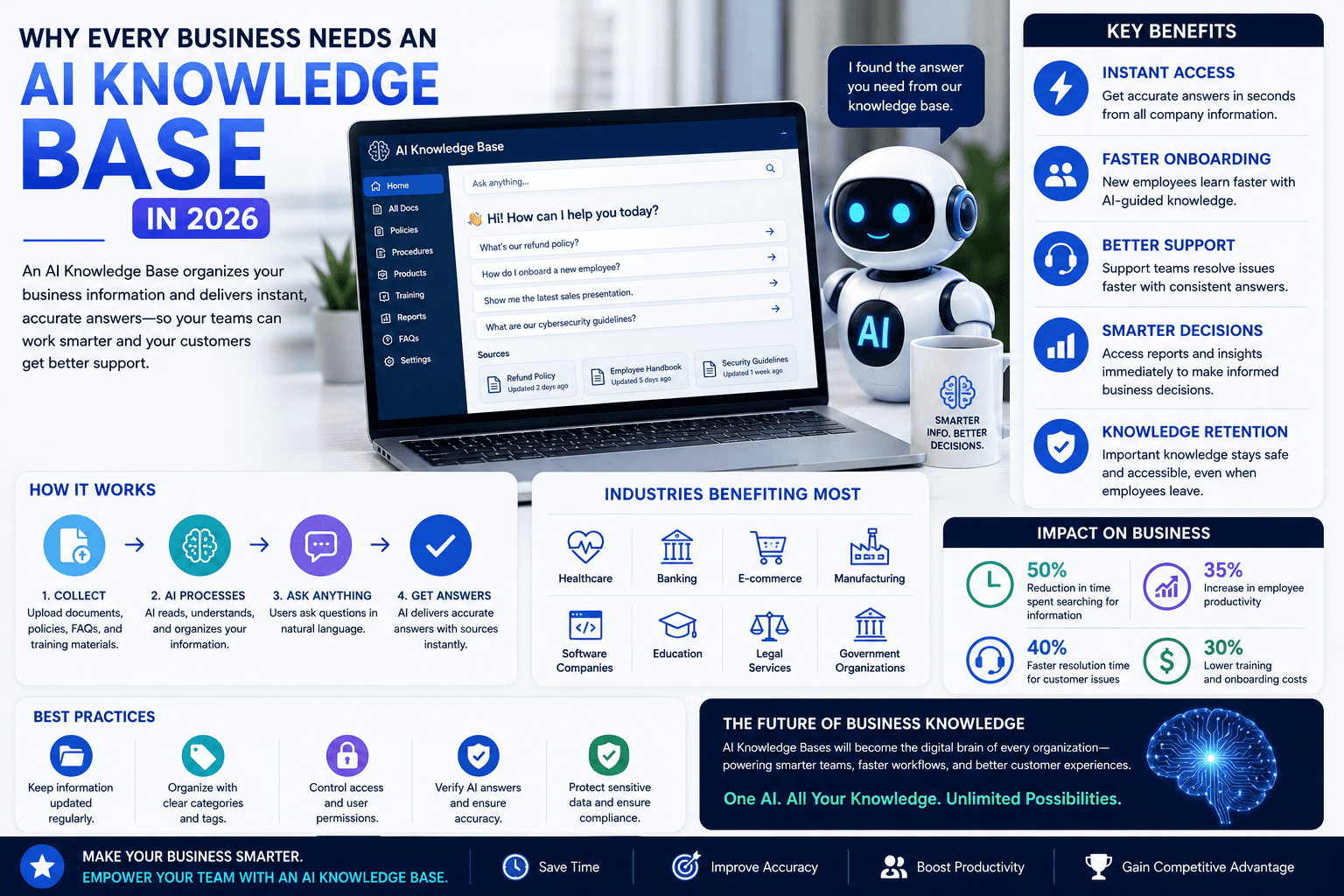
"What's our refund policy?"
"Show me the latest sales presentation."
"How do I onboard a new employee?"
"What are our cybersecurity guidelines?"
The AI instantly finds the correct information and provides a clear answer.
Why Businesses Are Investing in AI Knowledge Bases
As businesses grow, managing information becomes increasingly challenging. AI eliminates wasted time spent searching for documents and ensures employees always have access to the latest information.
Companies are adopting AI knowledge bases because they:
Improve employee productivity
Reduce training time
Deliver consistent customer support
Preserve organizational knowledge
Enable faster decision-making
Key Benefits
1. Instant Access to Information
Employees can find answers within seconds instead of spending valuable time searching through files.
2. Faster Employee Onboarding
New team members learn company policies, workflows, and procedures more quickly with AI-guided assistance.
3. Better Customer Support
Support teams receive accurate, consistent answers, helping them resolve customer issues faster.
4. Smarter Decision-Making
Managers gain immediate access to reports, documentation, and historical business information.
5. Knowledge Retention
Critical business knowledge remains available even when employees leave the company.
Industries Benefiting the Most
AI knowledge bases are transforming:
Healthcare
Banking
E-commerce
Manufacturing
Software Companies
Education
Legal Services
Government Organizations
Best Practices
Businesses should:
Keep information regularly updated.
Organize documents using clear categories.
Control user permissions and access levels.
Verify AI-generated answers for accuracy.
Protect sensitive business information.
Challenges to Consider
Organizations should also address:
Data privacy
Information accuracy
Access control
AI hallucinations
Compliance with industry regulations
Combining AI with human oversight ensures reliable knowledge management.
The Future of Business Knowledge
Experts predict AI knowledge bases will become the digital brain of every organization. Rather than searching multiple applications, employees will interact with a single AI assistant capable of retrieving documents, answering questions, summarizing reports, and recommending next steps.
Businesses that adopt AI knowledge management today will gain a significant advantage through improved efficiency, faster collaboration, and better customer experiences.
Final Thoughts
An AI knowledge base is no longer just a document repository—it is becoming the foundation of modern business operations. By making organizational knowledge instantly accessible, AI helps companies improve productivity, preserve expertise, and make smarter decisions.
As AI continues to evolve, businesses that invest in intelligent knowledge management will be better prepared for the future of work.
FAQs: Why Every Business Needs an AI Knowledge Base in 2026
1. What is an AI knowledge base, and how does it differ from a traditional knowledge base?
An AI knowledge base is a centralized system that uses artificial intelligence to organize, retrieve, understand, and present business information in response to natural-language questions. Unlike traditional knowledge bases, which typically require employees to search through categories, folders, or keywords, AI knowledge bases can interpret the intent behind a question and provide a contextual answer. They can connect information from documents, internal policies, customer records, support materials, and other approved sources, making organizational knowledge easier to access. This can significantly reduce the time employees spend searching for information across multiple systems.
2. Why is an AI knowledge base becoming essential for businesses in 2026?
Businesses are producing enormous amounts of information through emails, meetings, customer interactions, documents, project-management systems, and digital platforms. As information grows, employees can struggle to locate accurate and relevant answers quickly. An AI knowledge base helps address this problem by allowing employees to interact with organizational information conversationally. Instead of searching through multiple systems, employees can ask questions and receive summarized information based on approved sources. In 2026, this capability is becoming increasingly important as companies look for ways to improve productivity, support distributed teams, accelerate decision-making, and make better use of their existing information.
3. How can an AI knowledge base improve employee productivity?
An AI knowledge base can reduce the amount of time employees spend searching for documents, asking colleagues repetitive questions, and navigating different business applications. Employees can use natural-language questions to retrieve policies, procedures, product information, project details, and other relevant resources. AI can also summarize lengthy documents and identify important information without requiring employees to read every page. By reducing these administrative information-retrieval tasks, employees can dedicate more time to strategic, creative, and customer-focused responsibilities. The greatest productivity benefits typically occur when the knowledge base is connected to the systems employees already use.
4. Can an AI knowledge base improve employee onboarding and training?
Yes. AI knowledge bases can make onboarding more interactive by giving new employees an accessible source for company policies, procedures, product information, workflows, and frequently asked questions. Instead of relying entirely on training sessions or large documentation libraries, new employees can ask specific questions as they encounter unfamiliar processes. An AI assistant can provide explanations and direct employees to relevant official resources. This can reduce the burden on managers and experienced employees who otherwise spend significant time answering basic onboarding questions. However, AI should complement structured training rather than completely replace human guidance and mentorship.
5. How can businesses use AI knowledge bases to improve customer support?
AI knowledge bases can help customer-support teams quickly retrieve troubleshooting instructions, product information, policies, previous solutions, and other relevant resources. When an agent receives a customer request, an AI system can help identify the issue and surface information that may assist with resolving it. Businesses can also use controlled AI knowledge systems to provide customers with self-service answers to common questions. This can potentially reduce response times and allow human support representatives to concentrate on complicated cases. For sensitive or high-impact issues, businesses should maintain human review and ensure that AI responses are based on current, approved information.
6. How does an AI knowledge base help businesses preserve organizational knowledge?
Organizations often lose valuable knowledge when experienced employees leave because important information may exist in personal notes, conversations, documents, or individual expertise. An AI knowledge base can help centralize approved organizational information so employees have continued access to important processes and institutional knowledge. It can make information easier to discover and connect related resources that may otherwise remain scattered across departments. This can be particularly valuable for growing companies where knowledge becomes increasingly difficult to manage. Businesses should still establish formal documentation and ownership processes because AI cannot automatically capture every form of human expertise.
7. Can AI knowledge bases reduce information silos between departments?
AI knowledge bases can help reduce information silos by making approved information from different departments easier to discover through a unified interface. For example, sales teams may need product information maintained by product teams, while customer-support teams may need access to approved technical documentation. With appropriate permissions, employees can retrieve relevant information without manually searching multiple departmental systems. This can improve collaboration and reduce duplicated work. However, businesses must carefully configure access controls because breaking down information silos should not mean giving every employee unrestricted access to confidential or sensitive information.
8. What security risks should businesses consider when implementing an AI knowledge base?
Security is one of the most important considerations because an AI knowledge base may connect to sensitive company information. Businesses should establish strong authentication, role-based permissions, access controls, audit mechanisms, and data-governance policies. They should also understand how the technology provider stores, processes, and protects organizational information. Sensitive documents should not automatically be made available to every AI assistant or employee. Companies should regularly review permissions and monitor system behavior. Human oversight is also important when AI-generated answers could influence financial, legal, security, personnel, or other high-impact business decisions.
9. How can businesses ensure that an AI knowledge base provides accurate information?
Accuracy depends heavily on the quality and freshness of the information connected to the system. Businesses should identify authoritative sources and establish processes for reviewing, updating, and removing outdated documents. Important policies and frequently referenced information should have clear owners responsible for maintaining them. Organizations should also test AI responses and provide mechanisms for employees to report incorrect or outdated answers. Where possible, AI systems should show the sources supporting their responses so employees can verify important information. A well-governed knowledge base should prioritize trustworthy information rather than simply collecting the largest possible volume of documents.
10. What is the future of AI knowledge bases for businesses?
AI knowledge bases are likely to evolve from simple information-retrieval systems into intelligent organizational assistants that understand business context and connect information across multiple applications. Future systems may help employees research projects, summarize customer histories, identify relevant policies, prepare reports, answer operational questions, and initiate approved workflows. They may also become more personalized by adapting responses according to an employee's role and access permissions. As businesses generate increasing amounts of digital information, the ability to turn that information into accessible and actionable knowledge will become increasingly valuable. Companies that combine AI with strong data governance, security, and human oversight will be best positioned to benefit.