
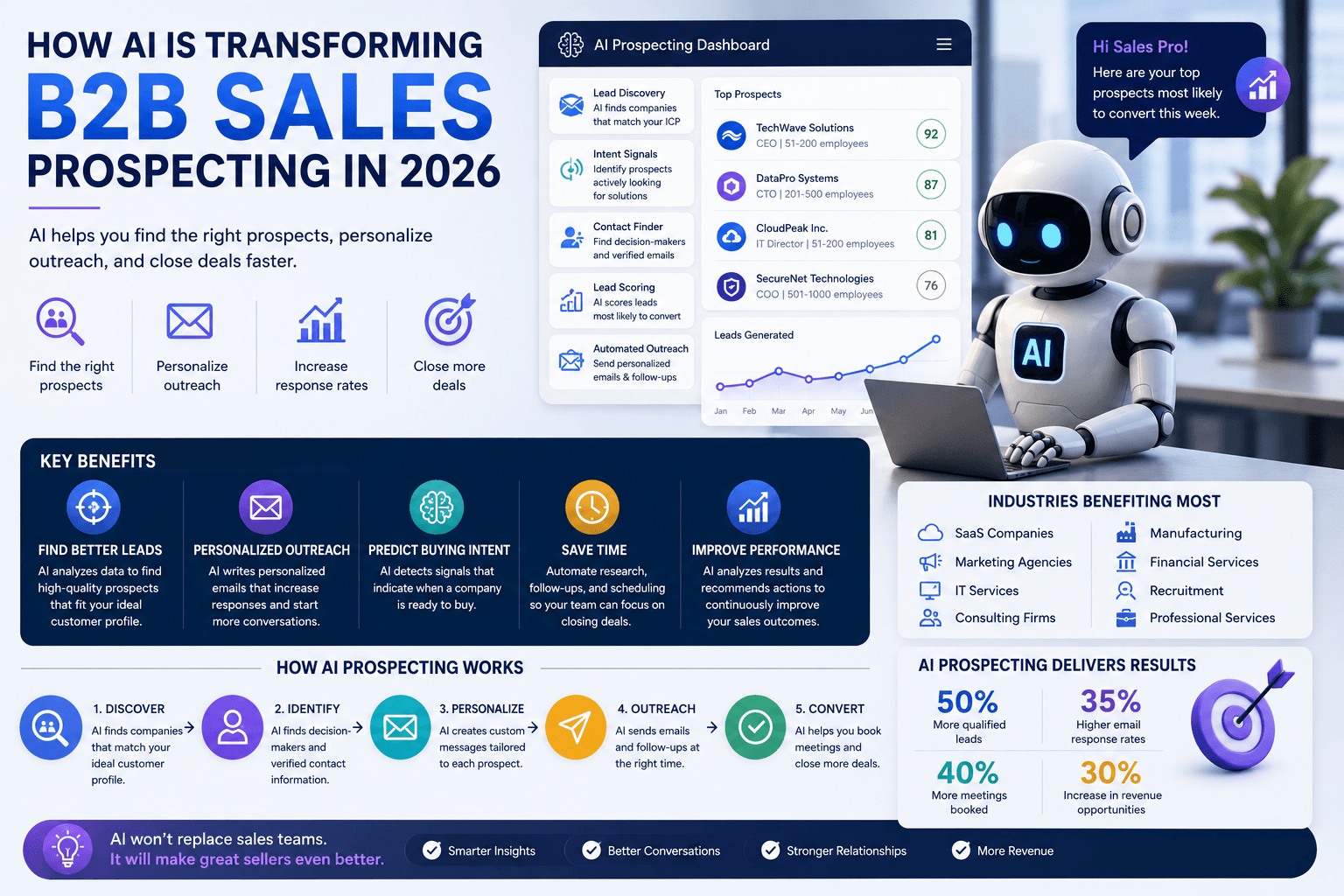

Finding high-quality leads has always been one of the biggest challenges for B2B businesses. Sales teams often spend countless hours researching companies, identifying decision-makers, writing emails, and following up with prospects. In 2026, artificial intelligence is transforming this entire process.
AI-powered sales prospecting tools are helping businesses identify the right customers, personalize outreach, and close deals faster than ever before. Instead of replacing sales professionals, AI is making them more productive and efficient.
What Is AI Sales Prospecting?
AI sales prospecting uses artificial intelligence to discover potential customers, analyze buying intent, qualify leads, and automate outreach.
Modern AI can:
Find businesses that match your ideal customer profile.
Identify decision-makers within companies.
Analyze customer behavior and purchase intent.
Generate personalized emails.
Schedule follow-up messages.
Score leads based on their likelihood to convert.
This allows sales teams to focus on building relationships instead of spending hours on manual research.
Why Businesses Are Adopting AI
Traditional prospecting is time-consuming and often results in low response rates. AI speeds up the process by analyzing massive amounts of data and identifying the most promising opportunities.
Companies using AI-powered prospecting report:
Higher-quality leads
Faster outreach
Increased response rates
More sales meetings
Better conversion rates
Key Benefits
1. Find Better Leads
AI analyzes industries, company size, technologies, and buying signals to identify ideal prospects.
2. Personalized Outreach
Instead of generic emails, AI creates customized messages based on each prospect's business and interests.
3. Predict Buying Intent
AI detects signals that indicate when a company is actively looking for a solution.
4. Save Time
Sales representatives spend less time researching and more time speaking with qualified prospects.
5. Improve Sales Performance
AI continuously analyzes campaign performance and recommends ways to improve future outreach.
Industries Benefiting Most
AI sales prospecting is delivering strong results for:
SaaS Companies
Marketing Agencies
IT Services
Consulting Firms
Manufacturing
Financial Services
Recruitment Agencies
Professional Services
Best Practices
Businesses should:
Define an ideal customer profile.
Keep customer data clean and updated.
Personalize AI-generated messages.
Combine AI insights with human relationship-building.
Track campaign performance regularly.
Challenges to Consider
Despite its advantages, businesses should pay attention to:
Data privacy regulations
Email compliance
AI accuracy
Over-automation
Maintaining authentic human communication
Successful sales strategies balance AI efficiency with genuine customer relationships.
The Future of AI Sales
Industry experts predict AI will become an essential sales assistant for every business. Rather than replacing sales teams, AI will handle repetitive research, lead qualification, and outreach preparation, allowing professionals to focus on negotiations and closing deals.
Businesses that adopt AI-powered prospecting today will gain a significant competitive advantage in an increasingly data-driven marketplace.
Final Thoughts
AI is revolutionizing B2B sales prospecting by making lead generation faster, smarter, and more accurate. Companies that leverage AI to identify opportunities, personalize outreach, and optimize sales performance will be better positioned for long-term growth.
As competition increases, AI-powered prospecting is becoming a must-have strategy for modern B2B sales success.
FAQs: How AI Is Transforming B2B Sales Prospecting in 2026
1. How is AI transforming B2B sales prospecting in 2026?
AI is transforming B2B sales prospecting by automating research, identifying suitable companies, analyzing buyer behavior, detecting purchasing signals, scoring leads, and helping sales teams personalize outreach. Instead of manually researching every potential customer, sales professionals can use AI to analyze large volumes of business data and prioritize prospects based on their likelihood of becoming customers. This allows sales teams to spend more time on relationship building, sales conversations, negotiations, and closing opportunities.
2. How does AI identify high-quality B2B prospects?
AI can analyze factors such as company size, industry, location, revenue indicators, technology usage, hiring activity, business growth, website activity, previous interactions, and other relevant signals. By comparing these factors with a company's ideal customer profile, AI can identify accounts that are more likely to need a particular product or service. This helps sales teams focus their efforts on relevant prospects instead of spending time on large numbers of poorly qualified leads.
3. What are buying signals, and how does AI identify them?
Buying signals are business activities or behavioral changes that may indicate a company is considering a purchase. Examples include hiring new employees, expanding into new markets, launching products, changing technology providers, increasing investment, researching solutions, or interacting with relevant content. AI can monitor available data and identify combinations of signals that suggest an account may have a stronger purchasing need.
4. Can AI create personalized B2B sales outreach?
Yes. AI can analyze information about a prospect's company, industry, job role, recent activities, and potential business challenges to help create personalized messages. Instead of sending identical emails to hundreds of prospects, sales teams can use AI to develop messages that are more relevant to individual accounts. Human review remains important because inaccurate information or overly automated messaging can reduce credibility and make outreach feel impersonal.
5. Will AI replace B2B sales professionals?
AI is more likely to transform sales jobs than completely replace sales professionals. Artificial intelligence can handle repetitive tasks such as research, lead scoring, data entry, and basic outreach preparation. Sales professionals can then focus on activities that require human judgment, including relationship building, negotiations, strategic conversations, handling objections, and understanding complex customer requirements.
6. How can AI improve B2B lead qualification?
AI can analyze historical sales data and current prospect information to identify characteristics associated with successful customers. It can assign lead scores, identify promising accounts, and recommend which prospects deserve immediate attention. This can help sales teams prioritize their time more effectively and avoid treating every lead as equally valuable.
7. How much time can AI save sales teams during prospecting?
The amount of time saved depends on the sales process, data quality, tools, and level of automation. AI can significantly reduce manual research, data collection, account summarization, CRM updates, email drafting, and lead qualification. The biggest productivity benefit often comes from allowing sales representatives to spend less time performing administrative tasks and more time engaging directly with potential customers.
8. What are the biggest risks of AI-powered B2B prospecting?
Important risks include inaccurate prospect information, outdated databases, incorrect AI-generated claims, privacy concerns, excessive automation, and low-quality mass outreach. If AI systems are used without appropriate human review, businesses could contact irrelevant prospects or send misleading information. Companies should establish data-quality standards, privacy controls, human review procedures, and clear rules for automated communication.
9. How will AI agents change B2B sales prospecting?
AI agents can potentially connect multiple prospecting activities into a single workflow. An AI agent could identify target accounts, research companies, analyze buying signals, prepare personalized outreach, update CRM records, and recommend follow-up actions. This could reduce the need for sales representatives to manually move information between different tools. However, businesses should carefully control agent permissions and maintain human oversight for important customer-facing decisions.
10. What is the future of AI-powered B2B sales prospecting?
The future of B2B prospecting will likely involve increasingly intelligent systems that continuously analyze business data, identify potential opportunities, predict buying intent, recommend the best prospects, and support highly personalized engagement. AI will handle more research and administrative work, while sales professionals will focus on trust, relationships, strategic decision-making, and complex negotiations. The most effective sales organizations will combine AI's data-processing capabilities with authentic human communication.