Artificial intelligence is no longer just a tool for automating repetitive tasks—it is becoming the foundation of modern business strategy. Across industries, organizations are moving beyond isolated AI applications and embedding artificial intelligence into core operations, decision-making, customer engagement, and long-term planning. As businesses compete in an increasingly digital economy, AI-driven enterprises are emerging as the new standard for efficiency, innovation, and sustainable growth.
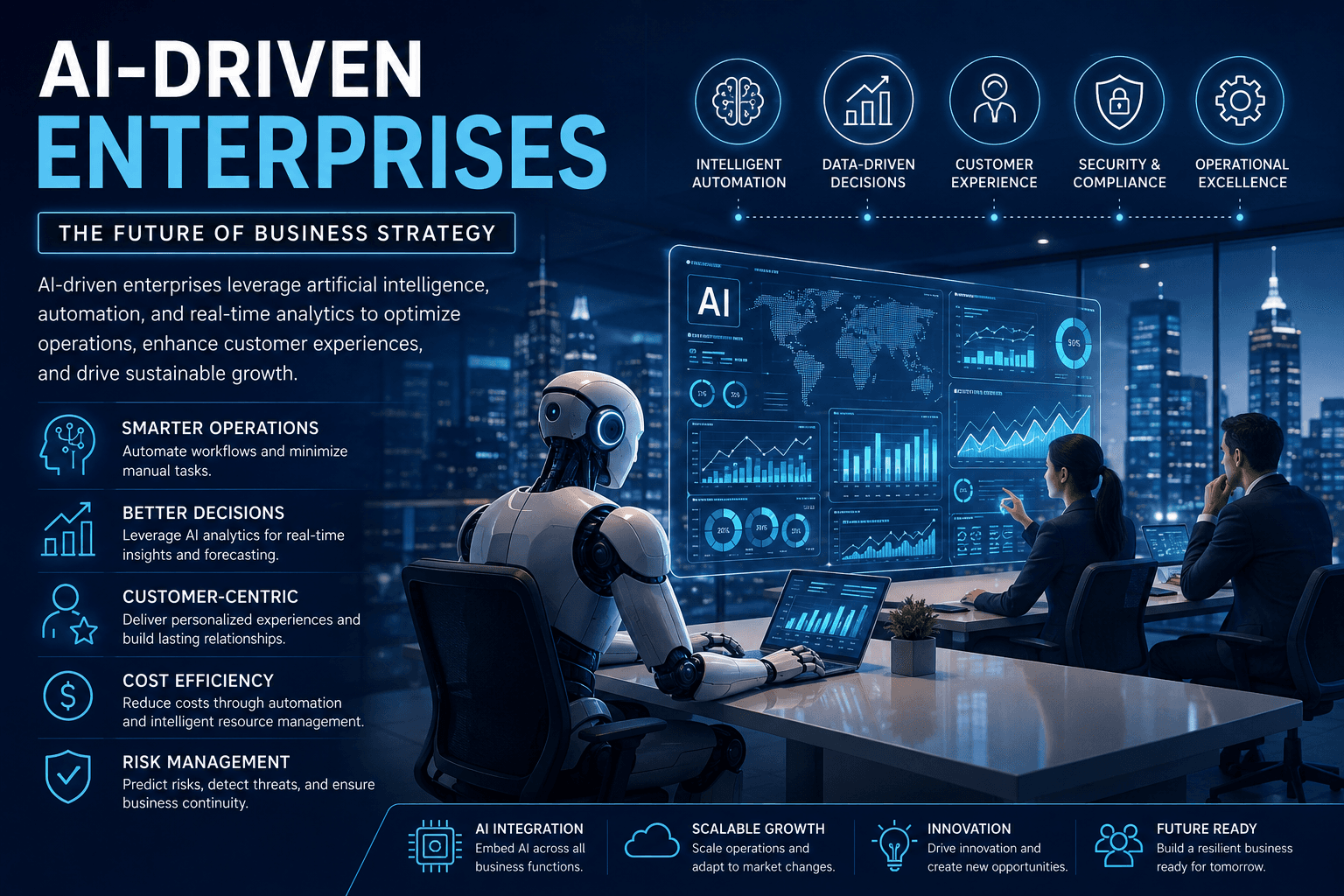
An AI-driven enterprise integrates artificial intelligence into every major business function. Instead of relying solely on human analysis and manual workflows, these organizations use AI to analyze vast amounts of data, automate routine processes, predict future trends, and support strategic decisions. The result is faster operations, lower costs, improved customer experiences, and stronger competitive advantages.
What Is an AI-Driven Enterprise?
An AI-driven enterprise is an organization that uses artificial intelligence as a central component of its business strategy rather than as a standalone technology. AI supports executives, employees, and customers by providing intelligent insights, automating workflows, and improving operational efficiency.
Key characteristics of AI-driven enterprises include:
Intelligent process automation
Data-driven decision-making
Predictive analytics
AI-powered customer experiences
Continuous operational optimization
Scalable digital transformation
Rather than replacing human expertise, AI enhances productivity by allowing employees to focus on innovation, leadership, and strategic initiatives.
AI Is Redefining Business Strategy
Traditional business strategies often relied on historical data and periodic market analysis. AI enables organizations to make decisions using real-time information, allowing leaders to respond quickly to changing customer demands and market conditions.
Modern AI platforms can:
Analyze millions of data points in seconds
Predict market trends
Identify business risks
Optimize pricing strategies
Improve resource allocation
Generate strategic business insights
This shift allows companies to become more agile while reducing uncertainty in decision-making.
Transforming Operations Through Intelligent Automation
Operational efficiency remains one of the biggest advantages of AI-driven enterprises. Intelligent automation streamlines repetitive tasks across departments, improving productivity while reducing costs.
Examples include:
Automated invoice processing
AI-powered inventory management
Smart supply chain optimization
Predictive equipment maintenance
Workflow automation
Intelligent document processing
By reducing manual intervention, businesses can increase accuracy, improve scalability, and accelerate growth.
Delivering Personalized Customer Experiences
Customer expectations continue to rise, making personalization a critical competitive advantage. AI enables businesses to understand customer behavior, preferences, and purchasing patterns in real time.
AI-powered solutions help organizations:
Recommend personalized products
Deliver targeted marketing campaigns
Offer 24/7 customer support
Predict customer needs
Improve customer retention
Enhance user experiences across digital channels
These capabilities strengthen customer relationships while increasing conversion rates and brand loyalty.
Smarter Financial Management
Finance departments are increasingly adopting AI to improve speed, accuracy, and transparency.
Artificial intelligence supports:
Financial forecasting
Fraud detection
Expense management
Cash flow analysis
Budget planning
Risk assessment
Real-time financial insights enable executives to make informed investment decisions while reducing operational risks.
AI-Powered Marketing Strategies
Marketing has become one of the fastest-growing applications of artificial intelligence. AI analyzes audience behavior, campaign performance, and market trends to improve marketing effectiveness.
Businesses use AI to:
Optimize advertising campaigns
Create personalized content
Segment customer audiences
Predict purchasing behavior
Improve SEO strategies
Measure campaign performance
This data-driven approach helps organizations maximize return on investment while reaching the right audience with greater precision.
Building Resilient Supply Chains
Supply chain disruptions have highlighted the importance of intelligent logistics. AI-driven enterprises use predictive analytics to improve planning and reduce operational risks.
Benefits include:
Demand forecasting
Inventory optimization
Supplier performance monitoring
Route optimization
Risk prediction
Automated procurement
These technologies improve efficiency while enhancing resilience against unexpected market changes.
The Role of AI in Executive Decision-Making
Executives increasingly rely on AI-generated insights to guide strategic planning. Instead of waiting for monthly reports, leaders gain access to real-time dashboards that monitor key performance indicators across the organization.
AI helps executives evaluate:
Revenue performance
Customer satisfaction
Employee productivity
Market opportunities
Competitive positioning
Business risks
With better visibility into business operations, organizations can make faster and more informed strategic decisions.
Challenges of AI-Driven Enterprises
Despite its advantages, implementing AI requires careful planning and governance.
Organizations must address challenges such as:
Data privacy and security
Regulatory compliance
AI bias and fairness
Integration with legacy systems
Workforce reskilling
Ethical AI governance
Successful enterprises combine advanced technology with strong human oversight to ensure responsible AI adoption.
Industries Leading AI Adoption
AI-driven enterprise strategies are transforming nearly every major industry, including:
Banking and financial services
Healthcare
Manufacturing
Retail and e-commerce
Logistics
Telecommunications
Insurance
Professional services
Education
Energy
Early adopters are gaining measurable advantages through improved efficiency, innovation, and customer satisfaction.
The Future of AI-Driven Enterprises
As artificial intelligence continues to evolve, enterprises will increasingly adopt advanced technologies such as generative AI, autonomous agents, predictive analytics, and intelligent automation platforms. Organizations that invest in AI infrastructure, employee training, and ethical governance today will be better positioned to compete in the digital economy.
Rather than replacing people, AI will continue to augment human capabilities, enabling businesses to innovate faster, adapt more effectively, and create greater value for customers and stakeholders.
Conclusion
AI-driven enterprises represent the next evolution of business strategy. By embedding artificial intelligence into core operations, organizations can improve efficiency, enhance customer experiences, strengthen decision-making, and accelerate innovation.
Businesses that embrace AI responsibly while maintaining strong governance and human oversight will be best equipped to thrive in the competitive landscape of 2027 and beyond. As AI becomes an integral part of enterprise strategy, it will shape the future of business across every industry.Why AI-Driven Enterprises Are Becoming the Future of Business Strategy
Frequently Asked Questions (FAQs)
1. What is an AI-driven enterprise?
An AI-driven enterprise is a business that integrates artificial intelligence into its core operations, using AI to automate workflows, analyze data, improve decision-making, and enhance customer experiences across departments.
2. How is an AI-driven enterprise different from a traditional business?
Traditional businesses rely heavily on manual processes and human decision-making, while AI-driven enterprises use artificial intelligence to automate tasks, generate insights, and optimize operations in real time.
3. What technologies power AI-driven enterprises?
AI-driven enterprises typically use machine learning, generative AI, predictive analytics, robotic process automation (RPA), natural language processing (NLP), cloud computing, and big data analytics.
4. What are the main benefits of AI-driven enterprises?
The primary benefits include improved efficiency, reduced operational costs, faster decision-making, enhanced customer experiences, increased productivity, and better business forecasting.
5. Which industries are adopting AI-driven enterprise strategies?
Industries such as banking, healthcare, manufacturing, retail, logistics, insurance, telecommunications, education, and professional services are rapidly adopting AI-powered business models.
6. Can small businesses become AI-driven enterprises?
Yes. Small businesses can adopt affordable AI tools for customer support, marketing automation, accounting, sales forecasting, and workflow management to improve efficiency and compete with larger organizations.
7. How does AI improve business decision-making?
AI analyzes massive amounts of data in real time, identifies trends, predicts outcomes, and provides actionable insights that help business leaders make faster and more informed decisions.
8. Does AI replace human employees?
No. AI is designed to automate repetitive and data-intensive tasks, allowing employees to focus on creativity, leadership, innovation, strategic planning, and customer relationships.
9. What challenges do AI-driven enterprises face?
Common challenges include data privacy, cybersecurity threats, AI bias, regulatory compliance, integration with legacy systems, implementation costs, and workforce reskilling.
10. Why are AI-driven enterprises considered the future of business?
AI-driven enterprises are becoming the future because they enable organizations to operate more efficiently, innovate faster, deliver personalized customer experiences, reduce costs, and remain competitive in an increasingly digital economy.