TFThe Future of Smart Homes in 2026: AI, Automation & Connected Living
Introduction
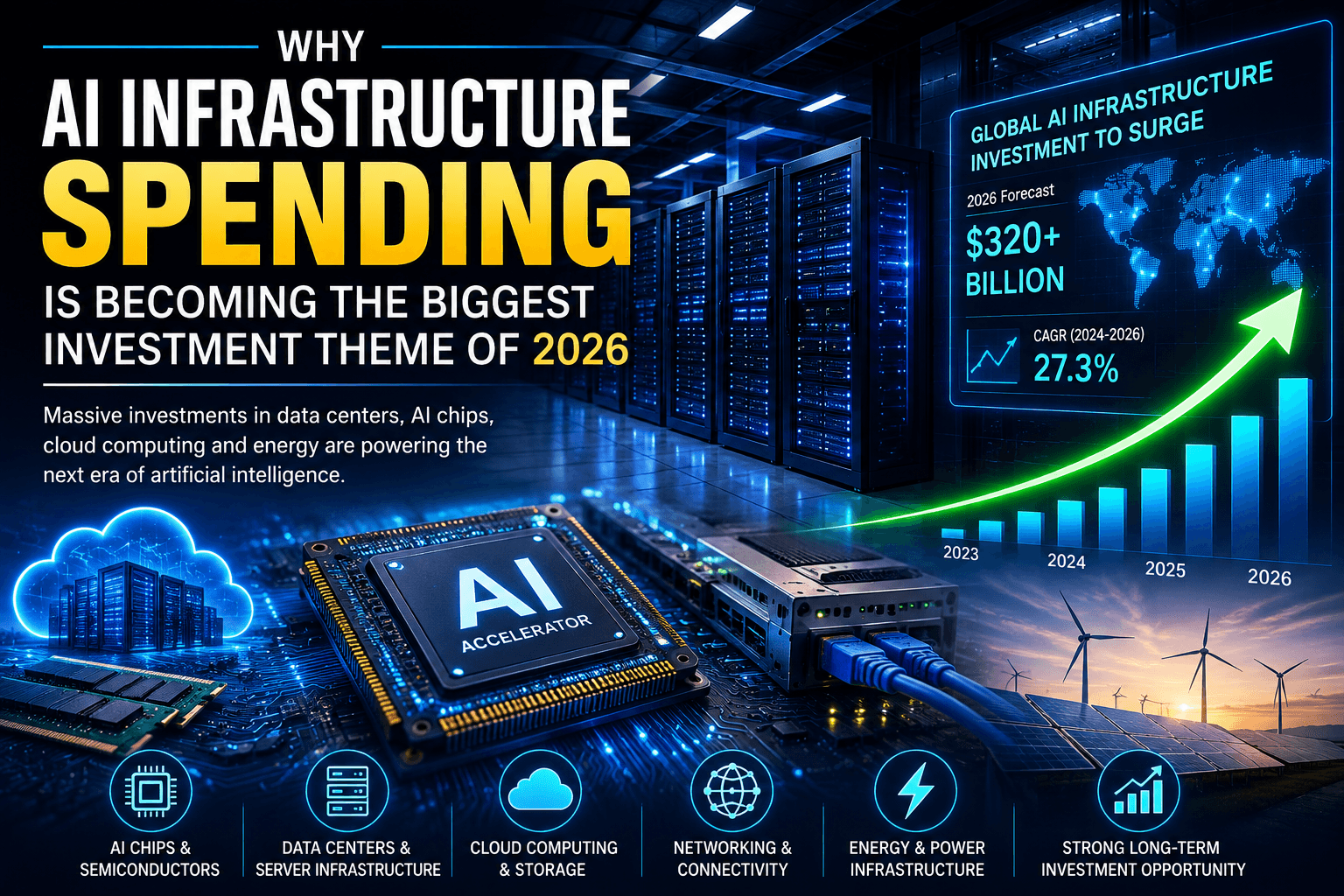
Artificial intelligence is no longer driven solely by software innovation. In 2026, the real competition has shifted to the infrastructure powering AI. Governments, cloud providers, chipmakers, and enterprise technology companies are investing hundreds of billions of dollars in data centers, AI processors, networking equipment, and energy systems to support increasingly powerful AI models.
This unprecedented wave of capital investment has made AI infrastructure one of the most significant investment themes in global financial markets. Rather than focusing only on companies building AI applications, investors are increasingly looking at the businesses supplying the computing power, storage, networking, and energy required to run artificial intelligence at scale.
As organizations adopt generative AI, autonomous systems, and intelligent automation, the demand for AI infrastructure continues to accelerate, creating long-term opportunities across multiple industries.
AI Infrastructure Is the Backbone of the AI Economy
Every AI application—from virtual assistants and financial forecasting tools to autonomous vehicles and healthcare diagnostics—depends on a powerful infrastructure ecosystem. Large language models require enormous computing capacity to train and process data, making infrastructure the foundation of the AI revolution.
This ecosystem includes:
High-performance AI chips
GPU clusters
Cloud computing platforms
Hyperscale data centers
High-speed networking
Advanced cooling technologies
Energy-efficient power systems
Data storage solutions
Without these technologies, even the most advanced AI software cannot operate effectively.
Why Companies Are Increasing AI Infrastructure Spending
Businesses are no longer treating AI as an experimental technology. Instead, AI has become central to digital transformation strategies, customer service, cybersecurity, software development, manufacturing, and financial operations.
Organizations are investing heavily because AI can:
Improve operational efficiency
Automate repetitive processes
Reduce long-term costs
Enhance decision-making
Increase productivity
Deliver personalized customer experiences
Accelerate innovation
To support these capabilities, companies require scalable and reliable infrastructure that can handle massive computational workloads.
Data Centers Are Expanding at Record Pace
One of the biggest beneficiaries of AI investment is the global data center industry.
Training advanced AI models requires thousands of interconnected processors operating continuously. This demand is driving a new generation of AI-focused data centers equipped with:
High-density GPU servers
Liquid cooling systems
Advanced networking
Renewable energy integration
High-capacity storage
Low-latency connectivity
Cloud providers and enterprise technology companies are expanding their global data center footprints to meet growing demand for AI computing services.
Semiconductor Demand Continues to Rise
AI infrastructure relies heavily on advanced semiconductors. Specialized processors designed for machine learning workloads have become critical components of modern computing.
Demand is growing for:
AI accelerators
GPUs
High-bandwidth memory
Advanced packaging technologies
Networking chips
Server processors
As AI adoption expands into healthcare, finance, automotive, manufacturing, and telecommunications, semiconductor companies remain central to long-term investment strategies.
Cloud Computing Powers AI Growth
Cloud computing has become the preferred platform for AI deployment.
Instead of purchasing expensive hardware, businesses increasingly access AI capabilities through cloud services, allowing them to scale computing resources as needed.
Benefits include:
Lower capital expenditures
Faster deployment
Flexible computing capacity
Improved security
Global accessibility
Easier software integration
This subscription-based model provides recurring revenue opportunities for cloud providers while reducing infrastructure barriers for businesses adopting AI.
Energy Is Becoming a Critical AI Investment
AI data centers consume enormous amounts of electricity. As AI workloads increase, reliable and sustainable energy sources are becoming essential.
Investment is growing in:
Renewable energy
Nuclear energy
Battery storage
Grid modernization
Energy-efficient cooling
Smart power management
Energy companies supporting AI infrastructure are increasingly attracting investor attention alongside traditional technology firms.
Enterprise Adoption Is Accelerating
Large organizations across every major industry are expanding AI infrastructure investments.
Examples include:
Healthcare
Hospitals use AI-powered infrastructure for medical imaging, diagnostics, and patient data analysis.
Financial Services
Banks deploy AI infrastructure to detect fraud, assess risk, automate compliance, and improve customer service.
Manufacturing
Factories rely on AI systems for predictive maintenance, robotics, and quality control.
Retail
Retailers use AI infrastructure for inventory forecasting, recommendation engines, and demand planning.
Logistics
Transportation companies optimize routing, warehouse automation, and fleet management using AI-powered computing platforms.
Investors Are Looking Beyond Software
Early AI investing focused mainly on software companies.
Today, investors increasingly recognize that infrastructure providers may generate stable, long-term revenue because every AI application depends on computing resources.
Many analysts believe the companies building AI infrastructure could benefit regardless of which AI software platforms ultimately dominate the market.
Risks Investors Should Consider
Despite strong growth, AI infrastructure investments also involve challenges:
High capital expenditure
Supply chain disruptions
Rising electricity costs
Semiconductor shortages
Regulatory uncertainty
Geopolitical tensions
Environmental concerns
Rapid technological change
Investors should evaluate financial strength, competitive positioning, and long-term demand rather than relying solely on AI-related headlines.
Conclusion
AI infrastructure spending has become one of the defining investment themes of 2026. As businesses expand artificial intelligence across every sector of the economy, demand for chips, cloud services, data centers, networking equipment, and energy infrastructure continues to rise.
For investors, the AI revolution extends far beyond software. The companies building the digital foundation of artificial intelligence may play an equally important role in shaping future market performance. As AI adoption accelerates globally, infrastructure providers are positioned to remain at the center of one of the most significant technological transformations of the decade.
FAQs:
1. What is AI infrastructure?
AI infrastructure includes the hardware, software, networking, storage, and cloud resources needed to develop, train, and deploy artificial intelligence applications at scale.
2. Why is AI infrastructure spending increasing in 2026?
Businesses and governments are investing heavily in AI infrastructure to support growing demand for generative AI, automation, machine learning, and advanced data analytics across industries.
3. What are the main components of AI infrastructure?
Key components include AI chips, GPUs, CPUs, cloud computing platforms, data centers, networking equipment, high-speed storage, cooling systems, and energy infrastructure.
4. Why are data centers important for AI?
AI models require massive computing power and storage. Modern data centers provide the processing capacity, networking, and security needed to train and run AI applications efficiently.
5. How do semiconductor companies benefit from AI infrastructure investments?
Semiconductor companies manufacture the processors and memory chips essential for AI workloads. Rising AI adoption has significantly increased demand for advanced chips and related technologies.
6. What role does cloud computing play in AI infrastructure?
Cloud computing allows businesses to access powerful AI resources without building expensive on-premises infrastructure, making AI more scalable and cost-effective.
7. Why is energy becoming a critical part of AI infrastructure?
AI data centers consume large amounts of electricity. Reliable energy sources, efficient cooling technologies, and renewable power solutions are becoming essential to support AI growth.
8. Which industries are investing the most in AI infrastructure?
Technology, healthcare, finance, manufacturing, retail, telecommunications, automotive, logistics, and government sectors are among the largest investors in AI infrastructure.
9. What are the biggest risks of investing in AI infrastructure companies?
Potential risks include high capital costs, semiconductor supply chain disruptions, increasing energy expenses, regulatory changes, cybersecurity threats, and rapid technological advancements.
10. Is AI infrastructure a long-term investment opportunity?
Many analysts believe AI infrastructure represents a long-term investment theme because demand for computing power, cloud services, advanced chips, and data centers is expected to grow as AI adoption expands worldwide.
11. How does AI infrastructure improve business productivity?
AI infrastructure enables organizations to process large volumes of data quickly, automate repetitive tasks, enhance decision-making, and deploy AI-powered applications that improve efficiency and reduce operational costs.
12. How are governments supporting AI infrastructure development?
Many governments are investing in AI research, semiconductor manufacturing, digital infrastructure, and national data centers while introducing policies to strengthen AI innovation, economic competitiveness, and technological leadership.
13. What should investors look for in AI infrastructure companies?
Investors should evaluate factors such as revenue growth, financial stability, AI-related partnerships, research and development spending, competitive advantages, data center expansion, semiconductor innovation, and long-term demand for AI computing services.