
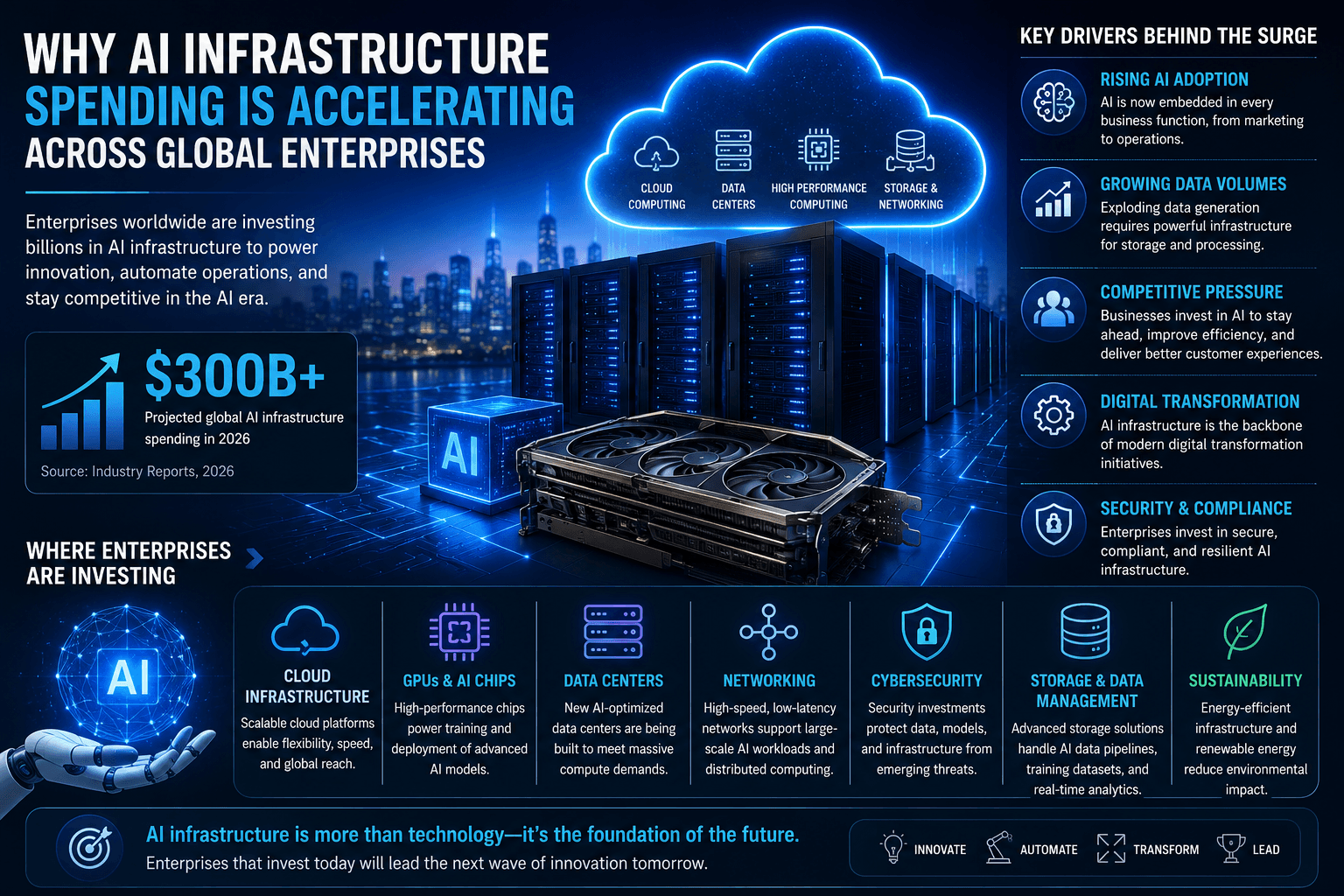

Artificial intelligence has moved beyond the experimental stage and become a strategic priority for organizations worldwide. From multinational corporations to fast-growing startups, businesses are investing billions of dollars in AI infrastructure to support intelligent applications, automate operations, and remain competitive in an increasingly digital economy.
The rapid adoption of generative AI, large language models, AI-powered automation, and advanced analytics has significantly increased demand for computing resources. As a result, enterprises are investing in cloud platforms, AI-optimized data centers, graphics processing units (GPUs), networking equipment, and cybersecurity technologies at an unprecedented pace.
Recent earnings and investment announcements from major technology companies highlight this trend. Companies including Microsoft, Alphabet, and Meta continue allocating enormous capital toward expanding AI infrastructure, reflecting strong enterprise demand despite investor scrutiny over the scale of spending. (Business Insider)
AI Has Become a Core Business Strategy
Only a few years ago, AI projects were limited to research departments or pilot programs. Today, artificial intelligence is integrated into everyday business operations.
Organizations use AI to:
Automate repetitive workflows
Improve customer support
Generate business insights
Analyze financial data
Detect fraud
Personalize customer experiences
Optimize supply chains
Accelerate software development
These capabilities require powerful infrastructure capable of processing enormous amounts of information quickly and reliably.
The Explosion of Generative AI
Generative AI has become one of the biggest drivers of infrastructure investment.
Businesses are deploying AI assistants that write reports, summarize meetings, generate software code, answer customer questions, and create marketing content.
Unlike traditional software, generative AI applications require enormous computational power during both training and deployment.
Every AI interaction depends on high-performance servers, advanced GPUs, networking equipment, and cloud storage.
This growing demand explains why enterprises continue expanding their AI infrastructure budgets.
Cloud Computing Is the Foundation
Modern AI cannot operate efficiently without cloud computing.
Cloud platforms provide:
Elastic computing resources
AI development tools
Massive storage capacity
Global availability
Enterprise security
High-speed networking
Rather than purchasing expensive hardware for every office, organizations can scale AI workloads using cloud services.
This flexibility allows companies to innovate faster while reducing operational complexity.
AI Data Centers Are Expanding Worldwide
Behind every AI application is a data center filled with advanced computing hardware.
Technology companies continue building new AI-focused facilities capable of supporting:
Large language models
AI training clusters
Machine learning
Data analytics
Business intelligence
Enterprise automation
Industry analysts estimate combined capital expenditure by leading cloud providers will reach hundreds of billions of dollars in 2026 as AI infrastructure expands globally. (TrendForce)
GPUs Have Become Strategic Assets
Graphics Processing Units (GPUs) are now among the most valuable components of AI infrastructure.
Unlike traditional processors, GPUs can process thousands of calculations simultaneously, making them ideal for AI model training and inference.
Growing demand has encouraged enterprises to:
Upgrade servers
Expand GPU clusters
Optimize AI workloads
Increase high-speed networking
Modernize storage systems
Many organizations now view AI computing capacity as a competitive advantage rather than simply an IT expense.
Why Enterprises Continue Increasing Spending
Several major factors explain the rapid growth of AI infrastructure investment.
1. Rising AI Adoption
Every department within modern organizations is exploring AI-powered tools.
Marketing teams use AI for content creation.
Finance teams analyze forecasts using machine learning.
HR departments automate recruitment.
Customer service teams deploy AI assistants.
As adoption expands, infrastructure demand naturally increases.
2. Digital Transformation
Digital transformation initiatives increasingly rely on AI.
Organizations modernizing legacy systems often deploy cloud-native AI applications that require scalable infrastructure.
3. Competitive Pressure
Companies recognize that competitors investing in AI today may gain long-term advantages in productivity, customer experience, and operational efficiency.
This encourages faster infrastructure investment.
4. Data Growth
Businesses generate enormous volumes of structured and unstructured data every day.
AI requires access to these datasets for learning, prediction, and decision-making.
Consequently, enterprises continue investing in storage and processing capacity.
Security Is Becoming More Important
As AI adoption increases, cybersecurity becomes increasingly critical.
Organizations are investing in:
Identity management
Data encryption
Threat detection
Zero Trust architecture
Secure AI deployment
Compliance monitoring
Protecting AI models and sensitive business data is now a major component of infrastructure spending.
Sustainability Matters
Building AI infrastructure also presents environmental challenges.
Large AI data centers consume significant amounts of electricity and cooling resources.
Many organizations are therefore investing in:
Renewable energy
Energy-efficient servers
Advanced cooling technologies
Carbon reduction initiatives
Sustainable data center design
Balancing AI growth with environmental responsibility has become a strategic objective for both governments and enterprises. (arXiv)
The Role of Hyperscale Cloud Providers
Major cloud providers continue expanding AI capacity to meet enterprise demand.
Microsoft continues investing heavily in cloud infrastructure while maintaining a disciplined capital spending strategy. (Business Insider)
Alphabet has increased investment in AI data centers as Google Cloud experiences strong enterprise demand for AI services. (The National)
Meta has committed substantial resources to AI infrastructure, including chips, servers, and data centers, as it pursues long-term AI ambitions. (Reuters)
These investments demonstrate how cloud infrastructure has become central to future business growth.
Challenges Facing Organizations
Despite rapid adoption, enterprises still face several obstacles.
These include:
Infrastructure costs
Talent shortages
AI governance
Data privacy
Compliance requirements
Energy consumption
Integration with existing systems
Organizations that develop clear AI strategies and invest in workforce training will be better positioned to overcome these challenges.
Looking Ahead
The future of enterprise AI depends on continued infrastructure innovation.
Businesses are expected to invest more heavily in:
AI chips
Edge computing
Intelligent networking
Quantum-ready infrastructure
Autonomous AI agents
High-performance storage
AI security platforms
As AI applications become more sophisticated, infrastructure will remain one of the most important areas of enterprise technology investment.
Conclusion
AI infrastructure spending is accelerating because artificial intelligence has become essential to modern business success. Enterprises are no longer investing solely in software—they are building the computing foundation required to support intelligent automation, predictive analytics, and generative AI at scale.
From cloud computing and GPU clusters to secure data centers and advanced networking, AI infrastructure enables organizations to innovate faster, improve productivity, and compete in a digital-first economy. Although these investments require significant capital, they are widely viewed as necessary to support long-term growth and technological leadership. As demand for AI continues to rise, infrastructure investment will remain a defining trend across industries worldwide.
Frequently Asked Questions (FAQs)
1. What is AI infrastructure?
AI infrastructure includes the hardware, software, networking, and cloud services needed to develop, train, and deploy AI applications.
2. Why are enterprises increasing AI infrastructure spending?
To support growing AI workloads, digital transformation, and intelligent automation.
3. What role do GPUs play in AI?
GPUs accelerate AI model training and inference by performing many calculations simultaneously.
4. Why is cloud computing important for AI?
Cloud platforms provide scalable computing resources and AI services without requiring businesses to own all the hardware.
5. What is an AI data center?
A specialized facility designed to support AI workloads using powerful servers, GPUs, networking, and storage.
6. Which industries invest most in AI infrastructure?
Healthcare, finance, retail, manufacturing, education, logistics, and technology.
7. What are hyperscale cloud providers?
Large cloud companies that operate massive data centers and provide AI infrastructure at global scale.
8. How does AI infrastructure improve productivity?
It enables automation, faster analytics, intelligent decision-making, and AI-powered applications.
9. What are the biggest AI infrastructure costs?
GPUs, servers, networking, storage, energy, cooling, and cybersecurity.
10. Why are AI chips important?
They provide the processing power required for training and running advanced AI models.
11. How does AI infrastructure support generative AI?
It delivers the computing power needed to process prompts, train models, and generate responses.
12. What security measures are essential for AI infrastructure?
Encryption, identity management, Zero Trust security, threat detection, and compliance monitoring.
13. How does AI infrastructure support digital transformation?
It enables organizations to modernize operations with intelligent automation and cloud-native AI solutions.
14. What challenges do businesses face when adopting AI infrastructure?
High costs, talent shortages, governance, energy use, and integration with existing systems.
15. What is edge AI infrastructure?
Infrastructure that processes AI workloads closer to users or devices instead of relying solely on centralized cloud data centers.
16. Why are companies building new AI data centers?
To meet increasing demand for AI computing capacity and cloud services.
17. Is AI infrastructure suitable for small businesses?
Yes. Cloud-based AI services allow small businesses to access enterprise-grade AI without large upfront investments.
18. How does AI infrastructure affect sustainability?
Modern AI infrastructure increasingly incorporates energy-efficient hardware and renewable energy to reduce environmental impact.
19. What technologies will shape future AI infrastructure?
Advanced GPUs, AI accelerators, edge computing, high-speed networking, and intelligent automation.
20. Why is AI infrastructure considered a long-term investment?
Because it provides the foundation for future innovation, competitiveness, and scalable AI adoption across industries.