
Introduction
Artificial intelligence is transforming the way businesses operate, compete, and innovate. From automating routine processes to powering advanced analytics and autonomous decision-making, AI has become a core component of modern enterprise strategy. However, as organizations rapidly adopt generative AI, large language models (LLMs), and AI-powered applications, many are discovering that traditional IT infrastructure is struggling to keep pace with growing computational demands. This has sparked what industry experts are calling the AI Infrastructure Reckoning—a critical reassessment of how enterprises build, manage, and optimize the technology foundation that supports AI.
During the early stages of AI adoption, many organizations relied heavily on public cloud platforms because they offered fast deployment, virtually unlimited scalability, and easy access to high-performance computing resources. While this approach enabled businesses to experiment with AI quickly, rising cloud costs, increasing GPU demand, stricter data privacy regulations, and growing cybersecurity concerns have forced enterprises to rethink their long-term infrastructure strategies.
In 2026, businesses are moving beyond a cloud-only mindset. Instead, they are embracing hybrid infrastructure that combines public cloud services, private AI environments, dedicated GPU clusters, and edge computing to achieve better performance, stronger security, and improved cost efficiency. This strategic shift is enabling organizations to process AI workloads more effectively while maintaining greater control over sensitive business data and critical operations.
This article explores why enterprises are rethinking their AI infrastructure, the technologies driving this transformation, the benefits of hybrid and private AI deployments, and how organizations can build scalable, secure, and future-ready AI environments that support long-term innovation and sustainable business growth.
Artificial intelligence has become the engine of enterprise innovation, but the explosive growth of AI workloads has also exposed the limitations of traditional IT infrastructure. During the first wave of enterprise AI adoption, organizations rushed to public cloud platforms to train and deploy large language models, automate workflows, and launch AI-powered customer experiences. While this rapid migration accelerated innovation, it also created unexpected challenges related to cost, performance, data privacy, and long-term scalability.
In 2026, businesses are entering what many technology leaders describe as the AI Infrastructure Reckoning. Instead of assuming that public cloud services alone can support every AI initiative, organizations are carefully re-evaluating how and where AI workloads should run. They are balancing cloud computing with private AI environments, dedicated GPU clusters, edge computing, and hybrid infrastructure models that provide greater flexibility and lower operational costs.
This shift is driven by one simple reality: AI is no longer an experimental technology. It has become a mission-critical business capability that powers customer service, cybersecurity, software development, financial analysis, healthcare, manufacturing, logistics, and countless other enterprise operations. As AI adoption expands, infrastructure decisions directly impact business performance, security, compliance, and profitability.
Unlike traditional enterprise applications, modern AI systems require enormous computing power. Training advanced foundation models can take weeks of continuous processing across thousands of GPUs, while running inference for millions of users demands low-latency, highly available infrastructure. Organizations that fail to optimize these environments often face rising cloud bills, slower application performance, and growing operational complexity.
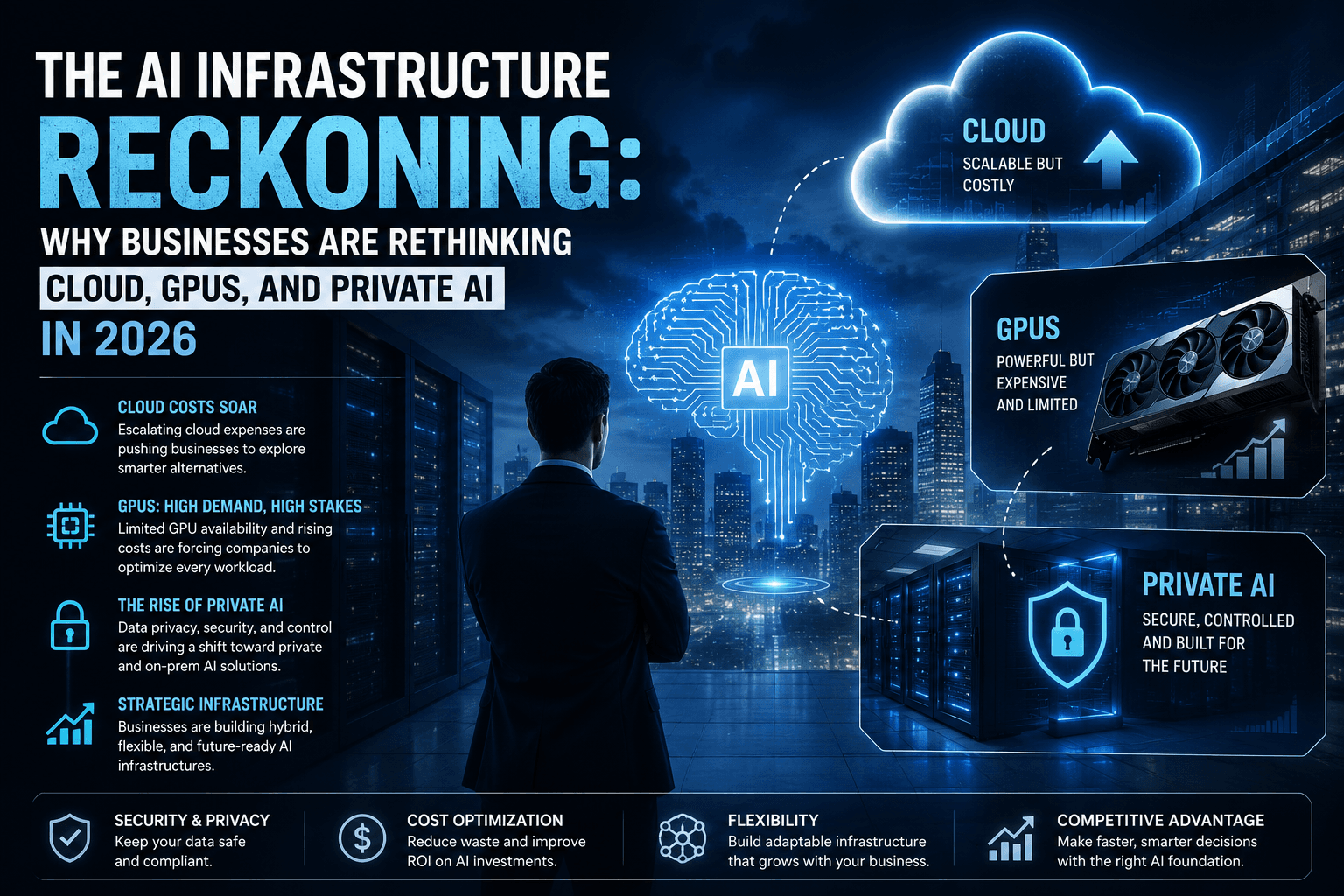
One of the biggest drivers of infrastructure change is the increasing cost of AI computing. Public cloud services offer unmatched scalability, but enterprises running large AI models around the clock are discovering that pay-as-you-go pricing becomes expensive over time. GPU instances, high-speed storage, networking, and data transfer costs can quickly exceed technology budgets, especially for businesses deploying generative AI across multiple departments.
As a result, many organizations are investing in private AI infrastructure. By deploying dedicated GPU servers inside their own data centers or private cloud environments, enterprises gain greater control over performance, security, and long-term costs. While the initial investment may be significant, private AI often becomes more cost-effective for organizations operating large-scale AI workloads continuously.
Security is another major reason businesses are reconsidering infrastructure strategies. Enterprise AI systems frequently process confidential customer information, financial records, intellectual property, healthcare data, and proprietary business insights. Sending sensitive data to external AI services may introduce compliance risks, particularly for industries governed by strict regulations. Private AI environments help organizations maintain greater control over sensitive information while meeting regulatory requirements.
Hybrid AI architecture is rapidly becoming the preferred approach for many enterprises. Instead of choosing between public cloud or private infrastructure, organizations combine both. Highly sensitive workloads remain inside private environments, while public cloud resources handle temporary spikes in demand, experimentation, or model training. This approach improves flexibility without sacrificing security or cost efficiency.
Edge AI is also playing a growing role in enterprise infrastructure. Rather than processing every AI request in centralized cloud data centers, businesses increasingly deploy AI closer to where data is generated. Manufacturing facilities, hospitals, retail stores, warehouses, and autonomous vehicles use edge AI to analyze information locally, reducing latency and enabling real-time decision-making even when internet connectivity is limited.
GPUechnology remains at the center of enterprise AI strategies
. Demand for high-performance accelerators continues to grow as businesses deploy increasingly sophisticated AI models. However, organizations are becoming more strategic about GPU utilization by optimizing workloads, sharing resources across departments, and using specialized hardware designed for inference rather than training. Efficient GPU management has become a key factor in controlling AI infrastructure costs.
Another emerging trend is the rise of AI infrastructure optimization platforms. These solutions monitor AI workloads, recommend resource allocation improvements, automate scaling decisions, and identify opportunities to reduce unnecessary computing expenses. By improving infrastructure efficiency, enterprises can maximize return on investment while maintaining high application performance.
Sustainability is becoming an equally important consideration. AI data centers consume significant amounts of electricity, making energy efficiency a priority for both financial and environmental reasons. Organizations are investing in liquid cooling technologies, energy-efficient processors, renewable-powered facilities, and intelligent workload scheduling to reduce carbon emissions without compromising AI capabilities.
Looking ahead, enterprise AI infrastructure will become increasingly intelligent. AI itself will manage computing resources, predict infrastructure failures, optimize energy consumption, and automatically allocate workloads across cloud, private, and edge environments. This self-optimizing infrastructure will reduce operational complexity while improving reliability and scalability.
Conclusion
The AI Infrastructure Reckoning represents a major shift in how businesses approach enterprise technology. Rather than relying exclusively on public cloud services, organizations are building balanced infrastructure strategies that combine cloud computing, private AI, GPU acceleration, edge computing, and intelligent automation. These investments are helping enterprises reduce costs, strengthen security, improve compliance, and prepare for the next generation of AI innovation.
As AI becomes central to every business function, infrastructure will no longer be viewed simply as an IT expense. Instead, it will become a strategic competitive advantage that enables organizations to innovate faster, serve customers more effectively, and adapt to rapidly changing market conditions. Companies that invest in flexible, secure, and scalable AI infrastructure today will be best positioned to lead the AI-driven economy of tomorrow.
The AI Infrastructure Reckoning represents a major shift in how businesses approach enterprise technology. Rather than relying exclusively on public cloud services, organizations are building balanced infrastructure strategies that combine cloud computing, private AI, GPU acceleration, edge computing, and intelligent automation. These investments are helping enterprises reduce costs, strengthen security, improve compliance, and prepare for the next generation of AI innovation.
As AI becomes central to every business function, infrastructure will no longer be viewed simply as an IT expense. Instead, it will become a strategic competitive advantage that enables organizations to innovate faster, serve customers more effectively, and adapt to rapidly changing market conditions. Companies that invest in flexible, secure, and scalable AI infrastructure today will be best positioned to lead the AI-driven economy of tomorrow.
Looking ahead, enterprise AI infrastructure will continue to evolve alongside advances in generative AI, autonomous AI agents, quantum computing, and next-generation networking technologies. Businesses that prioritize infrastructure modernization, AI governance, cybersecurity, and sustainable computing will gain a significant competitive edge in the years ahead. Investing in high-performance GPUs, hybrid cloud environments, intelligent workload management, and energy-efficient data centers will not only improve operational performance but also create a resilient foundation for future innovation. Organizations that align their AI infrastructure with long-term business objectives will be better equipped to scale AI initiatives, accelerate digital transformation, improve customer experiences, and unlock new revenue opportunities. In a world where artificial intelligence is rapidly becoming the backbone of business success, building a future-ready AI infrastructure is no longer optional—it is an essential investment for sustainable growth, resilience, and long-term competitive leadership.