In today's rapidly evolving digital landscape, AI is no longer limited to chatbots or virtual assistants. Enterprises are integrating autonomous AI agents into customer service, software development, cybersecurity, finance, healthcare, manufacturing, and supply chain management. These intelligent systems can independently analyze data, make recommendations, execute workflows, and collaborate with other AI models in real time. While this transformation is unlocking unprecedented levels of productivity and innovation, it also introduces new security challenges that traditional cybersecurity solutions were never designed to address. As organizations become increasingly dependent on AI-driven decision-making, protecting these systems from manipulation, data breaches, unauthorized access, and adversarial attacks has become a strategic business priority. This growing need for AI-specific security is driving the rapid adoption of AI Detection & Response (AIDR), a proactive approach that enables enterprises to build secure, resilient, and trustworthy AI ecosystems while maintaining compliance with evolving global regulations and industry standards.
Artificial intelligence has moved far beyond simple automation. In 2026, enterprises are deploying autonomous AI agents capable of making decisions, executing workflows, writing code, analyzing data, interacting with customers, and coordinating business operations with minimal human intervention. While these intelligent systems are helping organizations improve productivity and reduce operational costs, they are also introducing an entirely new category of cybersecurity risks.
Traditional cybersecurity tools were designed to protect users, servers, networks, and applications. However, they were never built to monitor autonomous AI agents that can independently access sensitive information, communicate with external systems, and perform complex business tasks. As AI becomes deeply integrated into enterprise operations, organizations need a security framework specifically designed for intelligent systems.
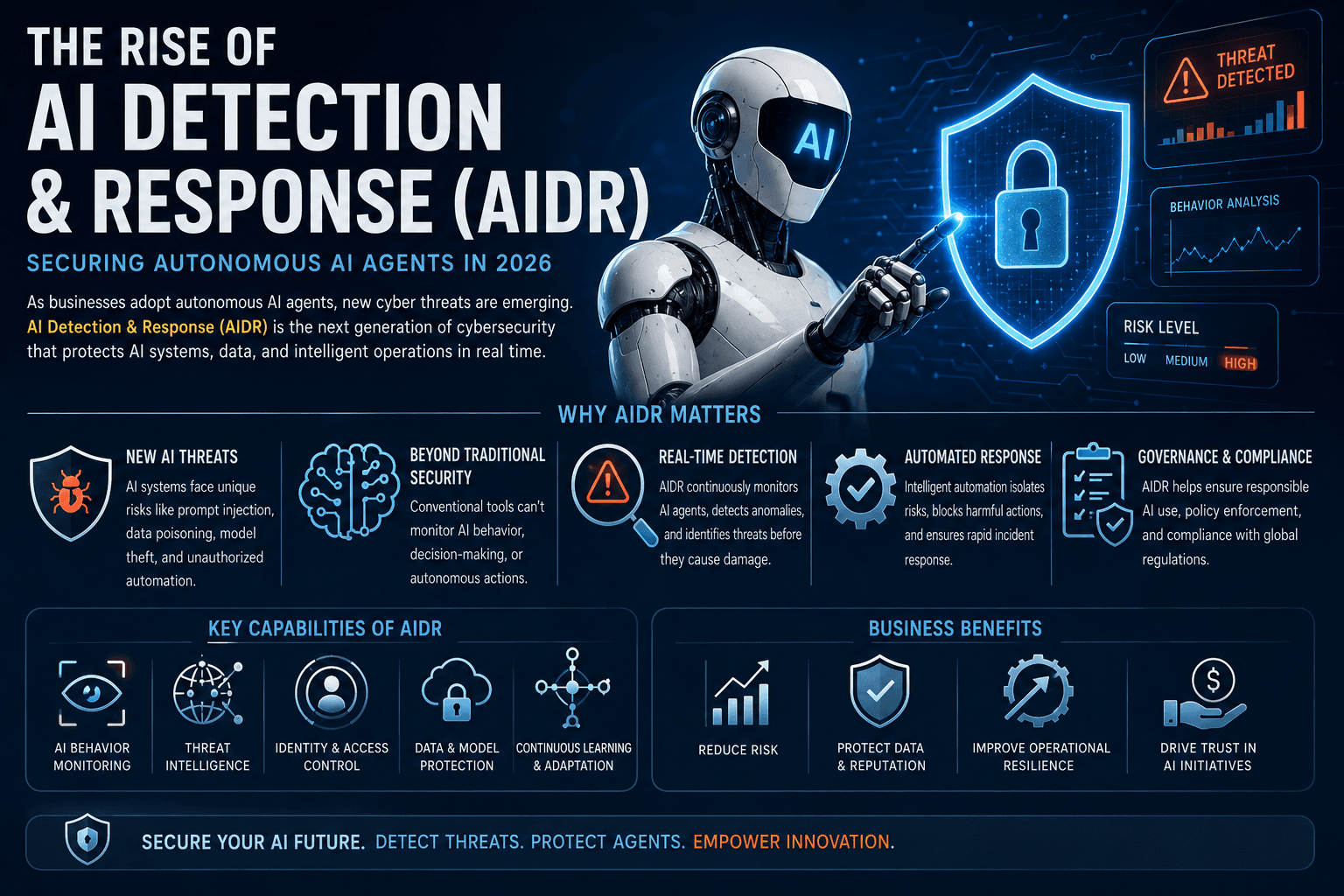
This need has led to the rapid emergence of AI Detection & Response (AIDR)—a next-generation cybersecurity approach focused on continuously monitoring, analyzing, and protecting AI systems. Rather than reacting after a security breach occurs, AIDR enables businesses to identify suspicious AI behavior, detect attacks targeting AI models, and respond before significant damage is done.
As businesses accelerate AI adoption, AIDR is becoming one of the most important investments for enterprise security teams.
Why Traditional Cybersecurity Is No Longer Enough
For decades, organizations have relied on firewalls, antivirus software, endpoint detection, identity management, and network monitoring to defend against cyber threats. These technologies remain essential, but they were designed for human users and conventional software—not autonomous AI systems.
Modern AI agents have capabilities that traditional applications never possessed. They can independently search internal knowledge bases, generate reports, interact with customers, execute business workflows, connect with APIs, and even collaborate with other AI agents. While these abilities improve efficiency, they also expand the attack surface for cybercriminals.
Unlike traditional software that follows fixed rules, AI agents continuously learn, adapt, and make decisions based on data and user interactions. This dynamic behavior makes them far more difficult to monitor using conventional security tools. Security teams must now evaluate not only whether a system has been compromised, but also whether an AI model is making trustworthy decisions, handling sensitive information appropriately, and operating within approved business policies.
For example, an attacker might manipulate the prompts sent to an AI assistant, poison its training data, exploit connected APIs, or trick it into exposing confidential information. Conventional security tools may detect suspicious network traffic, but they often cannot understand whether an AI model is making unsafe decisions or behaving abnormally.
Another challenge is the increasing number of third-party AI services and cloud-based models integrated into enterprise environments. Every external AI platform, API, or automation tool introduces additional security and compliance risks that require continuous monitoring. Organizations must also protect sensitive business data flowing between AI systems, cloud infrastructure, and employees to prevent accidental leaks or unauthorized access.
As AI adoption accelerates, cybercriminals are also using
Loop artificial intelligence to automate phishing campaigns, develop sophisticated malware, and identify vulnerabilities at unprecedented speed. This creates an environment where both attackers and defenders are leveraging AI, making cybersecurity significantly more complex than ever before. Businesses therefore need intelligent security solutions capable of monitoring AI behavior, detecting emerging threats in real time, and responding automatically before incidents escalate into major security breaches
.Modern AI agents have capabilities that traditional applications never possessed. They can independently search internal knowledge bases, generate reports, interact with customers, execute business workflows, connect with APIs, and even collaborate with other AI agents. While these abilities improve efficiency, they also expand the attack surface for cybercriminals.
For example, an attacker might manipulate the prompts sent to an AI assistant, poison its training data, exploit connected APIs, or trick it into exposing confidential information. Conventional security tools may detect suspicious network traffic, but they often cannot understand whether an AI model is making unsafe decisions or behaving abnormally.
This security gap has made AI-specific monitoring an essential component of enterprise cybersecurity.
Understanding AI Detection & Response (AIDR)
AI Detection & Response is a cybersecurity discipline dedicated to protecting AI models, autonomous agents, and AI-powered applications throughout their lifecycle. It combines artificial intelligence, behavioral analytics, threat intelligence, machine learning, and automated incident response into a unified security framework.
Unlike traditional security platforms that monitor only devices and networks, AIDR also monitors the behavior of AI systems. It analyzes how AI agents make decisions, access data, communicate with other systems, and interact with users. If unusual behavior is detected, the platform can automatically investigate the issue, isolate the affected system, and notify security teams.
For example, if an AI customer support agent suddenly begins revealing confidential business information or making decisions outside its normal operating parameters, an AIDR platform can detect the anomaly within seconds and initiate an automated response before sensitive information is compromised.
This proactive approach helps organizations reduce risk while maintaining the productivity benefits of AI.
The Growing Security Risks of Autonomous AI Agents
As enterprises deploy more autonomous AI agents, new cyber risks continue to emerge. One of the biggest concerns is prompt injection attacks, where malicious users manipulate instructions to override an AI system's safeguards and extract confidential information.
Another significant threat is training data poisoning, in which attackers intentionally insert misleading or malicious information into datasets used to train AI models. This can cause AI systems to generate inaccurate recommendations, make incorrect business decisions, or produce unsafe outputs.
AI agents connected to external APIs also present new security challenges. If a connected application is compromised, attackers may gain indirect access to enterprise systems through trusted AI workflows. Identity theft, privilege escalation, and unauthorized automation are becoming increasingly common concerns as organizations expand AI capabilities.
Additionally, many businesses now operate multiple AI agents that collaborate with one another. A vulnerability in one agent could potentially spread across interconnected systems, amplifying the impact of a security incident.
These evolving threats demonstrate why AI security requires continuous monitoring rather than periodic security assessments.
Core Components of an AIDR Platform
Modern AI Detection & Response platforms combine several advanced security capabilities to protect enterprise AI environments.
Continuous AI Behavior Monitoring
AIDR platforms establish behavioral baselines for AI systems and monitor every interaction in real time. Any unexpected changes in decision-making patterns, unusual API usage, excessive data access, or abnormal responses immediately trigger security investigations.
AI Threat Intelligence
Security platforms continuously analyze emerging AI-specific attack techniques, helping organizations stay ahead of evolving cyber threats. By incorporating global threat intelligence, AIDR systems can identify attack patterns before they spread across enterprise environments.
Automated Incident Response
When suspicious behavior is detected, AIDR platforms can automatically isolate affected AI agents, revoke credentials, suspend risky workflows, notify administrators, and generate detailed incident reports. Automation significantly reduces response times compared to manual investigations.
Identity and Access Management
Modern AI agents often require access to sensitive business systems. AIDR integrates with identity management platforms to ensure AI systems receive only the minimum permissions necessary for their assigned tasks, reducing the risk of unauthorized access.
Compliance and Governance Monitoring
Many industries must comply with strict regulations regarding data privacy, security, and responsible AI use. AIDR platforms help organizations monitor compliance, generate audit logs, and ensure AI systems operate within approved governance policies.