I1iPhone 18 in 2026: Latest Features, Price Expectations & Release Updates
Meta Description
Discover how autonomous supply chains powered by AI, IoT, and automation are helping businesses reduce costs, improve efficiency, and build resilient operations in 2026.
How Autonomous Supply Chains Are Transforming Global Business in 2026
Supply chains have become more complex than ever. Rising customer expectations, global disruptions, labor shortages, and fluctuating demand have forced businesses to rethink how they manage operations. In 2026, autonomous supply chains are emerging as a game-changing solution, allowing companies to automate critical processes while improving speed, accuracy, and resilience.
Powered by artificial intelligence (AI), the Internet of Things (IoT), robotics, and predictive analytics, autonomous supply chains can monitor, analyze, and optimize operations with minimal human intervention. Businesses that embrace this technology are gaining a competitive advantage by reducing costs, minimizing delays, and delivering better customer experiences.
What Is an Autonomous Supply Chain?
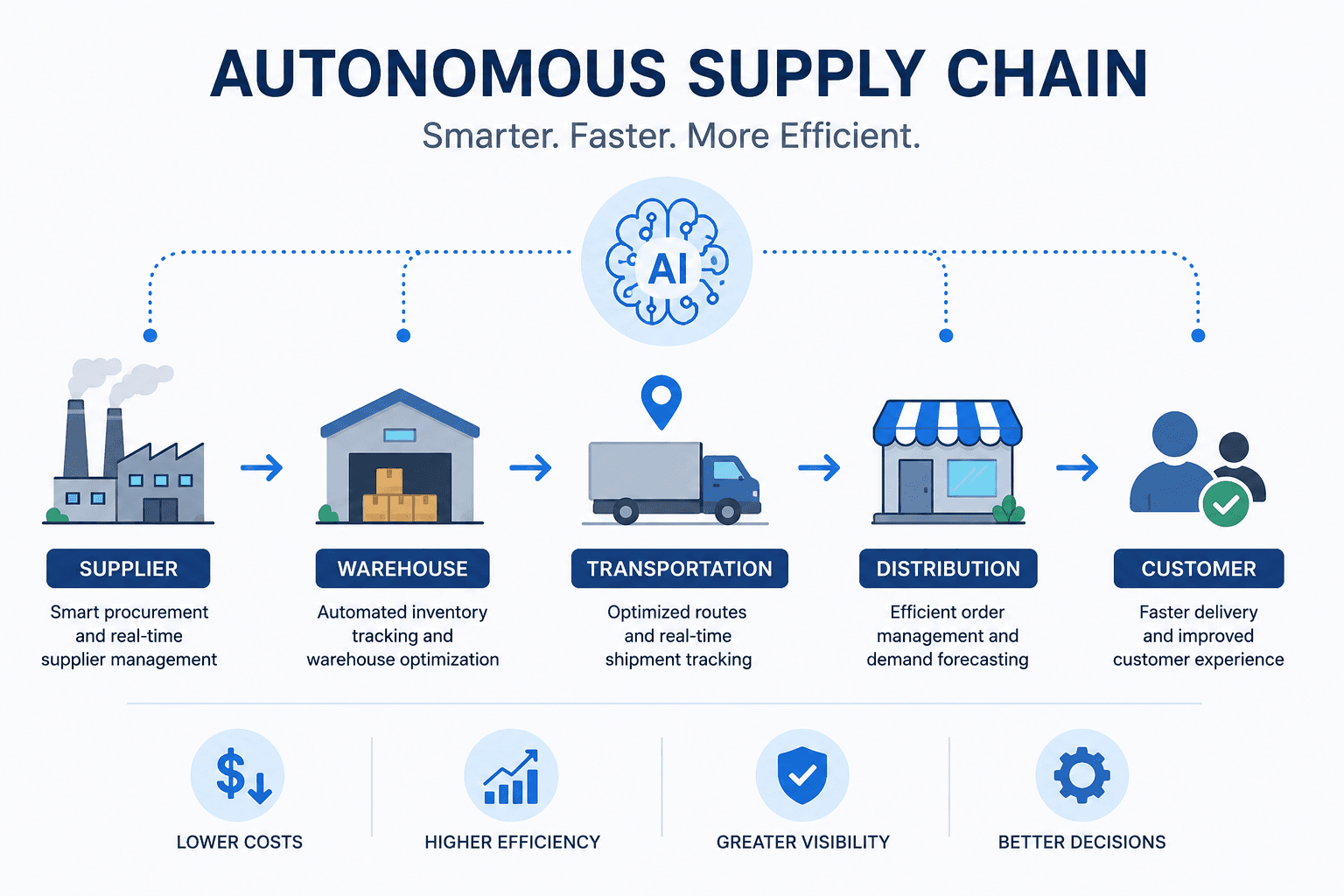
An autonomous supply chain is a connected ecosystem where intelligent technologies work together to manage logistics, inventory, procurement, production, and delivery automatically.
Instead of relying solely on manual planning, AI continuously analyzes real-time data and makes decisions that improve operational efficiency.
For example, an autonomous supply chain can:
Predict customer demand
Automatically reorder inventory
Optimize delivery routes
Detect supply disruptions early
Schedule warehouse operations
Monitor shipments in real time
Reduce product waste
This creates a faster, smarter, and more responsive supply chain.
Why Businesses Are Investing in Autonomous Supply Chains
Modern businesses need supply chains that can quickly adapt to changing market conditions. Traditional systems often struggle with unexpected disruptions, inaccurate forecasting, and manual processes.
Autonomous supply chains provide:
Faster decision-making
Lower operational costs
Greater visibility across the supply chain
Improved inventory accuracy
Reduced delivery delays
Better customer satisfaction
These benefits help businesses remain competitive in today's fast-moving global economy.
Technologies Driving Supply Chain Automation
Artificial Intelligence
AI analyzes massive datasets to forecast demand, identify risks, and recommend the best operational decisions.
Internet of Things (IoT)
Connected sensors track inventory, vehicles, equipment, and shipments in real time, providing accurate operational visibility.
Robotics
Automated robots improve warehouse efficiency by handling picking, packing, sorting, and inventory management with greater speed and precision.
Predictive Analytics
Businesses can identify potential disruptions before they occur, allowing proactive planning instead of reactive problem-solving.
Cloud Computing
Cloud platforms enable supply chain partners to share data securely, improving collaboration across manufacturers, suppliers, distributors, and retailers.
Industries Benefiting the Most
Autonomous supply chains are transforming many industries, including:
Manufacturing
Retail and e-commerce
Healthcare
Automotive
Food and beverage
Consumer electronics
Logistics and transportation
Companies across these sectors are improving efficiency while reducing operational risks.
Challenges to Address
Despite the advantages, businesses should prepare for several implementation challenges.
These include:
Integrating legacy systems
Protecting sensitive business data
Training employees on new technologies
Managing implementation costs
Ensuring regulatory compliance
A phased implementation strategy often delivers the best long-term results.
The Future of Supply Chain Management
Industry experts expect autonomous supply chains to become the standard for global commerce over the next decade. As AI becomes more advanced, supply chains will be capable of making increasingly complex decisions without constant human supervision.
Future innovations may include fully autonomous warehouses, AI-managed transportation networks, drone-assisted deliveries, and self-optimizing logistics operations.
Organizations that invest in these technologies today will be better prepared for future market challenges while improving profitability and customer satisfaction.
Conclusion
Autonomous supply chains represent one of the most important business innovations of 2026. By combining AI, IoT, robotics, and predictive analytics, businesses can create faster, smarter, and more resilient operations.
Companies that embrace supply chain automation today will be well positioned to reduce costs, improve operational efficiency, and meet growing customer expectations in an increasingly competitive marketplace.
For more insights on AI, digital transformation, business innovation, and emerging technologies, visit 1st4eBusiness and stay updated with the latest industry trends.